

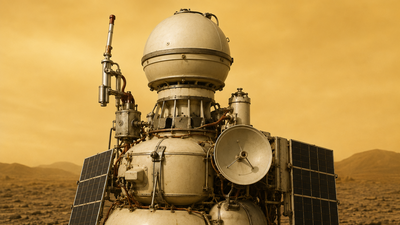
 On 1 March 1982, a spacecraft built to survive one of the harshest environments in the Solar System achieved what no mission had done before. After plunging through the thick atmosphere of Venus, the Soviet Union’s Venera 13 probe landed safely on the planet’s scorching surface and made history by transmitting the first-ever sounds recorded from another planet. It also returned the first colour panoramic images and conducted the first direct analysis of Venusian soil, offering scientists an unprecedented glimpse into Earth’s closest planetary neighbour. Designed to function for just over half an hour under conditions capable of crushing and melting ordinary spacecraft, Venera 13 exceeded expectations, surviving for more than two hours before Venus’s extreme heat and pressure finally overwhelmed its systems.
Why did the Soviet Union send Venera 13 to the most hostile planet in the Solar System
During the Cold War, the Soviet Union launched the ambitious Venera programme to explore Venus, a planet hidden beneath dense clouds of sulphuric acid and long regarded as one of the Solar System’s greatest mysteries.According to NASA’s High Energy Astrophysics Science Archive Research Centre (HEASARC), launched on 30 October 1981, Venera 13 reached Venus four months later. The mission’s objective was to study the planet’s atmosphere, surface composition and geology while testing engineering capable of withstanding high temperatures and atmospheric pressures.To survive these conditions, engineers equipped the lander with a heavily insulated pressure vessel, specialised cooling systems and instruments protected against intense heat. According to the Guinness Book of World Records, although its planned operational lifetime on the surface was only 32 minutes, the probe continued transmitting valuable scientific data for 127 minutes, setting a remarkable engineering milestone.According to the European Space Agency:”Venus is the hottest planet in the Solar System, with surface temperatures high enough to melt lead.”
How Venera 13 recorded the first sounds ever captured from the surface of another planet
One of Venera 13’s most remarkable achievements was capturing the first sounds ever recorded from the surface of another planet.The probe’s microphones primarily monitored mechanical operations such as the deployment of protective covers and scientific instruments. However, they also detected ambient vibrations from the dense Venusian atmosphere and wind moving across the lander’s structure, providing humanity’s first direct acoustic experience of another planetary surface.Alongside the audio recordings, Venera 13 transmitted the first colour panoramic photographs from Venus, revealing a barren landscape covered with fractured rocks beneath an orange sky created by the planet’s thick atmosphere filtering sunlight.The spacecraft also drilled into the surface using an automated sampling arm and analysed the material with an onboard X-ray fluorescence spectrometer. Scientists found the rock to resemble weakly differentiated basalt, suggesting that volcanic activity had played a major role in shaping Venus’s surface. The Venera missions returned the only images ever taken from the surface of Venus.
What the historic Venus mission revealed before the planet’s crushing heat destroyed the probe
Although Venus ultimately claimed the spacecraft, Venera 13 dramatically exceeded its design life and transformed planetary science.Its measurements confirmed the planet’s extraordinarily high temperatures, crushing atmospheric pressure and dry, volcanic terrain. Combined with later missions, these observations strengthened the view that Venus may once have possessed conditions more similar to Earth before undergoing a catastrophic greenhouse transformation.More than four decades later, Venera 13 remains one of the most successful planetary landers ever built. Its engineering achievements continue to influence modern missions, including renewed international efforts to explore Venus with spacecraft such as NASA’s DAVINCI mission and the European Space Agency’s EnVision mission.The brief sounds recorded by Venera 13 remain a powerful reminder of what humanity can achieve in the face of seemingly impossible conditions. Even on a world hot enough to destroy electronics and strong enough to crush submarines, the probe succeeded in giving Earth its first opportunity to hear another planet before the relentless environment finally silenced it.