
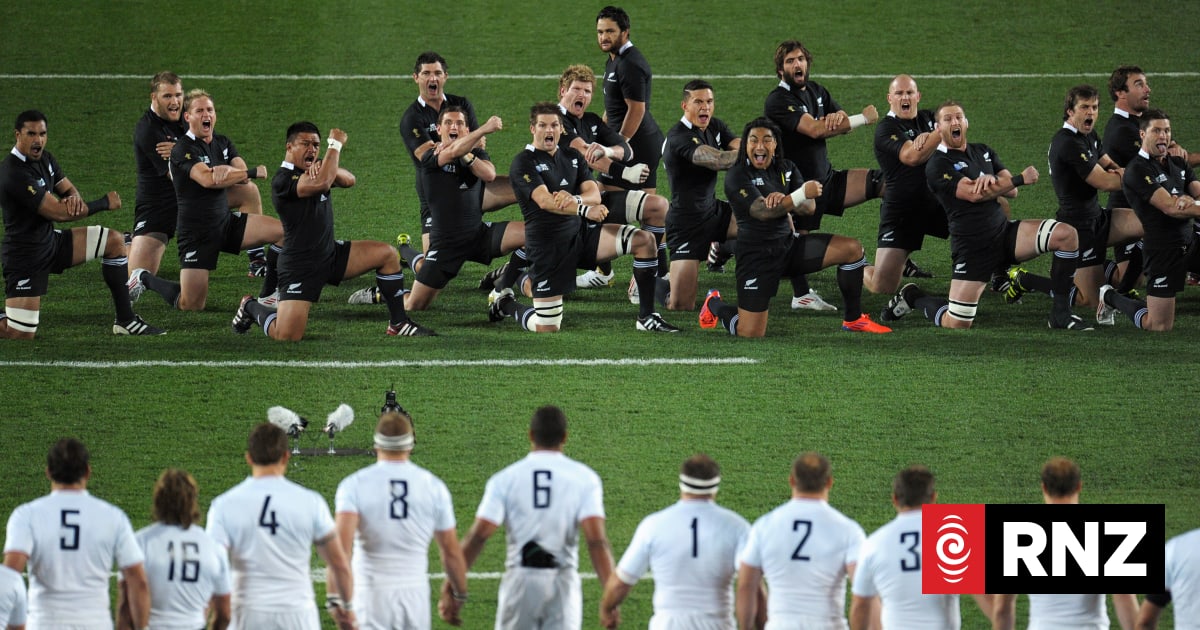
Kick off- 7.05pm, Saturday July 4
One NZ Stadium, Christchurch
The All Blacks and France share one of rugby’s most enduring rivalries.
For more than a century, their meetings have delivered unforgettable rugby, dramatic twists and moments that have shaped the sport’s history.
From controversy and heartbreak to innovation and excellence, this A-Z explores the people, places and moments that define the contest.
A is for Agonising – how the final few minutes of the 2011 World Cup final felt as the All Blacks eeked out an historic 8-7 win.
B is for Bernat-Salles – few All Black fans will forget the talismanic wingers arms outstretched in celebration during the infamous French win in the 1999 World Cup semi-final.
C is for Caveman – the affectionate nickname bestowed on All Black tormenter Sebastien Chabal, breaking Ali Williams’ jaw in 2007 in Wellington with a thunderous run.
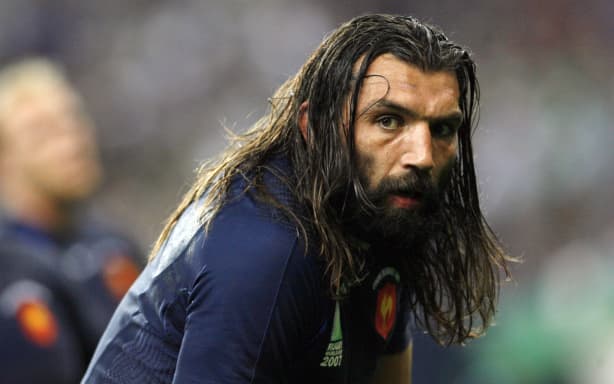
Sebastien Chabal at the Rugby World Cup in 2007.
Alain GROSCLAUDE
D is for Dusautoir – the French tackling machine Thierry Dusautoir was an impregnable force against the All Blacks, making a record 38 tackles in the 2011 World Cup final.
E is for Eden Park – from the last loss before the streak, to two World Cup finals, no battleground has produced the sheer weight of drama as the garden during this rivalry.
F is for Flair – a word synonymous with French rugby.
G is for Gouge – an ugly and all too common blight of this rivalry, the worst being the eye-gouge of Richie McCaw by centre Aurelien Rougerie in the 2011 World Cup final.
H is for Heist – an apt description of the 1999 Rugby World Cup semi-final, with France staging a miraculous comeback to win 43-31.
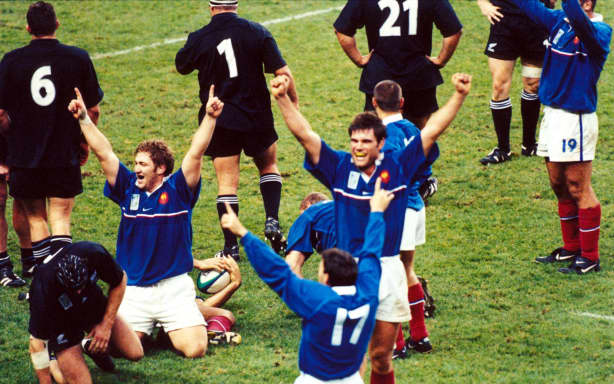
France celebrate after their semi final World Cup win against the All Blacks in 1999.
Photosport
I is for Inaugural – the first sides to contest a Rugby World Cup final in 1987 at Eden Park, the All Blacks winning 29-9.
J is for Jauzion – Yannick Jauzion scored the decisive try to send the All Blacks home from the 2007 World Cup, albeit from a missed forward pass.
K is for Kiwi-killers – a term French media bestowed on their team.
L is for Lamaison – the mercurial Christophe Lamaison, the chief conductor behind the infamous French victory in 1999.
M is for Maxime Médard – who snatched the late intercept which saw the French claim victory in Dunedin in 2009.
N is for Nantes – the scene of the most brutal battle between the two teams in 1986, with France prevailing 16-3. Allegations of drug use were made after the French players were seen frothing at the mouth.
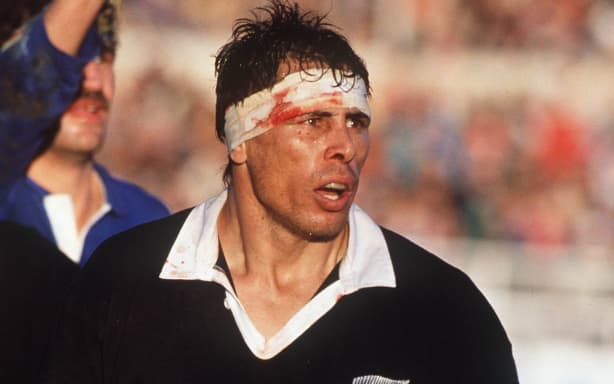
Wayne “Buck” Shelford at the Battle of Nantes.
Photosport
O is for Outrage – the collective feeling of All Blacks fans in 2000 after Wayne Erickson awarded Fabien Pelous a try despite the ball being a metre off the ground, New Zealand surviving 39-26 in Paris. He was not the last Wayne with a whistle to earn the ire of the New Zealand fans either…
P is for Public enemy number one – what referee Wayne Barnes became after the following….
Q is for Quarter-final – the stage where France stunned New Zealand in Cardiff in 2007 with a 20-18 victory.
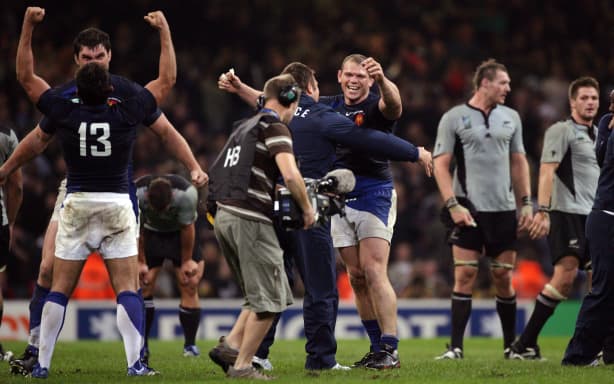
France celebrate as the All Blacks look on after the World Cup loss in 2007 in Cardiff
Photosport
R is for Rooster – the iconic emblem adorning the French uniform and haunting many a Kiwi fans’ nightmares.
S is for Scrotum – the body part torn open on Wayne Shelford by a French player who was never identified during the 1986 Battle of Nantes.
T is for the Try from the end of the world – France’s incredible length of the field effort in 1994 finished by Jean-Luc Sadourny, also marking the last time New Zealand lost at Eden Park.
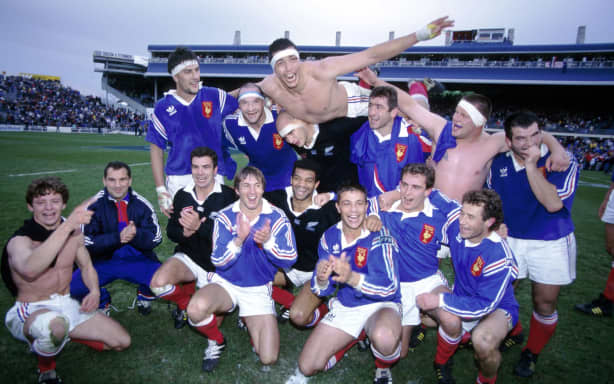
French players celebrate after beating the All Blacks 23-20 at Eden Park, in 1994.
Andrew Cornaga
U is for Upset – from 1994 to the 1999 to 2007 World Cups, the French are responsible for some of the most shocking All Black defeats in history.
V is for Villepreux – remembered for his 65-metre penalty against the All Blacks in 1968, Pierre Villepreux was the man primarily responsible for the French rugby renaissance in the 70’s.
W is for Whitebaiting – what Stephen Donald was doing before becoming a World Cup hero in 2011.
X is for Xavier Garbajosa – the electric winger who scored an individual scorcher as France stunned the 2000 All Blacks side 42-33 in Marseilles.
Y is for Yves-du-Manoir – the site of the first ever All Blacks loss to France in 1954, going down 3-0.
Z is for Zenith – what the All Blacks achieved in their finest hour against the French, a 62-13 demolition at the 2015 World Cup.
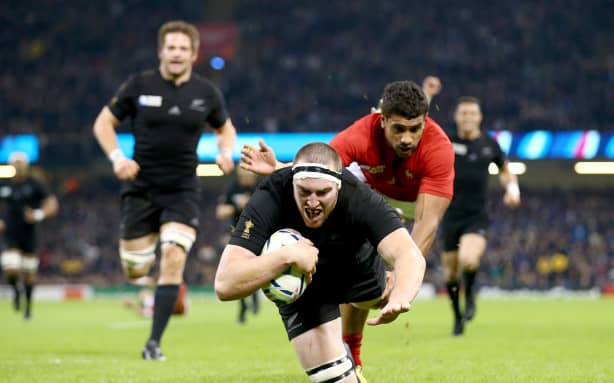
All Black lock Brodie Retallick scores the first try of the match during the 2015 Rugby World Cup Quarter Final against France in Cardiff.
PHOTOSPORT