
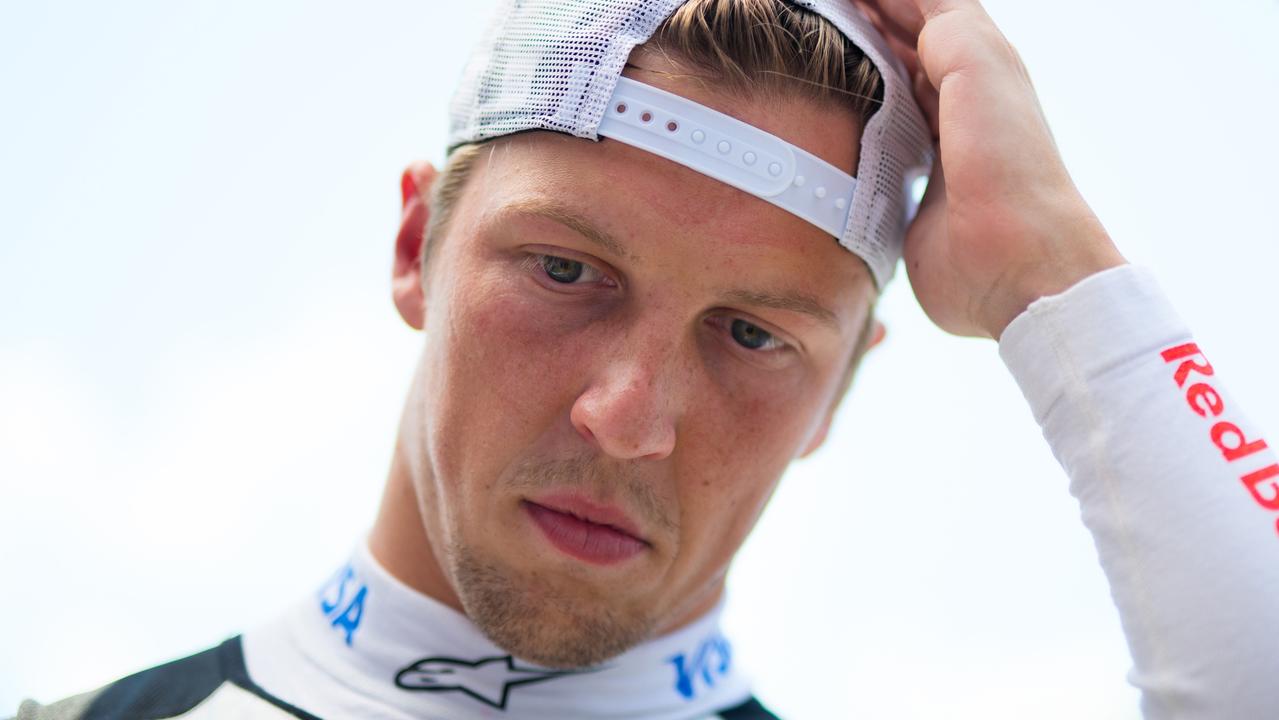
Former Formula 1 chief executive Bernie Ecclestone has backed calls to return the sport to naturally aspirated engines during an appearance in the F1 paddock at the Austrian Grand Prix.
Formula 1 is about to embark on a new round of political wrangling over engines, with FIA president Mohammed Ben Sulayem intending to introduce a new power unit formula by as early as 2030 but by 2031 at the latest.
The haste to change the rules follows months of discontent with this year’s new heavily hybridised motors, which feature an almost equal split between combustion and electrical power.

Fox Sports, available on Kayo Sports, is the only place to watch every practice, qualifying session and race in the 2026 FIA Formula One World Championship™ LIVE in 4K. New to Kayo? Join now and get your first month for just $1.
Max Verstappen has been the formula’s most vocal critical, describing it as “anti-racing” and like all-electric series Formula E “on steroids”.
Though the balance between combustion and electrical energy will be tweaked over the coming years, most drivers believe the formula is inherently flawed.
But this year’s advent of synthetic fuels, which are billed as carbon neutral, has allowed the sport to countenance a return to high-revving and naturally aspirated engines without damaging its green credentials, and Ben Sulayem has since said he intends to use his power as the sport’s regulator to force the change through sooner or later.
Ecclestone, who ran the sport for almost half a century until he was ousted in 2017 as part of Liberty Media’s takeover, backed the president’s move as “the right thing to do”.
“There’s one of the two things which I hope [Ben Sulayem] is going to do in the future: a three-litre engine,” he said, per Autosport.
“I don’t care if it’s a V8 or a V10 or a V12. I think probably all of you would be happy with that. I think it’s the right thing to do.
“[Ben Sulayem] would like it if all the teams put their hands up and said it’s fantastic, which I’m sure they would do if they weren’t controlled by a manufacturer.
“I think the manufacturers will come on board, because it’s obvious.”
PIT TALK PODCAST: George Russell claims just his second grand prix victory of the season in Austria to cut his championship deficit to 40 points, but should Max Verstappen have won the race — and what does Red Bull Racing’s big upgrade mean for his future as speculation continues to swirl around his intentions? | Listen to Pit Talk >
Ecclestone, who was a high-profile critic of the sport’s first hybrid engine in 2014 despite still running Formula 1 at the time, added that Verstappen was correct to go on the offensive against the regulations.
“He was right criticising,” he said. “I think the regulations weren’t necessary to do what has been done, and that’s what Max was complaining about.”
Speaking about Formula 1 more broadly since he relinquished the reins, Ecclestone said the Liberty Media era had been mostly good for the sport.
“They made things a little bit more American, which is basically what they wanted to do,” he said, per PlanetF1. “Otherwise they’re doing all the things that look good, which is also important.
“From that point of view, it’s positive.”
He did, however, declare that expanding the calendar to 24 grands prix was a mistake.
“Twenty-four races is wrong for everyone, including the public. You lose a lot of people who miss a race and say, ‘Oh, we’re going to see one very shortly in another couple of weeks’ or something.”
The calendar expanded to 21 races in the final year of his administration.
Brown won’t rule out Verstappen move | 00:27
RACING BULLS DRIVERS AT ODDS OVER TEAM ORDER DISOBEDIENCE
Racing Bulls rookie Arvid Lindblad embroiled himself in a team orders controversy after apparently wilfully disobeying an instruction not to overtake teammate Liam Lawson on reliability grounds at the Austrian Grand Prix.
Racing Bulls completed its third consecutive double points finish at the Red Bull Ring off the back of just its second double Q3 qualifying result of the season, consolidating its hold on sixth in the championship and reducing its deficit to midfield leader Alpine to just 13 points.
The team was so effective in Austria that it quickly became clear that it would comfortably finish ahead of all its midfield rivals — so long as it could manage its brake temperatures, which became critical late in the opening stint on the sweltering Sunday.
Lawson had been leading Lindblad in the first stint, but the need for Lindblad to stop first to avoid being undercut by Gabriel Bortoleto had the unintended effect of effectively undercutting his teammate, whom he passed incidentally as part of an overtake on Oliver Bearman after the Kiwi’s pit stop one lap later.
Lawson immediately passed both drivers with a decisive but risky double move on the way to turn 4.
The teammates were then told not to fight each other because brake temperatures were “critical” and would be a risk without lifting and coasting.
Lawson was asked whether Lindblad would try to pass him while they were both managing brakes. He was told that he would not be attacked.
Lindblad, however, overtook Lawson on the next lap on the brakes into turn 4, muscling him onto the outside line to take position.
Lawson angrily radioed his engineer, who confirmed Lindblad had been told.
“Last f***ing time I’m listening, man,” replied the New Zealander. “I lift off 50 metres [early] and I get attacked.”
The team responded by allowing Lawson to undercut Lindblad at the second stops, and this time the Briton obeyed the team instruction to stay behind to ensure a double points finish.
“We had a strategy and executed it in the first stint, and then we were trying to manage,” Lawson said afterwards. “I was told to manage brakes and that I wouldn’t be attacked, and then I was.
“Probably [we will have to discuss it internally], I would say. Yeah.”
Lindblad wouldn’t be drawn on the incident.
“In the end I’m happy with the race; it’s double points for the team,” he said.
“I had some fun, I got stuck in, I think I did a good race.
“We finished P9 and P10. It worked out pretty well. There was no threat from behind.”
Hamilton & Verstappen do battle again! | 00:39
MERCEDES UPGRADE BANNED AFTER FERRARI LOBBYING
Mercedes has been forced to roll back a controversial upgrade to its diffuser after lobbying from Ferrari ended with it being ruled illegal by the FIA.
The diffuser is the powerful aerodynamic part at the rear of the car that accelerates airflow under the floor to create downforce.
Mercedes debuted an ambitious take on the diffuser at the Canadian Grand Prix, where it introduced its last major upgrade package. A complex serrated edge effectively allowed the diffuser length to be extended, thereby increasing its power and efficiency.
According to The Race, Ferrari had had what it felt was a similar design outlawed by the FIA following private conversations with the governing body at the start of the season, and it subsequently abandoned further development on that part of the car.
Ferrari and reportedly Red Bull Racing asked for clarification about Mercedes’s part, which resulted in some changes being made by the German marque for the Monaco Grand Prix.
Ongoing lobbying, however, triggered the FIA to outlaw the trick design in a bid to prevent a spending war breaking out in a grey area of the regulations.
Mercedes was subsequently forced to remove the new diffuser from the car for the weekend’s Austrian Grand Prix via a technical directive, which acts as a supplementary regulation.
MORE FORMULA 1
EXPLAINED: Where Max’s future stands after ‘big F1 step’, fresh McLaren talks twist
TALKING POINTS: Baffling Austria flop explained; how Piastri first silenced greats
‘NEVER SEEN IT BEFORE’: What’s behind F1’s $311m chaos as volatile state of play explained
Racing Bulls, which had followed Mercedes with a similar design, was also forced to race with a modified diffuser, though Haas continued with a related but less extreme interpretation.
The incident underlines one of the several ways teams are able to quietly compete with one another away from the racetrack in a year that has fast become defined by the rate of car development.
Though a formal protest with the stewards can be lodged against any car on technical grounds at any time, that route is only taken if a team is confident that it can prove illegality.
When illegality is only suspected but a team can’t be certain, it’s common to query the FIA for its technical opinion on a similar design in the hope of having it formally ruled out via a technical directive, which would force a rival team to discontinue the affected part.
However, that approach only works if the querying team has a good idea about what rule is being broken and how.
Red Bull Racing, for example, asked several questions of the FIA in the hope of uncovering and banning what it thought were McLaren’s trick methods of cooling its tyres last year. The FIA obliged and declared that all of Red Bull Racing’s theories would be illegal, but none of them were being used by McLaren, which never had to make any changes to its car.