
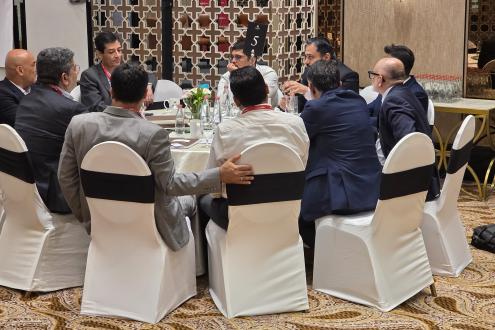
Hosted by Rohit Bhardwaj, Country Head – India, Director Private Clients at Henley & Partners, and Abhijit Bhave, the table explored “Scaling with Substance: Talent, Business Models and the Long-Term Sustainability of India’s Private Wealth Industry”. The discussion brought together senior participants from across private banking, wealth management, advisory, law, tax, family office services, investment management and global mobility advisory.
The conversation reflected an industry growing rapidly, but unevenly. India’s private wealth market is benefiting from rising client supply, greater capital accumulation, expanding family office activity and increased global investing interest. Yet participants questioned whether the operating model beneath that growth is sufficiently robust, as talent remains scarce, RM churn continues, margins are under pressure, regulation is likely to increase, and technology is reshaping both adviser productivity and client expectations.
The central question was not whether India’s private wealth industry can grow, but whether firms can scale with enough depth, discipline and institutional resilience. Participants suggested that long-term sustainability will depend on moving beyond RM-led portability, product-led revenue and short-term hiring cycles towards stronger platforms, better training, deeper propositions and clearer accountability.
Key Takeaways
Talent scarcity is now a structural constraint: Participants said client supply is expanding faster than the supply of capable private bankers, creating salary inflation, RM churn and weak economics.
Scale must be measured by depth, not headcount: The table challenged the idea that adding more RMs is the same as building scale. Product capability, research support, platform quality and specialist depth matter just as much.
Technology can improve productivity, but judgement remains central: AI and digital tools can support portfolio reviews, client communication, research and RM preparation, but participants disagreed on how far the relationship model can ultimately be replaced.
The RM model is becoming more institutional: Several participants argued that firms need to reduce dependency on individual RMs by building CIO-led platforms, specialist teams, discretionary capabilities and stronger house propositions.
Training needs to move beyond periodic product briefings: Participants discussed formal institutes, accreditation, internal capability building, product champions, behavioural profiling, internships and lateral hiring from outside traditional wealth pools.
Business model pressure is intensifying: Falling yields, higher RM compensation, regulatory scrutiny and competition from well-funded platforms are forcing firms to rethink distribution, advisory, discretionary and fee-based models.
Professional standards may need to rise before regulation forces them to: The table discussed whether India needs stronger certification, a code of conduct, self-regulatory structures and greater accountability for advice.
Globalising Indian clients require broader advice: Participants noted rising demand for cross-border solutions, global investing capability, succession planning, mobility, tax awareness and structures that go beyond domestic portfolio management.
Setting the Scene: What is WealthTHINK?
WealthTHINK is an exclusive, invitation-only forum designed for CEOs and senior management at leading private wealth management firms. It provides a platform for industry leaders to engage in peer-to-peer networking and collaborative discussion, free from product pitches and formal presentations. The event focuses on proactive, table-specific debates around key themes shaping the future of wealth management, including digitisation, AI, regulation, business model profitability, family office development, cross-border structuring and regional connectivity.
By keeping participation senior and the format deliberately interactive, WealthTHINK is designed to encourage honest, commercially grounded exchanges on the issues firms are grappling with in real time.
The starting point for the discussion was the talent gap. Participants agreed that India’s private wealth market is expanding quickly, but the industry has not invested enough in building the people needed to serve that growth. The result is a shortage not only of relationship managers, but also of investment counsellors, advisers and specialist support capable of serving a more sophisticated client base.
One participant captured the imbalance bluntly: “Client supply is racing ahead, but talent is falling short.”
That shortage has already affected economics. Compensation has risen sharply for experienced RMs, but capability has not necessarily risen with it. Several participants warned that firms are paying premium salaries for people who may take years to become profitable, or who may leave before the firm earns back its investment.
The issue is not only numerical. Private wealth clients are demanding more judgement, risk explanation, cross-border awareness, succession sensitivity and the ability to connect investment decisions with broader family priorities. Firms therefore need more than larger teams. They need people who can operate within deeper platforms and draw on stronger institutional support.
Scale Is Not Simply A Larger RM Force
The table challenged one of the most common growth narratives in Indian wealth management: that scale is achieved by adding relationship managers. Participants argued that true scale must also include proposition depth, product quality, advisory capability, technology, compliance, research, investment support and firm-level continuity.
One participant used a military analogy to make the point that firms cannot send RMs into the market without proper tools. The industry’s “soldiers” need more than enthusiasm and client lists. They need training, credible product architecture, access to specialists and a platform that allows them to answer increasingly sophisticated client questions.
“Scale is not whether you have 100, 200 or 250 RMs,” said one participant. “Scale is also the depth of your product and proposition.”
This has direct implications for relationship continuity. If a firm’s primary asset is the RM-client relationship, the business remains vulnerable when teams move. If the client is also connected to a CIO office, investment specialists, estate planners, tax advisers, discretionary managers, product teams and the wider platform, the relationship becomes harder to dislodge.
Several participants described this as a shift towards more institutional private banking. The RM still matters, but the firm must ensure that the client relationship does not sit entirely inside one individual’s mobile phone. That requires the organisation to bring more of itself to the client, particularly in the UHNI segment.
The RM Churn Cycle Is Damaging Unit Economics
Participants were candid about the consequences of the current hiring cycle. Firms are chasing the same narrow pool of experienced RMs, salaries are repriced, teams move between platforms, and the cycle often repeats before the economics have stabilised. Several participants described this as a structural problem, not simply a matter of individual behaviour.
The issue is partly caused by scarcity, but it is reinforced by the industry’s reliance on portability. When firms acquire talent instead of building it, they may gain short-term access to client relationships, but they also inherit higher cost, uncertain retention and weaker control over the long-term relationship.
One participant said the industry has become trapped in a cycle where firms “burn for two years” just as the RM is becoming productive, only for the team to move again.
The challenge is time. Building talent requires patience, but fast-growing firms often need revenue immediately. That tension is one of the reasons experienced RMs remain expensive, even when firms know the model is unstable.
Building Talent Requires A Broader Definition Of Capability
The table’s discussion of talent moved beyond simple recruitment. Participants explored what kind of person can become an effective private wealth adviser, and what kind of support they need to develop.
Several argued that the industry should not assume that only existing RMs can serve private clients. India did not historically have a deep private banking industry; many of today’s senior practitioners evolved into the role from banking, broking, investment management, advisory or other financial disciplines. That history suggests the next generation of private bankers can also be built, rather than only hired.
Participants described different approaches. Some firms are experimenting with non-traditional hires from service-led industries, such as hotels, where client handling and service discipline may be strong. Others are hiring interns and grooming them through a more demanding internal process. Some are identifying “product champions” who can specialise in debt, structured products, private equity or other areas, then travel across regions to support RMs and train teams.
One participant framed retention through three linked dimensions: financial growth, workplace culture and continuous capability development. The point was that compensation matters, but it is not the whole answer. People also need challenge, technical development, empowerment and a sense that the firm is improving their professional value.
“The best case is to learn and earn,” said one participant. “If people are doing neither, they will leave.”
This created a more nuanced view of talent retention. RMs may leave for money, but they may also leave because the platform does not help them grow, the proposition is weak, the client experience is frustrating, or the organisation does not give them enough support to compete.
Technology Can Make The RM Smarter
Technology was one of the most active points of debate. Participants agreed that AI and digital tools are already changing wealth management, but they differed on whether the result will be augmentation, replacement or something in between.
One view was that technology should be used primarily to make RMs more productive and more informed. AI can support portfolio reviews, generate client-ready insights, identify fund-level exposures, summarise market events, prepare talking points and reduce the time required to convert house views into client conversations. In this model, the technology sits behind the adviser and strengthens the adviser’s output.
Participants described use cases where an RM could receive a tailored recommendation after a CIO view is published, or where an event such as a geopolitical shock could be mapped quickly to client portfolios. That kind of workflow could shorten response times from days to hours or minutes.
“We are not taking technology directly to the client,” said one participant. “We are using it to make the RM look smarter in front of the client.”
This approach also has organisational benefits. If the firm controls the technology, data, research and recommendation framework, the adviser becomes more dependent on the platform. That may reduce portability, improve consistency and help ensure that the client receives the firm’s approved view rather than an improvised product push.
The Zero-RM Debate Is Real, But Segment-Dependent
The table also explored a more disruptive possibility: whether the RM could eventually become a much less central figure. Some participants discussed the idea of the RM as a “911 person” who is called only when needed, while AI, service teams, investment advisers, digital platforms and operational infrastructure handle the rest.
There was no consensus. Some participants argued that the direction of travel is clear: augmentation will eventually lead to partial replacement, especially as AI becomes more capable, consumer behaviour changes and clients become more comfortable with digital interaction. Others argued that Indian HNI and UHNI clients will continue to demand human touch, particularly when large cheques, family trust and emotionally significant decisions are involved.
The strongest middle-ground view was that the answer depends on segment and use case. A cost-conscious retail or mass affluent client may accept a largely algorithmic or subscription-based RIA model. A UHNI family allocating substantial capital may still want a person in the room, even if that person is supported by advanced technology.
“In India, the touch-and-feel market is not going away quickly,” said one participant. “The RM may be enabled by AI, but the judgement and the relationship still matter.”
This does not mean the RM role will remain unchanged. Much of the lower-value work around data gathering, first-level analysis, portfolio summaries and product comparison can be automated or heavily supported. What remains valuable is interpretation, timing, client-specific judgement and the ability to steady clients during uncertainty.
Clients Also Have AI Now
An important counterpoint was that technology does not only empower advisers. It also empowers clients. Participants noted that clients now arrive with more information, more data, more AI-generated comparisons and more confidence in challenging the RM.
This changes the adviser’s role. It is no longer enough to present a portfolio review or a fund recommendation and assume the client will accept it. Clients may ask why an AI-generated view differs from the RM’s recommendation, whether another platform offers a better solution, or whether a cheaper alternative would achieve the same objective.
That raises the required standard of advice. RMs need to understand not only the conclusion but the logic behind it. They need enough first-principles knowledge to explain risk, portfolio construction, return calculation and product structure. Several participants were concerned that excessive reliance on AI could weaken these fundamentals if advisers simply copy outputs without understanding them.
One participant warned that the industry must not allow technology to replace basic competence. If a high-cost RM merely forwards AI-generated material, the client or employer may eventually ask why that person is needed at all.
“AI can produce the presentation,” said one participant. “But the adviser still has to know what sits underneath it.”
The table’s message was therefore not anti-technology. It was that technology raises the bar. It can make good advisers more effective, but it can also expose weak advisers who do not understand the work behind the output.
Business Models Are Under Pressure
The discussion then moved to business model sustainability. Participants identified several pressures operating at the same time: falling yields, rising RM compensation, regulatory scrutiny, client sensitivity to cost, competition from new platforms and the economics of pure-play wealth management without asset management or lending support.
A recurring point was that fee models require confidence. Firms cannot simply announce that they charge for advice unless the service is deep enough, trusted enough and differentiated enough to justify it. Participants from advisory and professional services backgrounds noted that long-term relationships can survive without aggressive individual sales targets, but only where clients see genuine value and trust the people providing the service.
“Someone needs the confidence to say, I will charge a fee for the service, and clients will pay because the advice is worth it,” said one participant.
The table also recognised the tension between revenue and accountability. If regulation pushes costs down without increasing the industry’s ability to earn for high-quality service, firms may struggle to invest in talent. But if the industry focuses only on revenue without accountability, mis-selling and reputational risk increase.
Advisory, Distribution And Discretionary Models Will Coexist
Participants did not suggest that India will move cleanly from distribution to advisory. Instead, the likely future is a mixed market in which different models serve different client segments and preferences.
Some large families may continue to accept distribution economics where they trust the adviser and believe the value is clear. Participants gave examples of long-standing clients who understand the direct-versus-distribution debate but still prefer to pay through existing arrangements because the relationship, service and confidence matter to them.
Others may move towards advisory fees, especially as wealth becomes more institutional and families want clearer alignment. Discretionary models may also gain traction where clients want professional risk management, continuity and reduced dependence on individual RMs.
The table noted that discretionary assets can be stickier because the client relationship is connected to the investment process, not only to the RM. If the RM leaves, the portfolio management relationship, specialist team and platform proposition may remain in place.
The broader point was that no single model will dominate every client segment. Distribution, advisory and discretionary solutions will each have a place, but firms will need to be clearer about what value they are delivering and how that value is paid for.
Regulation And Professionalisation Are Coming
Professional standards formed another major part of the discussion. Participants compared India with more regulated wealth management markets such as Singapore and Hong Kong, where accreditation, certification and training requirements are more formalised. The table questioned whether India needs a more holistic professional qualification or continuing accreditation for wealth advisers, beyond existing product-led or minimum regulatory requirements.
There was scepticism about whether change will come quickly. Participants noted that regulators tend to focus more heavily on retail investor protection than on the HNI or UHNI wealth segment. Some suggested that meaningful regulatory action may only follow a major incident. Others argued that the industry should not wait for the regulator and should instead pursue a self-governing body, code of conduct or stronger professional framework.
One participant summarised the risk: “If the industry keeps making money without taking care of standards, it can be hit badly.”
Accountability was central to this part of the discussion. Participants questioned whether advisers and firms carry enough responsibility for advice, especially where clients suffer from poor recommendations or mis-selling. They also noted the contradiction between wanting higher-quality advice and continually pushing down the economics available to deliver it.
The broader conclusion was that professionalisation is inevitable, even if the timing is uncertain. As the market grows and more players enter wealth management, stronger standards, clearer accountability and eventual consolidation are likely.
The Globalising Indian Client Needs More Than Domestic Products
The table also touched on the increasingly global nature of Indian private wealth. Participants discussed clients seeking broader geographic exposure, global investing options, cross-border structures, GIFT City solutions, LRS routes, offshore funds and international advisory frameworks.
One participant contrasted firms that are trying to build offshore desks from India with firms that already operate internationally and are bringing that global capability into the Indian client relationship. The distinction matters because cross-border advice carries regulatory, tax, product and suitability pitfalls. It cannot be treated simply as another product shelf.
Participants also noted that many institutions talk about global investing, but fewer have the full platform capability to deliver it effectively. A credible proposition may require multiple routes: feeder funds, third-party products, offshore vehicles, Singapore VCC access, discretionary solutions or other structures. The RM alone cannot create that capability.
This is another reason the industry is becoming more proposition-led. As Indian clients globalise, they will expect firms to offer more than domestic equity, mutual funds or standard alternatives. They will need advice that connects portfolio construction with jurisdiction, tax, succession, mobility, family needs and regulatory constraints.
Private Wealth Advice Is Becoming Broader
The discussion also highlighted how the private client relationship increasingly extends beyond investments. Participants from legal, tax and estate planning backgrounds described families seeking advice on succession, trusts, wills, family governance and, at times, personal or family matters that sit far outside conventional portfolio management.
That breadth reinforces the need for collaboration. The RM cannot be expected to handle everything. Nor can a product specialist, lawyer, tax adviser or investment counsellor solve the entire client problem alone. Wealth management is moving towards a coordinated model in which different specialists contribute to the client relationship at different moments.
This also changes what “trusted adviser” means. For some families, the adviser is not only the person who recommends investments. It may be the person who knows whom to bring into the room, how to sequence the conversation, and how to manage sensitive decisions across family, legal, tax and investment dimensions.
The table’s implication was clear: firms that define wealth management too narrowly may miss where the client relationship is going. As Indian wealth becomes more complex, advice must become more integrated.
Culture May Be The Real Retention Strategy
Beyond compensation, technology and product access, participants repeatedly returned to culture. Some firms appear able to retain people for long periods because they hire early, train deeply, create loyalty and provide a professional environment where people can grow. Others suffer constant churn because the model is built around targets, incentives and individual portability.
The table discussed collective targets, collaboration across specialists and long-term professional development as possible alternatives to pure individual revenue pressure. Not everyone agreed that such models are easily transferable into wealth management, especially where sales performance varies sharply across individuals. But participants accepted that target-only systems can create predictable behavioural problems.
The discussion also introduced the idea of understanding RM behaviour in the same way firms study client behaviour. RMs go through stages: survival, growth, platform evaluation, ambition, frustration and, eventually, either institutional loyalty or departure. Firms that understand those stages may be better able to design roles, incentives and support systems that retain the people they actually want to keep.
This was one of the more important insights from the table. Talent retention is not only an HR issue. It is part of business model design.
Strategic Summary: Building Institutions, Not Just RM Networks
The discussion at WealthTHINK India 2026 made clear that India’s private wealth industry has entered a more demanding phase. Growth alone is no longer enough. Client supply is strong, but talent supply is constrained. Technology is powerful, but not a substitute for judgement. Fees are under pressure, but advice still needs to be paid for. Regulation may be uneven today, but professional standards are likely to rise. Clients are globalising, but not every platform is ready to serve them properly.
For firms, the central challenge is to build institutions rather than collections of portable relationships. That means investing in talent pipelines, training, accreditation, culture, specialist depth, CIO-led propositions, technology infrastructure, discretionary capability and cross-border competence. It also means accepting that the RM of the future may be less of a lone rainmaker and more of an orchestrator of firm-wide capability.
The table did not suggest that the human adviser is disappearing from Indian private wealth. On the contrary, many participants argued that trust, judgement and touch-and-feel engagement remain essential, especially at the HNI and UHNI level. But the adviser’s role is changing. The industry needs fewer unsupported salespeople and more informed, well-equipped professionals who can interpret complexity, coordinate specialists and guide clients through both opportunity and risk.
At WealthTHINK India 2026, the message from this table was straightforward: India’s private wealth industry can scale, but only if it scales with substance. The firms that last will be those that build capability deeper than the individual RM, value stronger than the product shelf, and institutions resilient enough to survive the next phase of growth.