
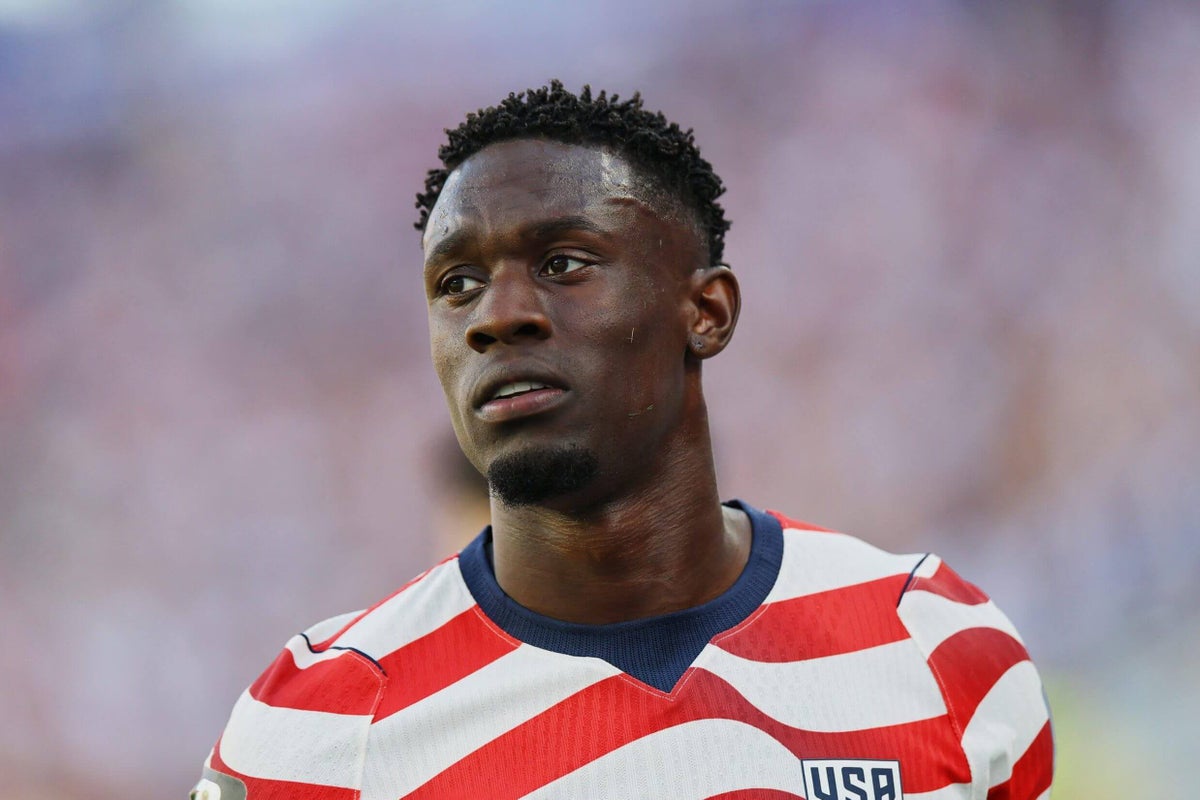
Folarin Balogun was sent off in the only blot on an otherwise dream night for the United States in their round-of-32 game against Bosnia and Herzegovina.
The 24-year-old was shown a straight red card for a foul on Tarik Muharemovic in the second-half of Wednesday night’s game in Santa Clara.
He was visibly distressed at referee Raphael Claus’ decision and was comforted by his team-mates as he left the field.
In his absence, the U.S. rallied against the adversity and added to the 1-0 lead Balogun himself had given them earlier, with Malik Tillman’s late free kick sealing the victory and a place in the last 16.
The U.S. will now face Belgium in Seattle on Monday, July 6 — a game for which Balogun will be suspended.
What happened with Balogun vs. Bosnia?
Was this worthy of a red card? 🟥 pic.twitter.com/WfrIxMRNMD
— FOX Sports (@FOXSports) July 2, 2026
As the ball was played up the left sideline from Antonee Robinson in the 61st minute, with the U.S. leading 1-0, Balogun reached out and tried to get his body in position. As he did so, he landed on the back of the leg of Muharemovic, raking down the calf and landing on the defender’s ankle.
It did not look like an intentional foul, but rather the forward landing awkwardly. On the slow-motion replay, however, it looked like a strong tackle. And there was no doubt that Balogun made rough contact on the defender.
After being instructed by the Video Assistant Referee to go to the pitchside monitor to review the incident, on-pitch referee Claus told Levi’s Stadium that Balogun had committed a “serious foul” and would be sent off.
Paul Tenorio
Why was he red-carded and what are the rules?
Announcing his decision to Levi’s Stadium, Brazilian referee Claus said that Balogun had committed a “serious foul” and would be sent off.
The laws of soccer, which are decided by the International Football Association Board, state that “a tackle or challenge that endangers the safety of an opponent or uses excessive force or brutality must be sanctioned as serious foul play.
“Any player who lunges at an opponent in challenging for the ball from the front, from the side or from behind using one or both legs, with excessive force or endangers the safety of an opponent is guilty of serious foul play.”
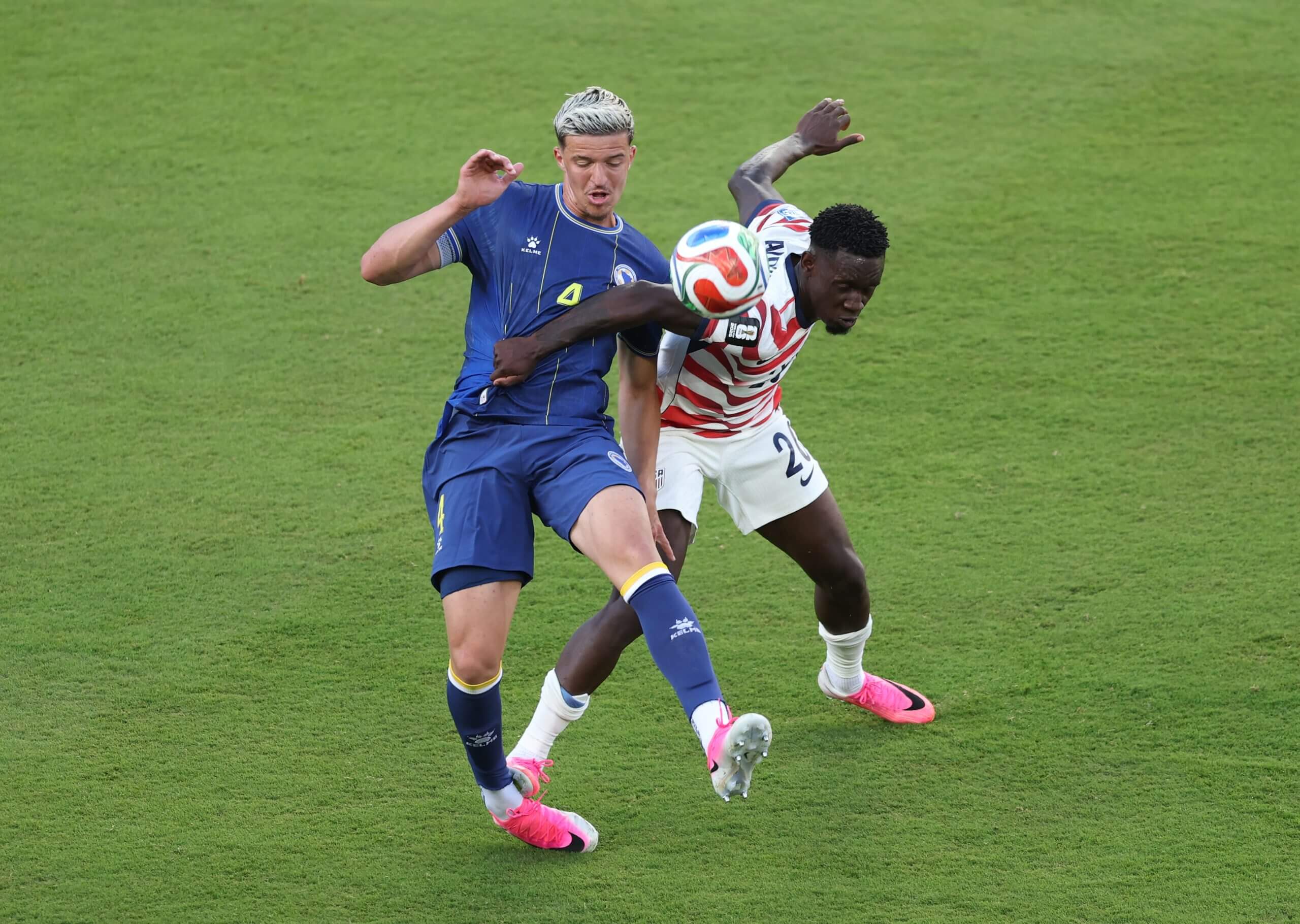
Balogun’s foul on Muharemovic. (Michael Steele / Getty Images)
Article 10.5 of FIFA’s regulations for the 2026 World Cup says:
“If a player or team official is sent off as a result of a direct or indirect red card (second caution), they will automatically be suspended from their team’s subsequent match. In addition, further sanctions may be imposed.”
If the ban can’t be served in the tournament, i.e. the team no longer has a game to play, Article 10.6 says:
“Any suspension that cannot be served during the FIFA World Cup 26 will be carried over to the representative team’s next official match in accordance with the relevant provisions of the FIFA Disciplinary Code.”
‘Unlucky but inevitable’ – an expert’s view
Analysis by former Premier League referee Graham Scott
The introduction of VAR has created situations such as Balogun’s red card
He was dismissed for ‘serious foul play’, which deals with players who endanger the safety of an opponent. Historically, the law was invoked by referees when players went flying into tackles at high speed and out of control, without a moment’s thought for the consequences.
Since we have had video review, the focus has shifted to the point of contact. Slow-motion replays and still images distort the offending player’s actions, with innocuous tackles looking more serious.
By contrast, players who dive in, off the ground, with both feet can escape red cards if they happen to miss their opponent.
Lionel Messi’s potential red card for Argentina against Algeria was a classic example. There is no intensity in his challenge, but the still images were ugly and on another day, he might have been sent off.
Balogun became a victim of this modern trend against Bosnia. His actions are all part of the normal rough and tumble of football, he is never out of control and the contact is accidental.
But the replays make for grim viewing, as Muharemovic’s ankle buckles and he is clearly in distress — no simulation here.
I would prefer tackles like this to produce cautions at worst. Messi was let off completely, and there is nothing reckless about Balogun’s actions either.
In the spirit of the law, Balogun was unlucky. But in its recent interpretation, a red card was inevitable.
Can the red card be appealed?
A team cannot appeal against a red card or the subsequent suspension, per a FIFA official.
When asked by The Athletic whether a red card can be appealed a FIFA official pointed to its regulations and Article 66.4 which states:
“A sending-off automatically incurs suspension from the subsequent match. The FIFA judicial bodies may impose additional match suspensions and other disciplinary measures.”
In Balogun’s case, he will now miss the U.S.’s last-16 meeting against Belgium with it possible he could miss further games should the U.S. progress further in the tournament should FIFA’s disciplinary committee choose to extend the suspension.
Miguel Almiron’s one-game ban for covering his mouth in a situation of confrontation was not increased by world soccer’s governing body, but Assim Madibo, the Qatar midfielder, saw his suspension increased to a five-match ban for his tackle on Ismaël Koné, which resulted in a broken leg for the Canada player.
Will Balogun be able to attend the USA’s next game?
Per FIFA’s rules, Balogun will be able to attend the game at Lumen Field but in a limited capacity.
Players serving a suspension “may be allowed to sit in the stands, but not in the immediate vicinity of the field of play,” FIFA says.
Balogun will also not be able to enter the U.S. dressing room, the stadium tunnel or the team’s technical area “before or during the match, attend the warm-up, or sit on the team bench.”