
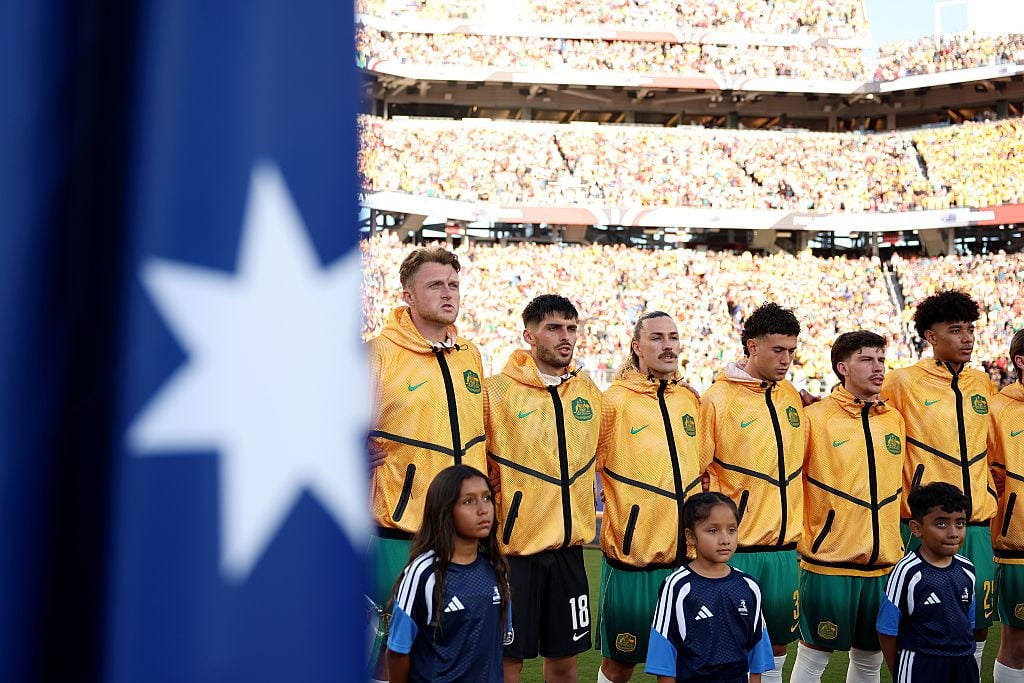
“We suffer, but we know how to suffer.” – Lionel Scaloni, Argentina Head Coach.
Australia progressed from the 2026 FIFA World Cup group stage by executing one of the tournament’s clearest examples of a risk-managed tactical model. Across matches against Türkiye, the United States and Paraguay, Tony Popovic’s side consistently prioritised defensive security, structural compactness and control of match volatility over excessive attacking ambition. The result was a team that proved exceptionally difficult to break down, yet equally struggled to create sustained attacking threat.
GENERAL SUMMARY AND APPROACH
This is not a defensive team in the traditional sense; defensive teams absorb pressure and hope to survive. Australia sought control, dictating where and how the game was played, even while not in possession.
Despite spending long periods without the ball, expected goals against remained consistently low, while expected goals for also remained among the lowest of teams progressing from the group stage. The data therefore paints a remarkably balanced picture: Australia successfully reduced opposition chance quality, but simultaneously restricted its own attacking output.
The team’s approach can best be described as risk-calibrated football. Rather than asking: “How can we create the most chances?” the tactical behaviour consistently reflected: “How can we concede the fewest high-quality chances while remaining capable of capitalising on isolated opportunities?” This philosophy was evident throughout every phase of play.
Australia willingly conceded possession during build-up, allowing opponents extended circulation across their defensive line before engaging. Possession control figures reflected this approach:
Türkiye: 27%
United States: 30.3%
Paraguay: 46.2%
 Tony Popovic in Seattle. Photo: Getty Images
Similarly, Australia’s pressing behaviour demonstrated deliberate restraint rather than passivity. The objective was rarely to force immediate turnovers high up the pitch. Instead, pressing primarily served three purposes: slow opposition progression, force play towards wide areas and allow Australia’s defensive block to remain compact. Consequently, Australia generated very few high turnovers but equally prevented opponents from consistently attacking central spaces.
Perhaps the most revealing conclusion concerns Australia’s footballing identity. Australia cannot accurately be described as either: a traditional counter-attacking side; or a possession-dominant positional side.
Traditional transition teams commit significant numbers forward and create repeated overloads after regaining possession. Australia rarely did so. In fact, the number of counter-attacks attempted sat between just 1 and 3 per match. Transitions were typically 1v1, 2v2 or 3v3 situations, with overloads extremely rare.
Similarly, possession-dominant teams manipulate opposition structures through sustained circulation, positional rotations and numerical superiorities in the front third. Australia rarely attempted this either.
Instead, Australia occupies an intermediate identity. Possession functioned primarily as a defensive mechanism rather than an attacking weapon. The objective was to reduce match volatility by ensuring games were played within controllable conditions. Viewed through this lens, Australia’s group-stage performance represents both a success and a limitation.
The defensive framework consistently achieved its objectives, becoming stronger as the tournament progressed – first half against USA aside. However, the same structural discipline that protected Australia without the ball also reduced attacking support, limited penetration, isolated forwards and restricted opportunities to create high-quality chances.
Australia’s most impressive structural achievement was vertical compression. By maintaining a team length of 16–22 metres across all matches and defensive phases, opposition central midfielders were systematically denied the space required to turn and play forward. This discipline forced attacking teams to play around the block rather than through it, contributing directly to conceding only two goals.
FORMATION / STRUCTURE / LINE-UPS
Australia’s tactical framework remained remarkably consistent throughout the group stage. While personnel and certain positional roles changed between matches, the team’s underlying principles changed very little.
Regardless of opponent, the priority was always to maintain defensive compactness, minimise transition exposure and preserve structural balance before pursuing attacking opportunities. The system was therefore less defined by its nominal formation than by the relationships and distances between units.
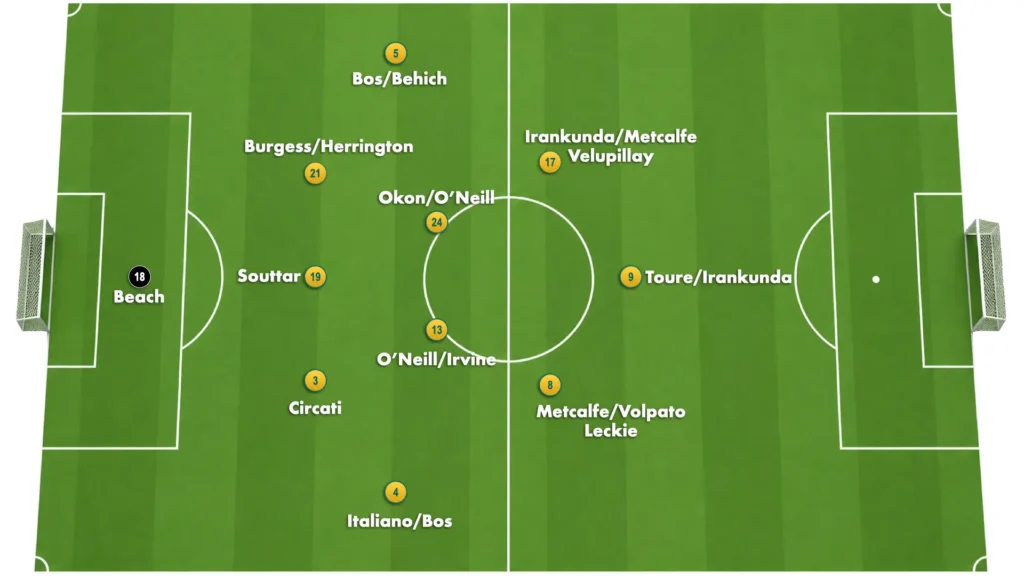
Australia generally defended from a compact 5-4-1 (or 5-2-3 in pressing moments), transitioning into a 3-2-4-1 or 3-4-3 in possession. Australia’s structural expansion remained measured. Wing-backs advanced cautiously, central midfielders rarely vacated their stabilising positions simultaneously, and at least five players consistently remained behind the ball during sustained possession. This produced excellent defensive stability but inevitably stunted attacking numbers and possibilities.
Structural Compactness
The defining feature of Australia’s structure was its compactness. Rather than attempting to compress space through aggressive pressing, Australia compressed space by maintaining short distances between defensive and midfield lines.
The team consistently defended with a relatively short overall block, preventing opponents from accessing central areas between the lines. Importantly, Australia’s compactness extended beyond purely defensive phases.
When possession was lost, recovery distances were short because players were already positioned close together. Rather than overly relying on athletic recovery runs, Australia relied on proximity, enabling immediate pressure around the ball and consistent second-ball recoveries. This positional safety became one of Australia’s greatest competitive strengths throughout the group stage.
Team Length and Vertical Distances
Australia generally maintained appropriate distances between the goalkeeper, defensive line and midfield. These relationships enabled effective circulation during build-up, secure defensive transitions, immediate access to second balls and protection against counter-attacks.
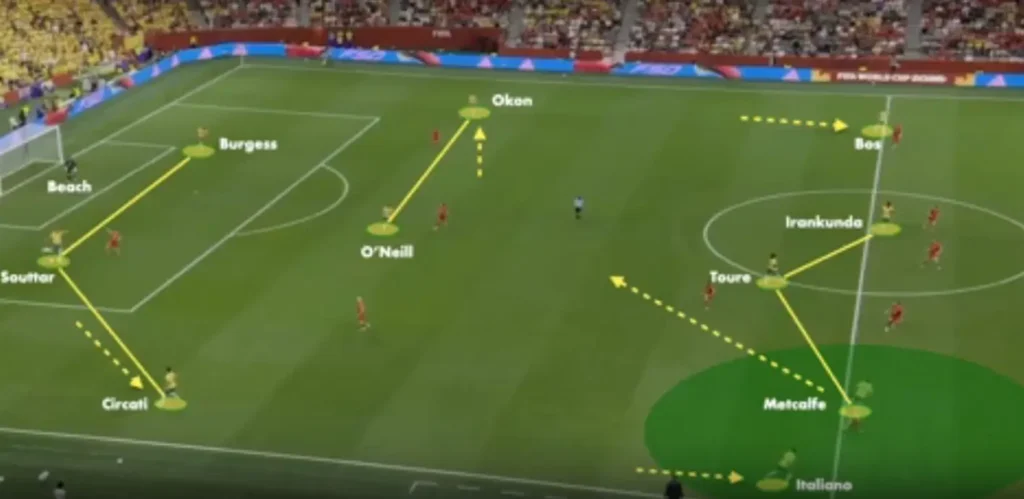
However, one vertical relationship consistently undermined Australia’s attacking play. The distance between midfield and attack was frequently too large. Against Türkiye and the United States, this gap regularly exceeded 35 metres, leaving Toure and later Irankunda isolated against multiple defenders.
Although this distance reduced to approximately 25-30 metres against Paraguay, support remained inconsistent and attacking combinations remained limited.
This excessive spacing produced several consequences simultaneously. Forwards were forced to drop away from goal simply to receive possession. Receiving deeper reduced their ability to threaten the space behind defenders and crucially, opposition centre-backs were rarely required to defend large spaces behind them.
Possession Structure
Australia’s possession structure reflected the team’s broader philosophy of risk reduction. Rather than using possession to manipulate opposition defensive structures aggressively, possession primarily functioned to maintain organisation, control tempo, minimise turnovers and prepare defensive rest positions.
Across the tournament, pass completion regularly exceeded 80%, with several players recording completion rates above 90%. These figures indicate excellent ball security but also illustrate a broader tactical tendency. High completion rates were achieved primarily through circulation rather than penetration.
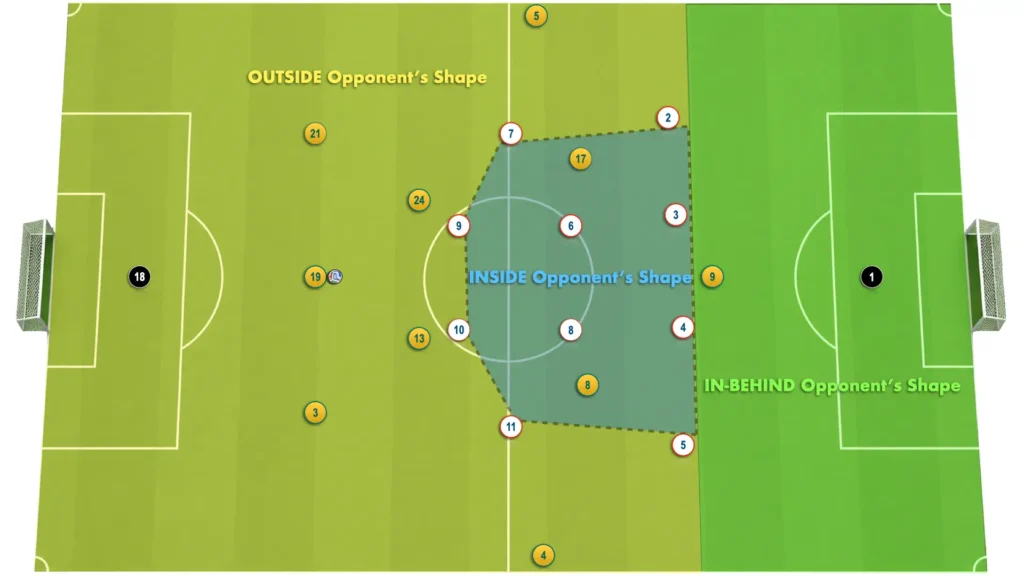
Line breaks attempted – Around/Through the opposition shape:
vs Türkiye: 30/15
vs USA: 41/30
vs Paraguay: 50/32
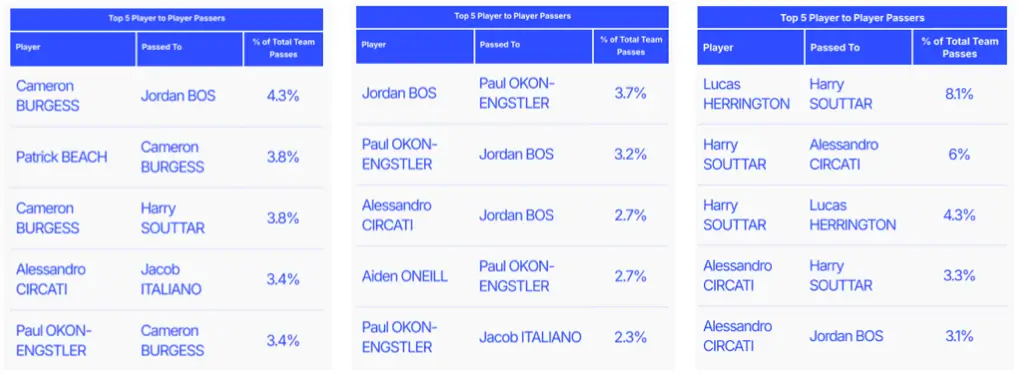
Top 5 player-to-player passes vs Türkiye/USA/Paraguay:
The ball frequently remained in front of and outside opposition defensive structures instead of consistently breaking inside and in-behind them. Possession therefore became a mechanism for maintaining control rather than creating instability.
Defensive Shape Without the Ball
Australia deliberately allowed opponents extensive possession in less dangerous areas. Against Türkiye, Australia held only 27% possession but Türkiye spent 41% of possession building unopposed. Australia engaged minimally during the opposition’s first phase. Similar patterns appeared against the United States.
This reflected a conscious trade-off. Allowing harmless possession reduced opportunities to force dangerous turnovers but simultaneously protected Australia’s defensive organisation from becoming stretched and exposing its structural vulnerabilities.
Player Profile Compatibility
Perhaps the most important finding concerns not formation but player relationships. Australia’s attacking issues were less about selecting the “wrong individuals” than selecting combinations of similar player profiles.
Football is not additive, it is multiplicative. The effectiveness of any player depends heavily upon the movements and characteristics of those around them and the context of each match.
Several Australian partnerships consistently occupied similar spaces while performing similar functions. The clearest example occurred in central midfield where Aiden O’Neill and Paul Okon-Engstler both functioned primarily as connectors.
Both preferred receiving to feet, circulating possession, offering support in front of opposition pressure and maintaining rhythm and control rather than destabilising defensive structures.
Aiden O’Neill made 101 offers to receive over the three matches, 58 of these were in front of the opposition and just 24 between the lines. Although O’Neill received possession 42 times from these movements, many receptions occurred in relatively safe areas where immediate forward progression was limited.
Rather than complementing one another, both midfielders often performed the same tactical function. Irvine’s late arrivals in the box added a point of difference off the ball but his function generally fitted the existing mould. The consequence was a midfield capable of retaining possession and protecting the defensive line but less capable of manipulating opposition defensive structures.
Australia frequently passed around pressure instead of progressing through it. The absence of a genuine destabilising midfielder – one willing to receive inside the opponent’s shape or between the lines, turn, drive forward, commit defenders and release runners became one of the defining offensive limitations of Australia’s play. Connor Metcalfe’s standout second goal against Turkiye was the best example showing how this can work.
Inside Winger/Double-10s Relationships
Similar compatibility issues emerged in the “inside winger” positions. Instead of complementary movement – one receiving short while another attacked in behind – multiple players sought possession in an identical manner.
Both often regularly occupied the “in-between” spaces, especially during deep build up, receiving with their backs to goal under immediate pressure without nearby support and without runners threatening beyond the defence.
Rather than stretching opponents vertically, Australia’s attacking players often compressed themselves into similar spaces. The result was reduced variation, fewer complementary movements and diminished collective attacking output.
BUILD UP AND PROGRESSION
Australia’s progression model reflected the central philosophy of its World Cup campaign: maintain possession security, preserve defensive structure and advance the ball with minimal risk.
Elite attacking teams progressively transfer responsibility for advancing possession from defenders to midfielders and ultimately to forwards. Australia’s progression rarely followed this pattern. Instead, responsibility remained concentrated within the defensive unit, with midfielders and wingbacks primarily supporting circulation rather than driving attacks.
Goalkeeper Restarts and Deep Build Up
Probably the most symbolic element of Australia’s progression is how they restarted play. Most times, Beach would play direct and long. There was a willingness to sometimes start short but this was not at the expense of safety. Australia’s set up in these moments were the first signs of the disconnect between the back three, midfielders and the attacking players.
CONCLUSIONS
Australia’s 2026 FIFA World Cup group-stage campaign demonstrated the effectiveness of a clear, disciplined and highly coherent tactical identity. The team progressed from the group not by dominating possession or overwhelming opponents offensively, but by consistently reducing the volatility of matches through exceptional organisation, compactness and defensive control.
The statistical profile reflects this identity. Across the three group matches Australia averaged just 33.8% possession, scored 2 goals, conceded 2 goals, kept two clean sheets, and progressively reduced opposition shots from 30 against Türkiye to 9 against the United States and 7 against Paraguay. Few teams combined such defensive consistency with such modest attacking output.
These numbers highlight the central paradox of Australia’s tournament. The qualities that made Australia difficult to defeat were often the same qualities that limited its ability to win more comfortably.
Final Assessment
Australia is not a low-possession counter-attacking side in the traditional sense, nor are they a possession-dominant positional team. They are something in between: a side that uses possession to organise its defence, values territorial control over ball domination, and seeks to reduce match volatility. Australia became increasingly effective at controlling where football was played but not yet at controlling how opposition defenders behaved.
If Australia can maintain its outstanding defensive organisation while developing more complementary attacking relationships, improving midfield progression and increasing genuine penetration, the data suggests the team possesses a significantly higher performance ceiling than was demonstrated during the group stage.
The foundations are already in place. The next stage is transforming a team that is exceptionally difficult to beat into one that is equally capable of consistently deciding matches.