
Arbitrary movement in three dimensions
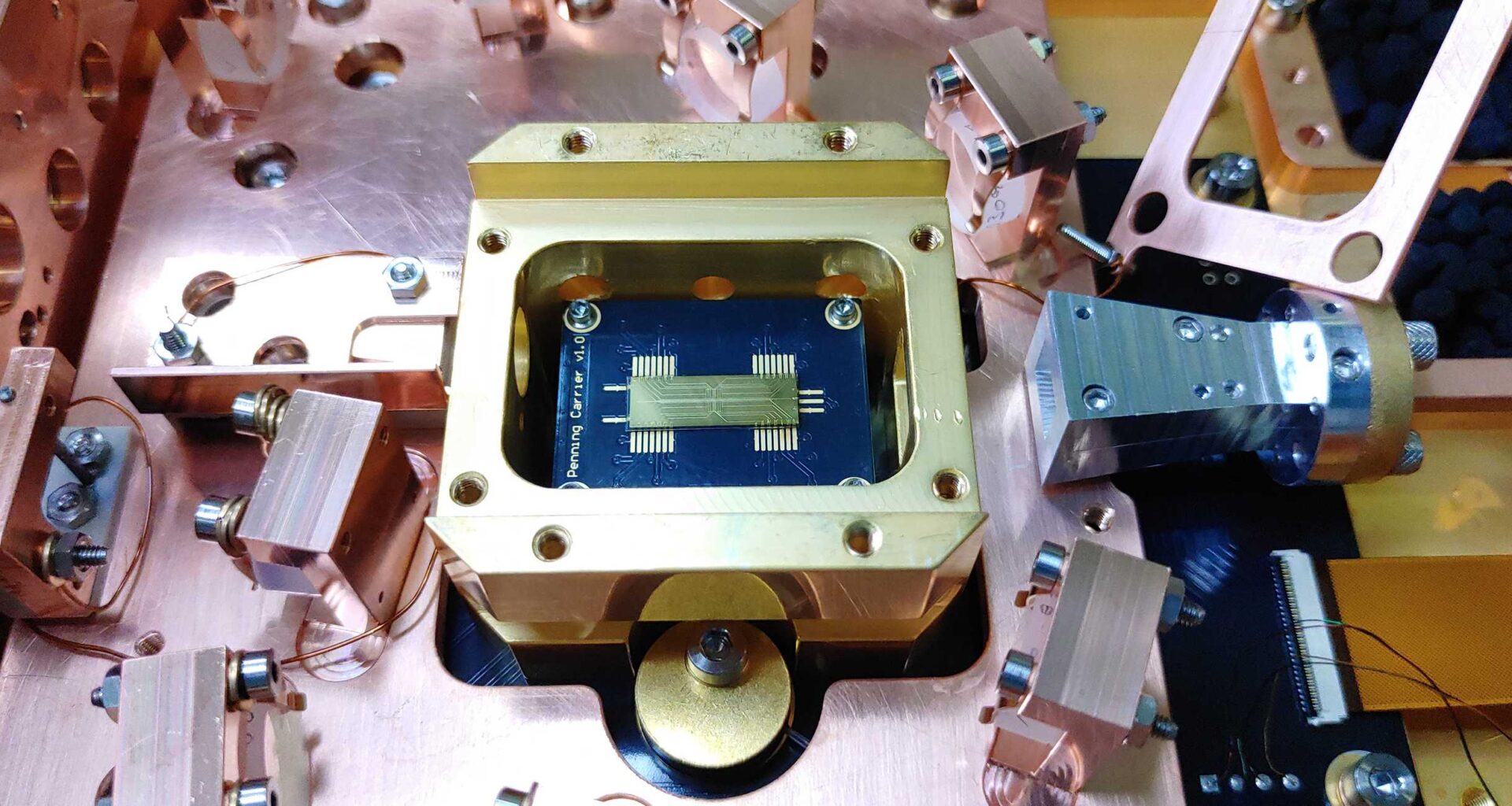
“Two years ago, we developed a novel chip trap that allowed to move an ion arbitrarily in three dimensions”, explains doctoral student Tobias Sägesser. Whereas in conventional traps, charged atoms are trapped by oscillating electric fields in the radio frequency range, the ETH researchers use a so-called Penning trap that is based on a combination of static electric and magnetic fields.
“This has two significant advantages”, says Shreyans Jain, also a doctoral student in Home’s group: “On the one hand, this allows us to position the ions in three dimensions, which isn’t possible using radio-frequency traps. On the other hand, the absence of oscillating fields within the trap makes it easier to detect tiny oscillating fields on the chip.”
The measurement of very small oscillating electric fields works as follows: first, the researchers use laser beams to cool a trapped beryllium ion to the point that it reaches the lowest quantum mechanical oscillation state in the trap – in other words, it effectively comes to a standstill. Then they change the electric voltages on the electrodes of the trap so that the ion moves to the desired point above the chip. “In doing so, we can vary the height above the chip from 50 micrometres up to 450 micrometres and scan an area of 200 by 200 micrometres”, says Sägesser.