
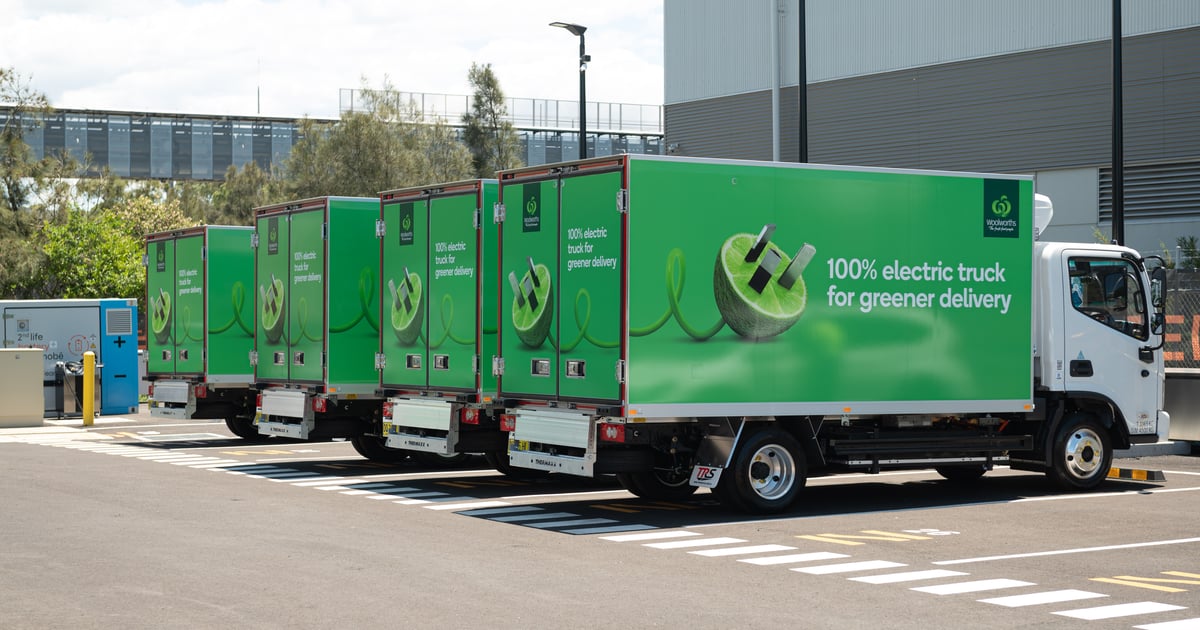
The Clean Energy Finance Corporation (CEFC) has committed up to AU$22 million (US$15.16 million) to electric fleet specialist Zenobē Australia to fund the acquisition of up to 148 battery electric trucks (BETs).
This will support what the two organisations describe as the “largest fleet rollout of electric trucks in Australia to date”.
The Foton T5 trucks will be leased to Woolworths for last-mile grocery delivery across New South Wales and Victoria, with additional vehicles deployed in Queensland, Western Australia and South Australia.
Under the arrangement, Zenobē retains ownership of the vehicles throughout the lease term, allowing Woolworths to deploy battery-electric trucks without taking on end-of-life asset risk.
The lease package includes vehicle maintenance, warranties and upgrades.
The CEFC investment focuses solely on vehicle acquisition and leasing, building on an earlier CEFC commitment to deploy battery electric trucks with Zenobē. The full fleet rollout is expected to be completed over the course of 2027.
CEFC head of infrastructure Julia Hinwood said the investment was designed to move the market toward price parity between electric and diesel trucks.
“By increasing the uptake of BETs we’re helping develop the market to bring them closer to price parity with their non-electric counterparts. This investment reflects the commercial viability of BETs and enables Zenobē to set competitive rentals to incentivise customers to lease BETs,” Hinwood said.
“With fuel price volatility and supply risks increasingly material for freight operators, early large-scale deployments are critical to generating the real-world performance data and operating benchmarks needed to underpin a secondary market for electric heavy vehicles.”
Electric trucks lagging behind passenger EV uptake
The deployment arrives against a backdrop of stubborn underperformance in Australia’s heavy-electric-vehicle market relative to the passenger segment.
Of the 12,003 trucks and heavy vans sold in Australia so far during 2026, only 0.9% were electric.
That compares with 27.5% of new passenger and light commercial vehicle sales being electric or plug-in hybrid in April 2026, according to figures cited by the federal government.
Transport accounts for up to 23% of Australia’s national emissions, and road freight activity is projected to grow approximately 35% between 2025 and 2040, driving a 10% increase in truck emissions. By 2035, road transport is projected to account for 83% of all transport emissions.
Last-mile delivery operations of the kind Woolworths operates have long been identified as among the most suitable applications for electrification, given predictable routes, high vehicle utilisation and depot-based overnight charging.
The Zenobē model, which removes asset ownership risk from the operator and bundles maintenance into the lease, is designed to eliminate the upfront capital barrier and operational uncertainty that have slowed fleet electrification decisions across Australian logistics.
Zenobē’s expanding Australian and global platform
The CEFC commitment follows a AU$400 million fleet electrification financing platform Zenobē closed for Australia and New Zealand in June 2026, backed by a syndicate of five international lenders, including MUFG Bank, Crédit Agricole CIB, Siemens Bank, SMBC and Société Générale.
That platform was structured around four operational seed projects in Leichhardt, Dunedin, West Auckland and Greater Wellington, and was described as the first integrated multi-site heavy vehicle electrification financing platform established in either market.
Zenobē has also been expanding beyond Australia and New Zealand. In March 2026, the company acquired Revolv and expanded its North American fleet operations, adding 13 operational sites and more than 100 electric trucks to its global portfolio.
The company now supports more than 3,400 commercial electric vehicles across 122 depots globally and employs more than 380 people across Australia, New Zealand, Europe, the UK and North America.
The CEFC has committed over AU$260 million to EV-related projects since inception and has helped finance more than 20,000 EVs, with a total value of more than AU$1.2 billion, including third-party capital through co-finance programmes.