
To figure out what the little red dots might be, if not simply really big galaxies, scientists turned to spectroscopy, a technique that spreads out the collected light by its wavelength, or color. This allows astronomers to see the intensity at each wavelength. Each color of light in the collected data, called a spectrum, reveals the chemical elements that make up the glowing material.
That light also travels across long distances, which keep growing because the universe is expanding. That expansion actually shifts colors toward the red end of the spectrum. But because astronomers understand the patterns of lines from each chemical element, they can still find those patterns even if they’re redder. By tracking those specific colors and how much they’ve shifted toward red, astronomers can determine how far away the object is. Scientists can also use those shifted lines to understand how gas at the light source is moving. That turned out to be crucial information to understanding the little red dots.
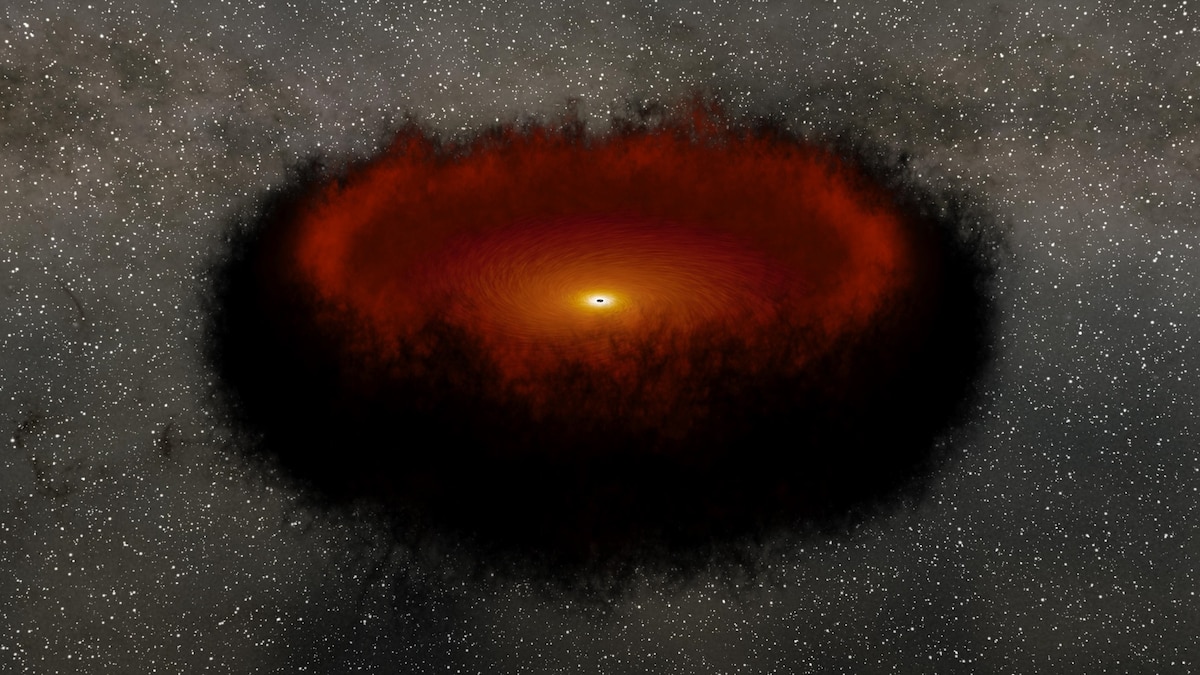
Hydrogen is the most prevalent material in the universe, but instead of a narrow marker for the element, light from the little red dots produced a blurred, or broadened, region in the data. That blurring is a result of incredibly fast movement, thousands of kilometers per second, says Kocevski, toward and away from the viewer. These blurred lines, he says, implies “something really massive, and gas orbiting it,” like a supermassive black hole with material swirling around it.
Once astronomers uncovered this broad hydrogen line, the main hypothesis shifted from massive galaxies to massive black holes that were actively pulling in matter at the center of their forming galaxies. The red color, astronomers thought, was due to a large amount of dust reddening the active black hole’s glow. But when they captured even more data, the evidence yet again pointed elsewhere and the active black holes began to look like something even more puzzling.