
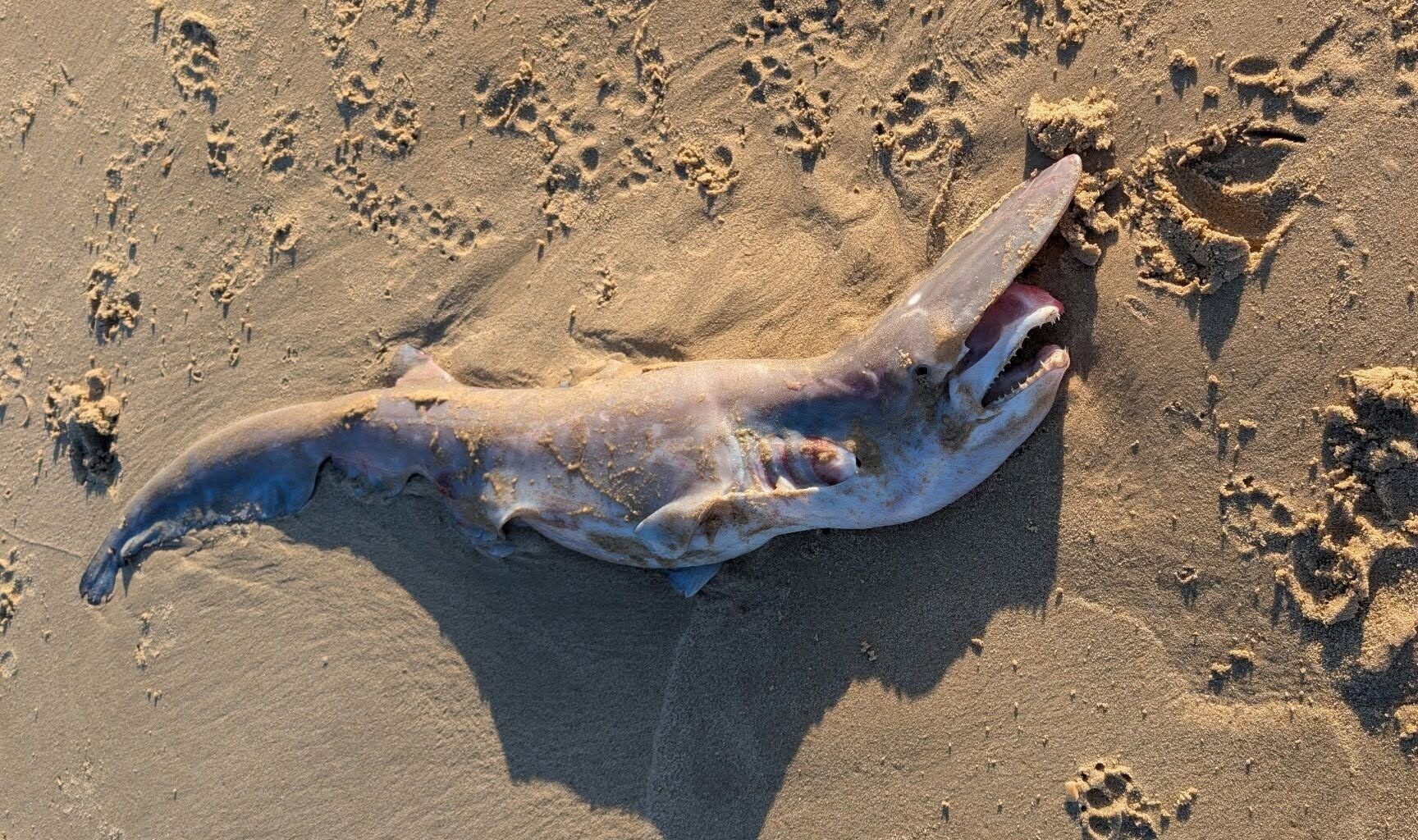
A deep-sea shark that washed up at a popular Sunshine Coast dog beach is believed to be the first known record of the rare species in the northern half of Australia.
The deceased goblin shark was found just north of the Stumers Creek mouth at Coolum on Thursday morning, with Queensland Museum alerted to the discovery.
Museum researchers said it was an extremely rare find and a representative went to the beach to try to secure the specimen, but by the time she arrived the shark had disappeared.
Queensland Museum ichthyologist Dr Jeff Johnson confirmed from photographs that the Coolum shark was a goblin variety, which are usually found along the sea floor in depths of around 1000m.
In addition, he said it was well outside its known Australian range.
In Australia, the species has previously been recorded off New South Wales, Tasmania and possibly South Australia but, even then, sightings are rare.
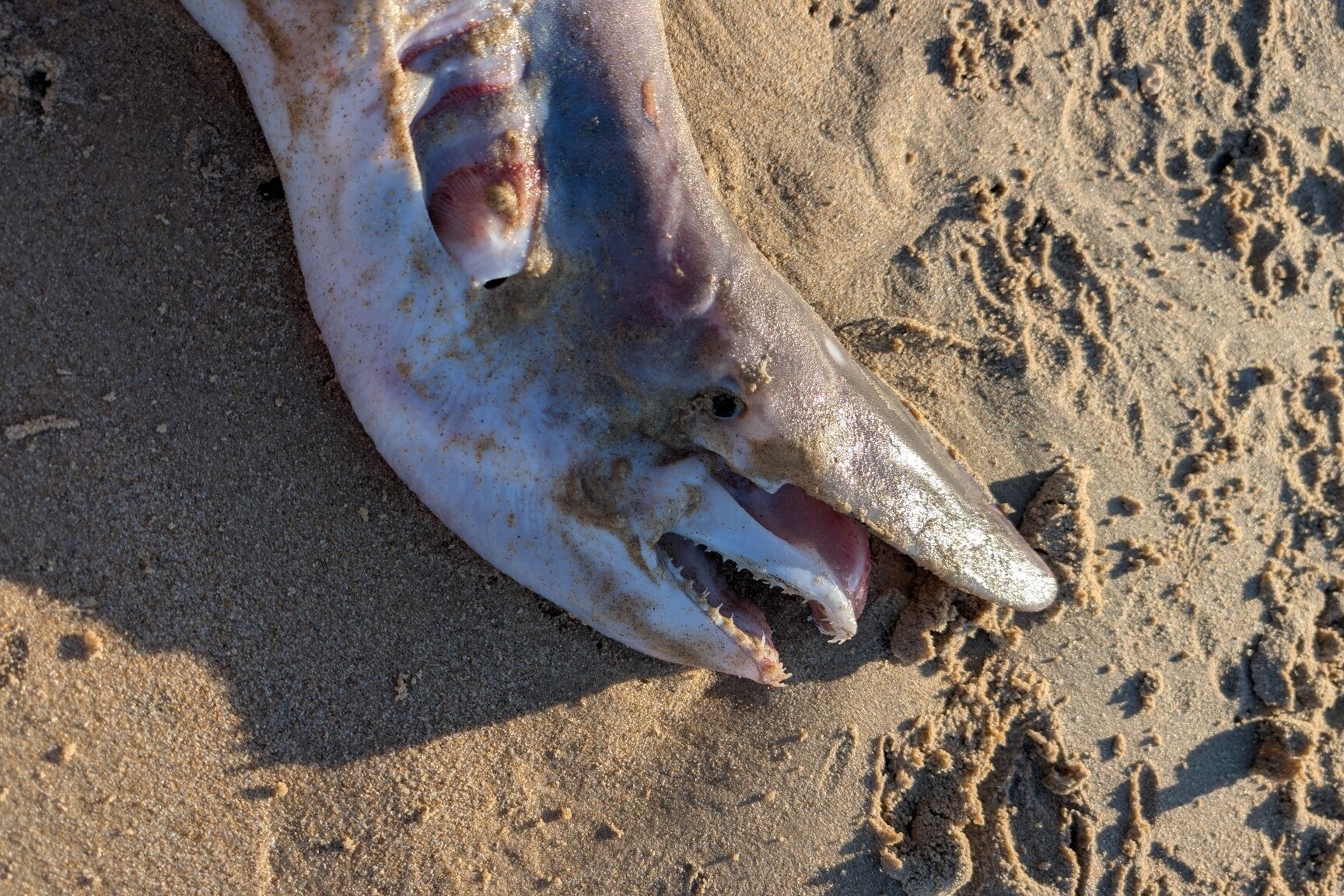 The shark found near Stumers Creek. Picture: Philip Dunbavan.
Goblin sharks, which belong to a lineage dating back about 125 million years, are so elusive that footage of live specimens in their natural deep-sea habitat made worldwide headlines in June.
The footage formed part of a study published in the Journal of Fish Biology in May, documenting two live observations in the central Pacific: one near Jarvis Island in 2019 and another on the slope of the Tonga Trench in 2024.
“We would have loved to have the specimen for our collection at the museum. It would have been the first one recorded for the northern half of Australia,” Dr Johnson said.
Queensland Museum is now calling for anyone who knows what happened to the shark, or finds it if it washes ashore again, to contact the museum.
Dr Johnson said the shark may have been washed back out by the tide, dragged into the ocean or taken from the beach by someone.
The local find sparked public interest after a post on the Stumers Creek Off Leash Dog Beach Facebook page called for information about the shark’s whereabouts.
Resident Philip Dunbavan said he photographed the animal after another beach walker spotted the strange creature on the sand.
He said he knew it was a shark, but had “no idea” what kind it was.
“It was a weird looking creature. I’ve never seen anything like it,” Mr Dunbavan said.
“I posted it on iNaturalist to find out what it is and a whole heap of people got back to me and confirmed it was a goblin shark.”
Mr Dunbavan said Queensland Museum later saw the iNaturalist post and tried to contact him.
Goblin sharks are one of the world’s most unusual-looking sharks, with a long flattened snout and jaws that can extend from the mouth to seize prey.
Despite their striking appearance, Dr Johnson said goblin sharks were not considered a threat to beachgoers.
“They don’t occur in depths that people would be,” he said.
“It’s probably been sick and sort of drifted in from out much deeper, just washed up on the shore,” he said.
Dr Johnson estimated the shark was about 1.5m long from photographs, although the species can grow to about 3.9m.
He said it was not unusual for deep-water fish to occasionally wash ashore, although they were often eaten before they could be found or collected.
Like stories that inform, connect and celebrate the Sunshine Coast? So do we. Join an independent local news revolution by subscribing to our FREE daily news feed at the bottom of this article.
Dr Johnson said if the Coolum specimen had been secured it would have been preserved, photographed, genetically sampled and made available for research.
He said there were goblin shark specimens in the Australian Museum collection and in CSIRO’s collection in Hobart, but Queensland Museum did not have one.
Anyone who sees the shark, or knows what happened to it, is urged to contact Queensland Museum.