
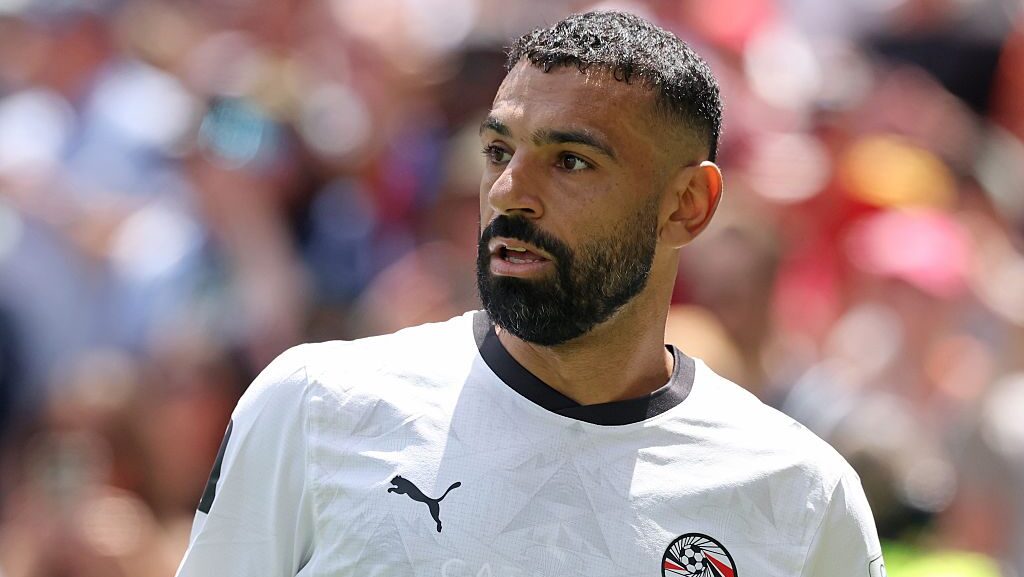
Having progressed from the group stage at the second consecutive World Cup, Australia face Egypt in Dallas tomorrow in the Round of 32. Egypt qualified in second from a nailbiting Group G and their team is headlined by two stars in Manchester City’s Omar Marmoush and Liverpool legend Mohamed Salah. But what should we expect from Egypt – and how can Australia win?
How do Egypt play?
Egypt’s style of play does not really fit neatly into any category. They are not a team that seeks to dominate teams through weight of possession, nor are they a counter-attacking team that aims to absorb pressure and catch teams on the break. Rather, setting up in a 4-2-3-1, their attacking threat revolves around maximising the strengths of their two aforementioned stars: Salah and Marmoush.
Salah, playing notionally as the 10 behind the striker, largely takes up positions on the right-side of Egypt’s attack, drifting between the half-space and wider areas. He is dangerous from both, and while probably lacking the brilliant speed which characterised his earlier years at Liverpool, he is an elite chance creator when cutting onto his left-foot. His ability to fire quick passes into central areas has proved a threat – as seen in Eman Ashour’s early goal against Belgium – as has his ability to play balls centrally and follow up the pass with a dangerous off-ball run, something which created his own goal against New Zealand. Whenever isolated 1v1, be it in half-spaces or from a run into the right-channel, Salah is dangerous and able to make things happen. Australia need to avoid these situations. He is also a talented set-piece taker, and Australia need to be wary defending corners taken by Salah.
Manchester City attacker Omar Marmoush poses a different threat. Marmoush has played both as a centre-forward and as a wide attacker, and is capable of causing problems from either position. Marmoush’s biggest asset is his ability to receive in tight spaces, immediately turn forward and attack defenders before either shooting or creating chances for teammates. Marmoush is Egypt’s most dangerous dribbler (he’s completed 8 dribbles at the World Cup, no other Egyptian has completed more than 4), and his capacity to drive at defenders from central areas is troubling for opponents, as his ability to shoot powerfully from around the box.
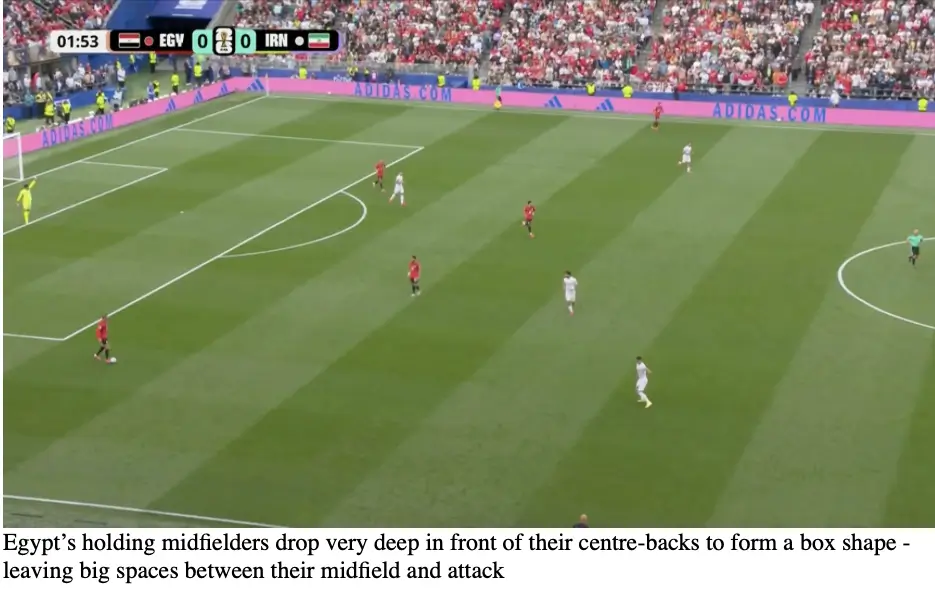
These two stars form the focal point of Egypt’s play, and Egypt’s system aims to bring them into play. Though, as referenced earlier, Egypt line up in a 4-2-3-1, this often becomes a 4-2-4 in possession, with Egypt’s holding midfielders dropping very deep to form almost a box shape with the centre-backs and Egypt’s fullbacks often moving quite high up the pitch. In attack, Egypt form something of the front four (or at times a front three), and the aim is often to find passes into these attackers who then seek to find flicks and combine in tight spaces to create problems centrally. Pyramids attacker, Mostafa Ziko, who has started two of Egypt’s games as their centre-forward, is essential to this strategy, often dropping deep to link play and coming into wider areas to combine. This mode of attack has been successful on occasion, in particular leading to Egypt’s goal against Iran.
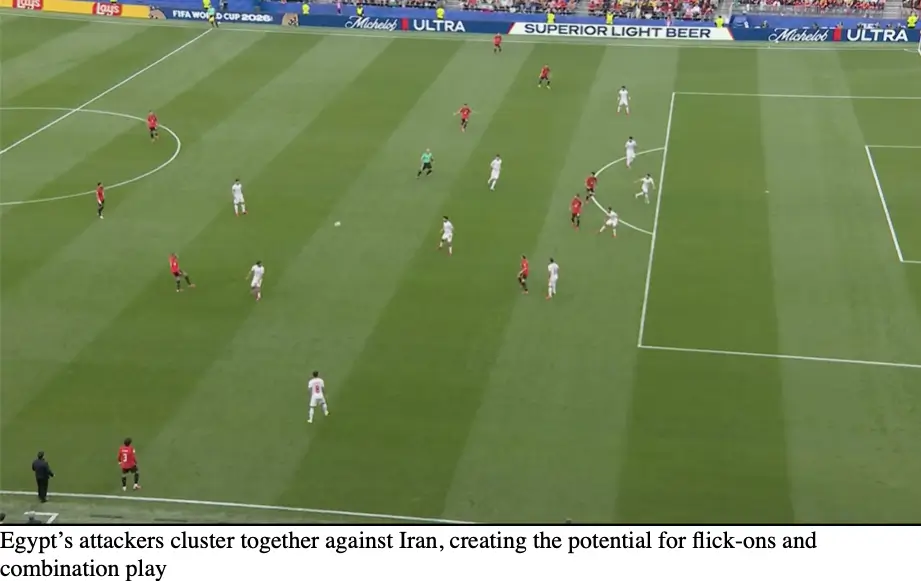
Generally, however, Egypt have struggled to create clear chances from buildup play, despite averaging 54.3% possession across their three group games. Their passing has often been errant and the significant distances between their deeper midfielders and their star attackers has often created a disconnect that Egypt have struggled to bridge. Though their holding midfielders often seek to play balls in behind for their attackers to run onto, few of these have been successful, with distance often seeming to be a problem. Against Iran in particular, they looked more comfortable attacking in transition than following long passages of buildup, and despite having 61% possession in that game, they created very few chances of note.
Out of possession, Egypt defend either in a 4-4-2 or a 5-3-2, with one of their wingers at times becoming a wing-back when defending. They rarely press high or even press at all, generally remaining in a mid or a low block. Salah, who generally presses on the right side of the front two, is something of a defensive weakness.
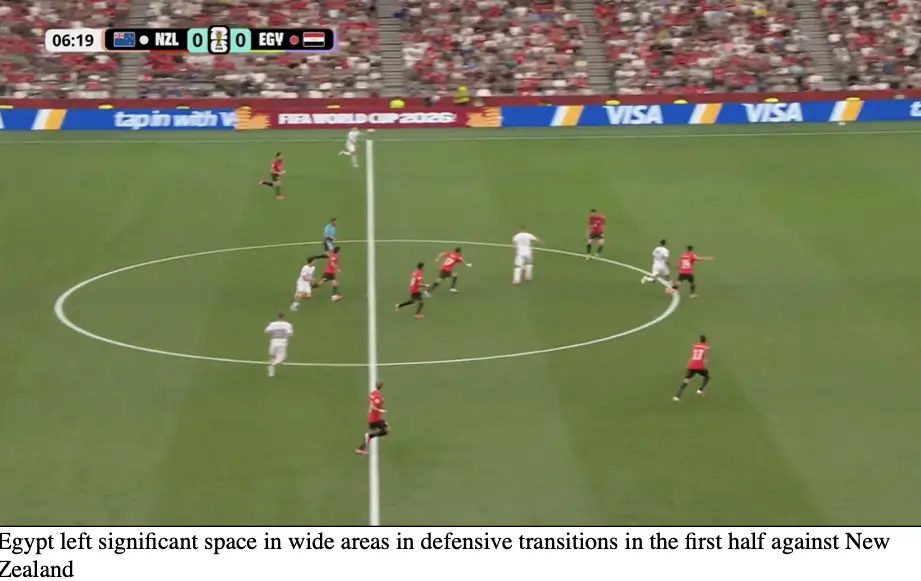
His workrate off the ball often lacks effort consequently allowing opportunities for ball progression down the left-side. Australia can exploit this, with three of their most progressive players in Jordan Bos, Lucas Herrington and Paul Okon-Engstler potentially lining up together on the left-side against Egypt. In defensivetransition, Egypt are also at times vulnerable. While their centre-midfielders of Mohanad Lasheen, Mahmoud Saber and Marwan Attia do well to cover ground, the high positioning of fullbacks Mohamed Hany and Ahmed Fatouh often leaves exploitable spaces in wide areas that Australia’s wing-backs could well target.
How will Egypt line up?
As referenced, Egypt line up in a 4-2-3-1 under Hossam Hassan. However, they come into the Round of 32 with several players suspended or under injury clouds. Key midfielder Mohanad Lasheen, who played every minute of the group stage and who has been one of Egypt’s best players, is suspended, while Nice centre-back Mohamed Abdelmonem and left-back Ahmed Fatouh come into the game with injury issues, with Fatouh in particular likely unavailable. Most notably, Mohamed Salah was taken off the pitch against Iran with a hamstring complaint, though he returned to training on Tuesday. That said, this is how they seem likely to line up:
Shobeir; Hany, Rabia, Ibrahim, Hafez; Attia, Saber; Ashour, Salah, Marmoush; Ziko
What are Egypt’s weaknesses, and how can Australia win?
There are several areas which I believe Australia can successfully exploit. The first is the height disparity between the two teams. If Egypt line up as above, their tallest player will be centre-back Rami Rabia, who is 186cm. Australia, in contrast, have four taller likely outfield starters: Lucas Herrington, Harry Souttar, Alessandro Circati, Cristian Volpato – with Paul Okon-Engstler and Mohamed Touré also 186cm and Tete Yengi and Jackson Irvine both in excess of 190cm.
Set-pieces are an area which should be a strength for Australia, yet through the World Cup so far, Australia’s delivery has been disappointing. If the delivery can improve – Australia can be a real threat from set-pieces against Egypt, who conceded a very soft Finn Surman goal from a corner against New Zealand. Likewise, Egypt struggled significantly against Iran when defending crosses from open-play. Almost every cross that Iran delivered threatened Egypt’s defence, with Iran having a late goal disallowed from a free-kick just after hitting the cross from a header. Australia have been a cross-heavy team at times throughout the tournament, to little effect, but this is an area to exploit.
Moreover, Australia can just generally use their size advantage to control the game through second balls, with centre-backs Rami Rabia and Yasser Ibrahim uncomfortable in aerial duels (Rabia has only won 42% of aerial duels at the World Cup; Ibrahim has only won 25%). Australia, with the exception of the first half against the USA, have been very effective at controlling possession from second balls, and this is an area in which Egypt struggle.
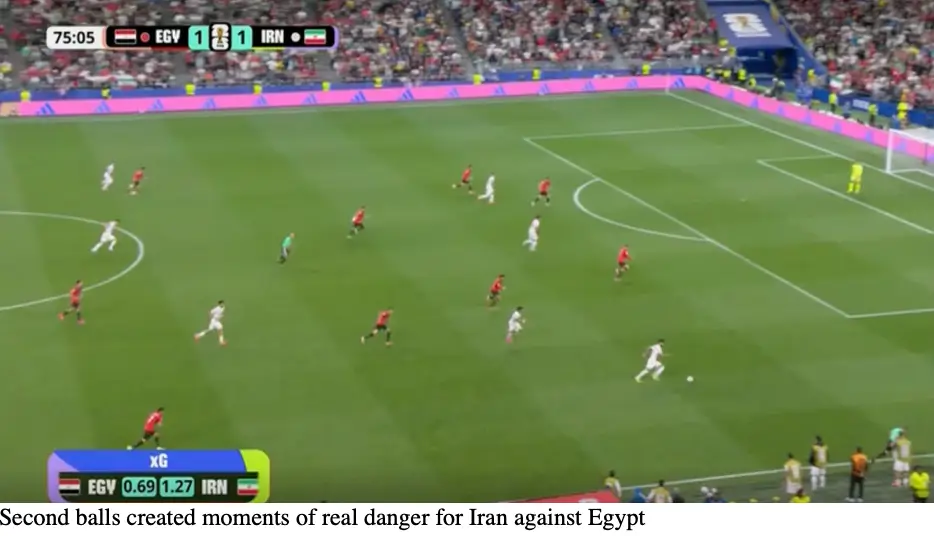
Another area for Australia to exploit is Egypt’s defence of transition moments and runs in behind. As discussed earlier, the high positioning of Egypt’s fullbacks often leaves them vulnerable in wide areas to transitions. Australia have speed in wide areas through Jordan Bos and Nestor Irankunda, and just as Australia scored their opener down the right side against Turkey, there is potential for Irankunda to attack in behind right-back Mohamed Hany, who likes to get forward. Similarly, New Zealand were able to cause Egypt trouble, particularly in the first half, through consecutive forward runs from the likes of Marko Stamenić and Elijah Just, who ran off each other and found space in behind. If Jackson Irvine starts, his ability to make forward runs could trouble Egypt, particularly if players like Jordan Bos, Nestor Irankunda and Connor Metcalfe run off him.
A further weakness is their on-ball ability when pressed. Both of Egypt’s likely starting centre-backs, Rami Rabia and Yasser Ibrahim, as well as both of their likely starting holding midfielders, are not only right-footed but rarely use their left. Under pressure, they are prone to giveaways, and just generally, their right-footedness is a limiting factor on their ability to play out of trouble. Again, Irankunda can pose a threat here with his speed while pressing.
All in all, Australia should again be confident heading into this game. While Egypt have two players of huge quality in Mohamed Salah and Omar Marmoush, if Australia can limit their influence while exerting their physical dominance, the Socceroos have a real chance of a trip to Atlanta for a second consecutive World Cup Round of 16 appearance.