
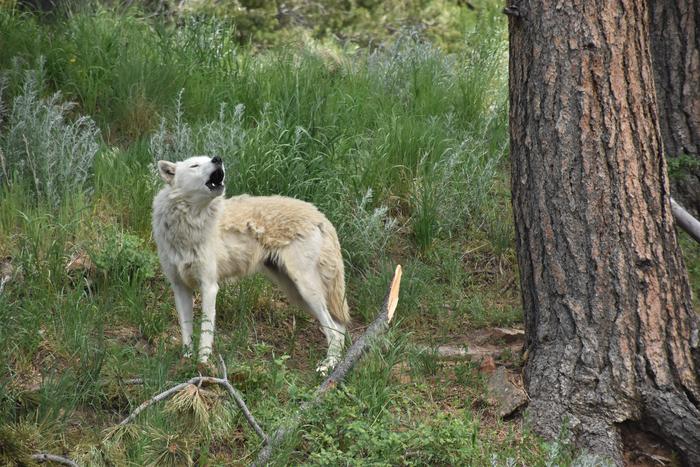
 A gray wolf (Canis lupus) at Mission:Wolf Sanctuary in southern Colorado. Gray wolves remain endangered in most of the continental United States, especially the Mexican wolf subspecies (Canis lupus baileyi) which suffers from genetic bottlenecking.
Credit
Jenny Thompson
A research team at the University of Illinois Urbana-Champaign is urging the scientific community to reform how it uses genetic technologies for wildlife conservation
In two new publications, researchers from the Centre for Indigenous Science (CIS) argue that modern conservation genomics must move away from top-down academic and corporate approaches, instead centring Indigenous communities, ecological knowledge, and data sovereignty.
The collaborative initiatives, published in the journals Conservation Biology and Ethnobiology Letters, address the ethical deficits surrounding nonhuman biobanking and high-profile corporate “de-extinction” projects.
The double standard in genomic ethics
In the Conservation Biology paper, researchers highlight a stark double standard within the scientific community: while rigorous ethical guidelines, consent protocols, and data sovereignty frameworks have been established for human genome research involving Indigenous populations, no equivalent protections exist for nonhuman genomic data.
This regulatory gap is highly evident in the expansion of biobanking—the systematic collection and cryogenic storage of biological samples and genomic data from diverse organisms to facilitate future ecological restoration. As high-throughput sequencing technologies accelerate, societal and ethical consensus on data ownership has lagged behind.
The researchers recommend extending human genomic research safeguards to nonhuman biobanking by establishing two core pillars:
Indigenous data sovereignty:
Access and benefit sharing:
Ensuring that local communities actively direct how these genomic assets are utilised.
Indigenous groups possess deep generational knowledge regarding species of critical cultural and ecological importance. Centring this perspective has already proven vital in major restoration efforts, such as protecting the Great Barrier Reef and reviving bison populations in the United States. The authors urge scientists to view organisms not as isolated data points, but as parts of a deeply interconnected, relational ecosystem.
Critique of corporate “de-extinction” and CRISPR projects
The second paper, published in Ethnobiology Letters, examines the ecological and ethical realities of genetic resurrection. The authors analyse a project by biotechnology firm Colossal Biosciences, which utilised CRISPR gene-editing technology to engineer a gray wolf offspring displaying traits of the extinct dire wolf.
While the project captured global headlines, the CIS research team argues it prioritised public relations over genuine ecological utility. Making targeted genetic edits to an animal creates a creature with extinct physical traits, but it fails to account for the wider ecological reality:
It does not address the historical role the extinct species played in its ecosystem.
It offers no framework for how such animals could realistically survive in modern, altered wilderness environments.
The focus on high-glamour, extinct predators distracts resources from urgent, grounded conservation work needed for critically endangered living species, such as the red wolf or the genetically bottlenecked Mexican gray wolf.
A holistic framework for future conservation
The CIS researchers emphasise that as biotechnology companies accelerate de-extinction and biobanking initiatives, the living animals caught up in these experiments and the Indigenous communities who have managed these ecosystems for millennia are the ones most impacted.
To ensure future genomic tools support the environment holistically, the team outlines three mandatory criteria for ethical conservation genomics:
Holistic Ecosystem Tracking: Evaluating species based on their active, relational roles within a broader environmental system rather than treating them as isolated biological novelties.
Prioritising the Living: Shifting primary funding and technical focus away from sensationalised de-extinction projects and toward preserving currently endangered species facing imminent extinction.
Centring Indigenous Leadership: Moving past superficial consultation and entering true, organic collaborations that respect Indigenous data rights and place local land stewards at the front of environmental decision-making.