
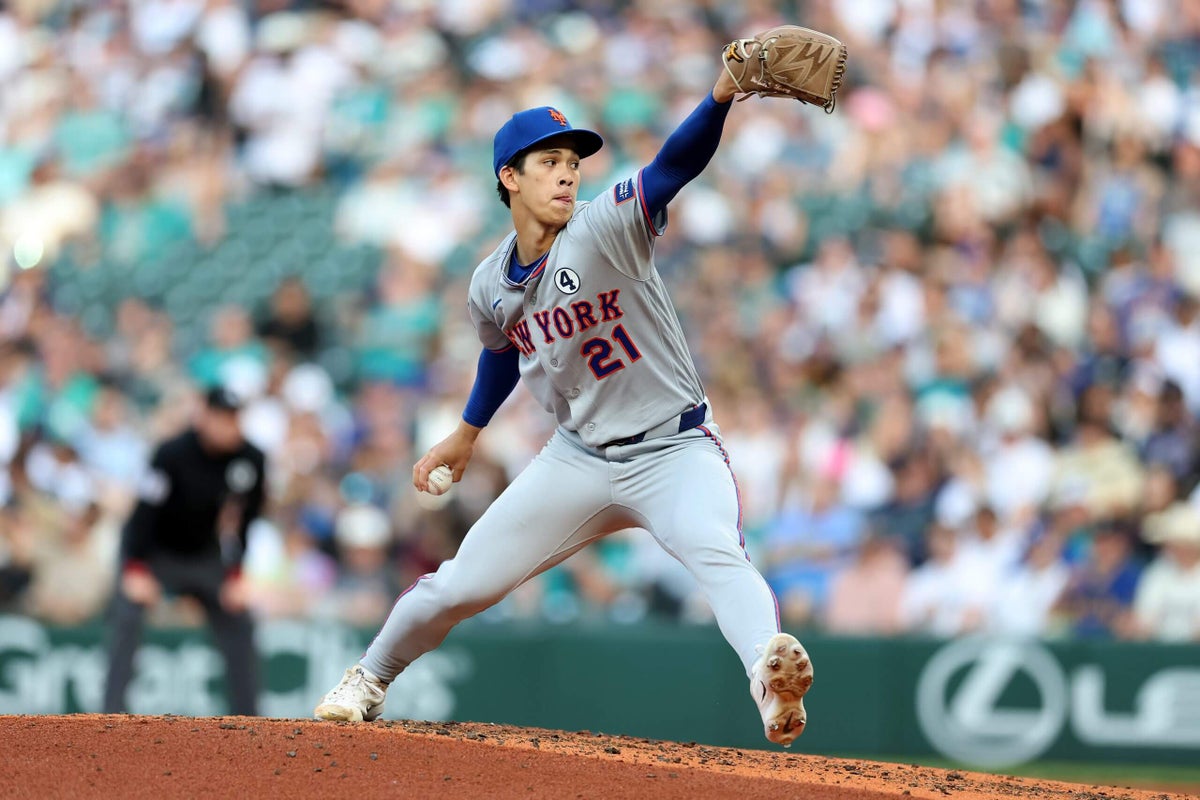
While the New York Mets have yet to settle on a direction one month ahead of the trade deadline, they understand the realities of their position: 15 games under .500, 14th in the National League and 10 games out of the postseason.
It will take a remarkable and perhaps historic July to prevent the Mets from selling by Aug. 3.
Through recent conversations with people familiar with the Mets’ plans — each person received anonymity in exchange for candor because they were not authorized to speak freely — The Athletic gleaned a broad outline of New York’s priorities for the deadline.
In the likely event the Mets do end up selling, expect them to target the best minor-league prospects they can land — regardless of position or proximity to the major leagues. This may sound obvious, but it’s not unusual at the deadline for teams to prioritize, say, pitchers over bats, near-ready players over ones that fit a longer-term timeline.
The Mets would aim to accumulate as much talent as possible without caring as much about fit.
That said, New York is not contemplating any kind of rebuild or even the kind of retrenchment they embraced the last time they sold in 2023. While not ruling out anything at this point, the Mets will require very strong returns to move any players with team control beyond 2026.
This pitcher leads the league in baseball’s new flawed swing metric
Derek VanRiper and Eno Sarris
Further, the Mets would be open to adding major-league talent at the deadline, though not in the type of “need-for-need” trades they explored last offseason (such as the deal that sent Brandon Nimmo to the Rangers for Marcus Semien). If a major-leaguer with additional team control who fits a longer-term need is available at the deadline, the Mets would look into it regardless of their chances of contending in 2026.
A big part of compiling prospects at this deadline would be to better position the farm system for trades for major-league talent this winter. The upcoming free-agent class is generally considered subpar by the industry, and the probability of a lockout could make it more difficult than usual to add impact talent through free agency.
Currently, New York’s farm system is not as highly ranked as it was a year ago. Part of that is the graduation of Carson Benge and A.J. Ewing to the major leagues this season. Another part is regression among several well-regarded prospects.
Within the first month of the season, the Mets felt it necessary to examine why so many of their pitchers battled command issues and why some of their position players struggled to hit with power consistently.
Pitchers Jonah Tong and Jack Wenninger, along with first baseman/outfielder Ryan Clifford, are the most notable players who have languished in Triple A.
The lack of attractive pitching options in Triple A acutely hurt the major-league club as the Mets’ rotation thinned out because of injuries and poor performance. Tong and Wenninger were both with the big-league team during spring training. When the Mets needed them most last month, neither pitcher was in a position to provide sustainable help.
Ahead of the season and in an effort to enhance his capabilities as a starter, the Mets added to Tong’s arsenal, giving him an east-to-west offering. The initial results, however, are not good; Tong has particularly struggled with pitch sequencing. His 13.3 percent walk rate in Triple A is higher than any of his percentages at any level since 2023.
The Mets wanted Tong to make changes for his long-term development, but they failed to make things stick in the relatively short term so he could be counted on to help the major-league team.
Wenninger has also regressed, with his walk rate rising from 7.6 percent last year in Double A to 13 percent this year in Triple A. As someone who relies on spin, Wenninger has struggled to adapt to the different ball that is used from one level to the next.
Unlike Tong, Wenninger did not appear in top-100 lists ahead of the season. Tong earned such accolades for the first time in his professional career. Neither player was considered a can’t-miss blue-chipper coming out of their respective draft years. Still, these were the pitchers the Mets felt good about as their depth. The Mets’ player development staff helped them become good prospects ahead of the season, but then things stalled with neither player maintaining their value. New York needs improvement in this area.
It’s not all bad this year for the Mets’ farm system. But a lot of their positives are occurring at the lower levels. In Low A, Elian Peña is holding his own offensively as an 18-year-old, with his defensive range grading out at a level that makes some within the Mets believe he can stick as a middle infielder. Similarly, Mitch Voit, the Mets’ first-round pick last year, is showing in High-A Brooklyn that he could handle shortstop.
The Mets did not experience significant turnover from last year’s player development staff, which received a lot of attention for improving players. Their process has not changed significantly, which, in theory, means their ability to make players better still exists. The general underperformance through the first half of the season, however, was enough for owner Steve Cohen to tell the New York Post that he is “extremely worried” about his club’s future.
Obviously, the present is no less foreboding. On June 1, we speculated that the Mets would need to win 26 of their next 47 games and get to at least 52-54 the week before the deadline to seriously contemplate buying. New York is 10-18 over that stretch, with no indication a 16-3 run is in the cards. They are on track to become classic sellers in a market lacking them. Enhancing their pipeline in a major way is a necessity.