
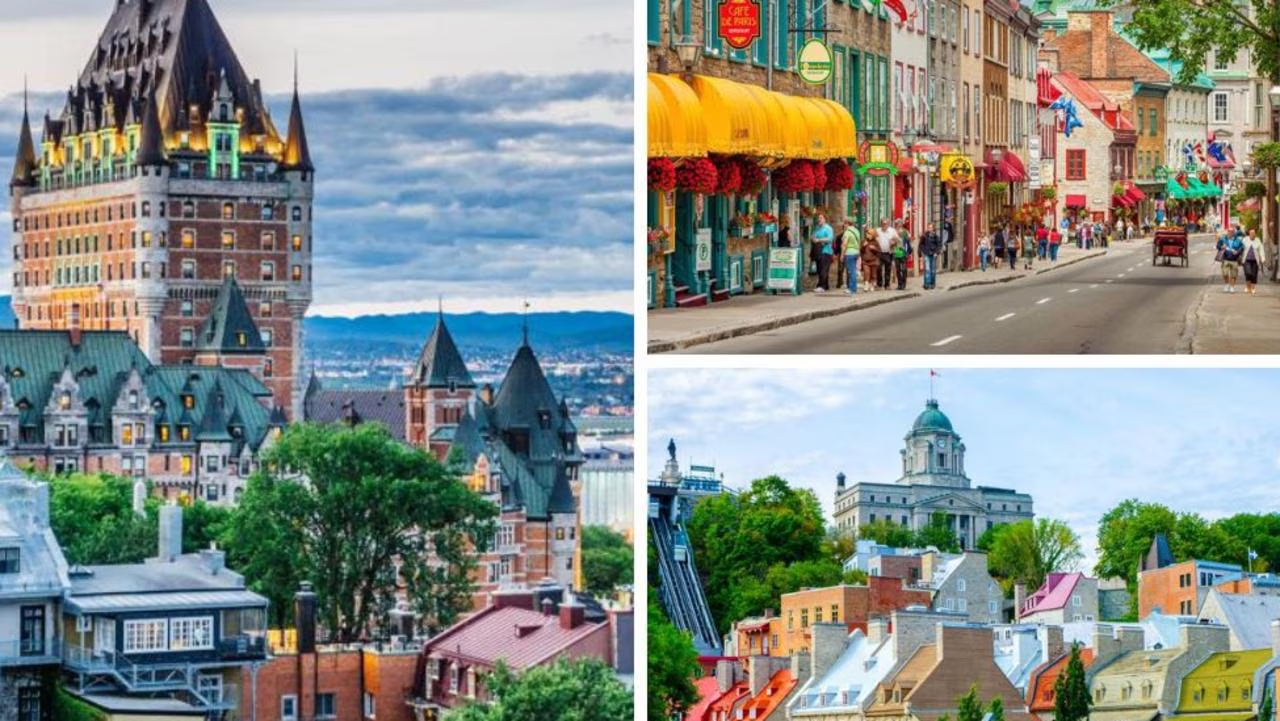
In almost every way, Quebec City doesn’t look or feel like somewhere that should exist in North America.
Charming stone buildings with colourful shutters glow in the afternoon sun. Flower boxes spill from centuries-old balconies perched above quaint, cobblestone streets. Cafe terraces buzz with conversation, while the fairytale turrets of Château Frontenac rise above it all. There’s not a skyscraper in sight. It feels less like North America than a corner of provincial France somehow transplanted across the Atlantic.
For most Australian travellers, it’s easy to forget you’re in Canada at all.
Unlike Paris, where English has become commonplace in tourist hotspots, it’s entirely possible to spend hours wandering Old Quebec hearing almost nothing but French.
It is a reminder that while France has changed with the centuries, Quebec has preserved something older — a North American city whose identity has remained unapologetically French for more than 400 years.
Designated a UNESCO World Heritage Site, the fortified historic district is one of the oldest European settlements in North America and the only walled city north of Mexico. Yet despite its historical significance, it never feels like an open-air museum.
The city is neatly divided into two walkable precincts — the bustling Upper Town (Haute-Ville) and the postcard-worthy Lower Town (Basse-Ville) — connected by a funicular known as the Funiculaire du Vieux-Quebec.
And in summer, it hums.
Rue Saint-Jean buzzes from morning until well after dark. Cafe terraces spill onto the pavements. Artists sketch portraits in the shade while musicians perform in squares where horse-drawn carriages clip-clop past families licking maple soft serve.
Around almost every corner is another picture-perfect scene.
The impossibly pretty Rue du Petit-Champlain, often described as North America’s oldest commercial street, bursts with hanging flower baskets and colourful boutiques. Stone staircases wind towards the Upper Town, where the iconic Château Frontenac rises dramatically above the St Lawrence River like something lifted from a fairytale.
From the wooden boardwalk along Dufferin Terrace, ferries glide across the river while street performers draw applause against one of Canada’s most spectacular backdrops.
The city somehow manages to feel grand and intimate at the same time.
Unlike many European destinations overwhelmed by tourism, Quebec City still invites wandering without a checklist.
The best moments often come by accident — turning into a tiny laneway lined with ivy-covered stone walls, discovering a tiny wine bar tucked beneath a 300-year-old building or lingering over lunch while the afternoon quietly slips away.
Summer is when the city truly comes alive.
The long Canadian winter gives way to outdoor festivals, concerts and markets. Locals reclaim the streets with an infectious enthusiasm, filling restaurant terraces well into the evening as daylight stretches towards 9pm.
There is a distinctly European rhythm to life here.
Meals are unhurried. Wine flows freely. Nobody seems in a rush to be anywhere else.
For visitors, that pace quickly becomes contagious.
One of the best places to appreciate the city’s extraordinary setting is from Hôtel Le Capitole.
Overlooking Place D’Youville on the edge of Old Quebec, the boutique hotel offers arguably one of the finest perspectives in the city. Floor-to-ceiling windows frame rooftops, church spires and centuries-old fortifications stretching across the historic centre, particularly magical as golden hour bathes the stone buildings in warm light.
The location is equally impressive.
Within minutes, guests can walk through the old city gates and lose themselves among the cobbled streets without ever needing a taxi. By evening, many of Quebec City’s finest restaurants, cocktail bars and cafes are just a short stroll away before returning to watch the city lights flicker across the skyline from the comfort of the hotel.
It’s the kind of view that encourages lingering.
The city seems to unfold differently every time you look out.
Perhaps that’s what makes Quebec City so memorable.
It’s not simply that it resembles France. In many ways, it feels like a version of France that has been frozen in time while still embracing the energy of a modern city.
The language, architecture, food and culture combine to create an atmosphere unlike anywhere else in North America.
By the time you leave, you’ll understand why so many travellers describe Quebec City as one of Canada’s most beautiful destinations.
And why, for a few glorious summer days, it can feel as though you’ve escaped to another world.
This writer was a guest of Le Capitole Hotel.