
Most Aussies who haven’t opened Netflix or swiped in at the gym lately have felt the sting of that automatic renewal hitting their bank account.
For Mark Redman, a $299 annual membership sparked a nightmare — and an awkward conversation at the dinner table with his wife — when he was automatically upgraded to a $4999 “lifetime package”.
That’s an eye-watering increase of nearly 1600 per cent.

“I was in tears trying to explain it to my wife, that this guy is chasing me for money,” the Melbourne-based public servant told news.com.au.
“She knew that I had signed up to a thing … $300 over a year she’s not overly concerned about, but suddenly having to find $5000 — obviously to me it’s quite a bit of money.”
Mr Redman, 42, had forked out $299 for what he thought was a 12-month subscription to sports tipping website Sporting God last May.
But almost immediately, the punter began receiving emails trying to “upsell” him to the “lifetime package”, which “will cost upwards of $50,000 moving forward!” and was a “once-in-a-life-time opportunity”.
“I am going to pass on the lifetime deal,” he wrote back on May 28.
In September, five months into his subscription, Sporting God claimed he would need to “renew” his plan as it was “increasing all prices to reflect the true value of our services!”
“I am just unsure why I would need to renew now when the package I have just purchased is for 12 months,” he wrote back.
Sporting God states in its terms of service that “annual subscriptions renew 12 months after the date you subscribe”.
Mr Redman did not give the situation much more thought until this May, when he received a shock letter of demand “saying that my subscription had expired and payment of $4999 was due”.
“I went back and said, ‘I have not agreed to this, I haven’t seen a renewal notice, can you show me where I agreed to any of this?’” he said.
That sparked a series of increasingly hostile emails culminating in threats of legal action and debt collection.
Sporting God claimed Mr Redman had “been sent in excess of 50 renewal and account-related emails” and that “in May 2025 you were specifically advised that the 12-month package alone would be moving to $4999 going forward, which was acknowledged by you”.
“You have since been sent countless renewal reminders and have opened all of them and have not responded or stated you wished to cancel,” Sporting God wrote on May 26.
“You have instead continued accessing paid content.”
Mr Redman denies ever consenting to the renewal.
He stressed “I do not believe I am in the wrong” but said he was prepared to pay the advertised price of $900 for Sporting God to go away and “cancel all communications”.
Sporting God warned “our legal team has gone over this very clearly and you definitely are liable for that amount” but offered a “goodwill gesture”.
“Can you pay $2499 today to ensure no further account escalation?” the tipster begged.
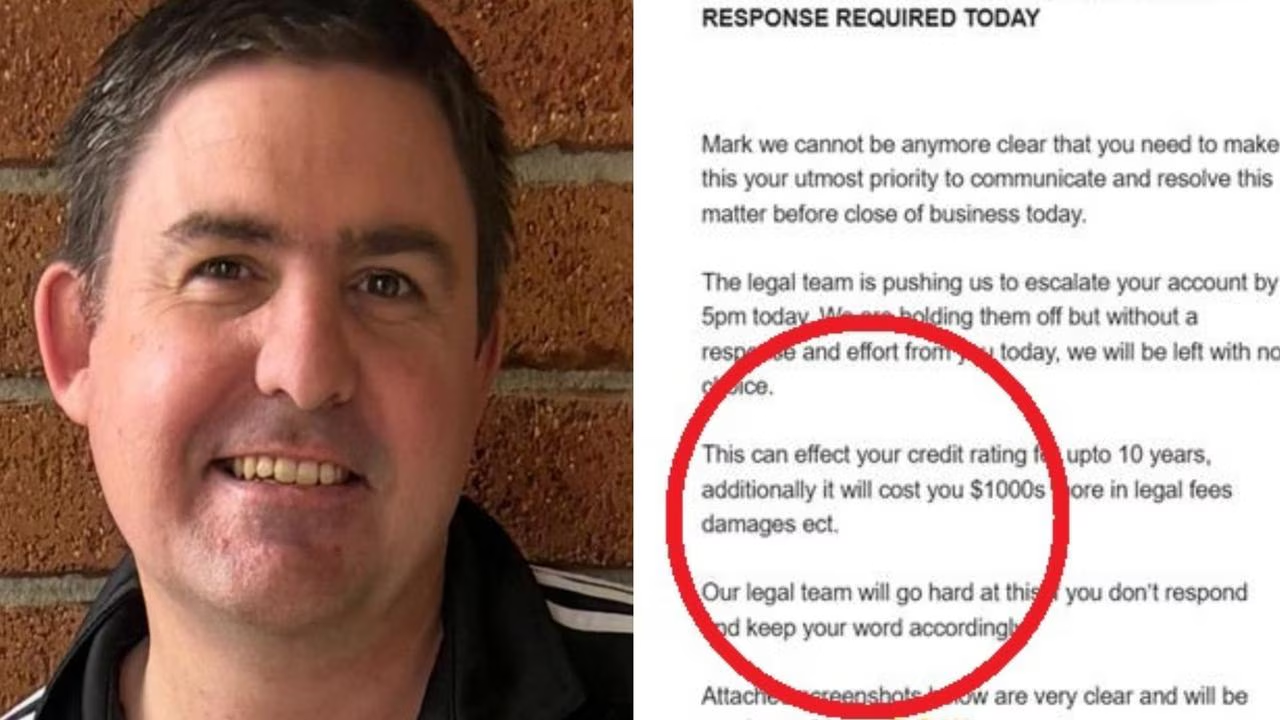
Mr Redman forked out the $900 hoping to end the matter, but on May 29, Sporting God wrote ominously, “Mark we cannot be anymore clear that you need to make this your utmost priority to communicate and resolve this matter before close of business today.
“The legal team is pushing us to escalate your account by 5pm today. We are holding them off but without a response and effort from you today, we will be left with no choice.
“This can effect your credit rating for up to 10 years, additionally it will cost you [thousands] more in legal fees, damages, etc.
“Our legal team will go hard at this if you don’t respond and keep your word accordingly.”
At that point, Mr Redman cut off contact and submitted a complaint with the consumer watchdog.
Under Australian Consumer Law (ACL), consumers are not required to pay for products or services that they didn’t ask for.
“Unsolicited supply” is when a consumer or business “receives products or services they didn’t request” or a business “claims to have supplied services that a consumer or business didn’t receive or request”.
“It’s against the law for businesses to issue a bill or invoice that states an amount to be paid for unsolicited items unless … the business reasonably believes they have a right to be paid,” the Australian Competition and Consumer Commission (ACCC) states.
Consumer advocate Adam Glezer from Consumer Champion, who is representing Mr Redman, said it appeared “Sporting God is trying to strongarm Mark into paying $5000 for a program or an upgrade that he never purchased”.
“You can’t use pressure tactics to get money off someone that they never agreed to,” Mr Glezer said. “Hounding somebody like this is unconscionable.”
Mr Glezer said he wanted to “expose this behaviour so [Sporting God] can’t do this to anybody else going forward and importantly to act as a warning to anyone considering these bully tactics”.
He added that the tipster’s legal threats appeared dubious at best.
“I called [Sporting God] out on the lawyer ‘threat’ and asked to be put in contact with their lawyer but that was obviously disregarded,” he said.
“I honestly don’t believe [Sporting God] has a lawyer, I believe they are empty threats, however if they keep this up for much longer there’s every chance they’ll need one.”
Sporting God, which grew out of a popular NBA tipping Facebook page called NBA God, offers punters “premium sports tips that have been extensively analysed by our experts using a range of data and statistics” on NBA, AFL, NRL, NFL and tennis matches.
Sporting God did not respond to requests for comment.
A spokesman for the ACCC said the watchdog “does not generally comment on specific examples or individual reports, as per our Media Code of Conduct”.
“All businesses must comply with the Australian Consumer Law (ACL), including when offering subscriptions or memberships,” he said in a statement.
“Under the ACL, businesses must not make engage in misleading or deceptive conduct, or make false or misleading representations to consumers, in either the sign-up, renewal or cancellation stages.
“Businesses are also prohibited from using unfair terms in standard form subscription or membership contracts.
“Businesses should provide clear and accurate information to consumers upfront about the memberships or subscriptions they are offering, including any automatic renewal of a contract, the initial and ongoing costs of the contract, and the consumers’ ability to cancel the contract.
“Businesses must also not request payment for a subscription service that a consumer has not requested or agreed to, unless they reasonably believe there is a right to payment.
“Whether conduct is misleading or otherwise breaches the ACL will depend on the specific circumstances of each matter.”
More than three-quarters of Aussies pay for at least one subscription service, spending an average of $136 per month — $1637 per year — according to ING, which estimates the total annual subscription bill at $26.5 billion.
Polling by comparison site Compare the Market last month found half of Australians were paying for an unused subscription, costing hundreds of dollars per year.
According to Finder research from 2023, two-thirds of Aussies have at least one subscription set to auto-renew, even though more than half said they had been slapped with an unexpectedly high bill.