
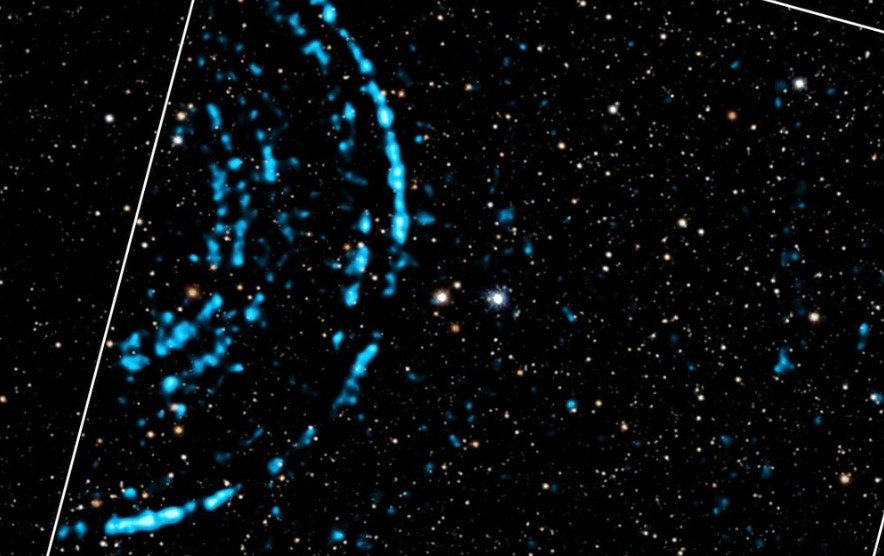
Data from NASA’s Chandra X-ray Observatory suggests that the outer spiral arms of the Milky Way may extend further than thought. NASA announced on 1st July that the findings, released in Astronomy & Astrophysics, could lead scientists to adjust how they picture our galaxy’s structure.
Researchers determined the distances to the dust clouds in the Milky Way’s spiral arms by combining data from Chandra with observations from XMM-Newton, a European Space Agency mission with NASA collaboration.
The distance measurements were derived from studying the light echoes produced by gamma-ray bursts. These bursts are among the brightest events in the universe and originate from dramatic processes such as the collapse of massive stars or the collision of neutron stars. The bursts lie far beyond the Milky Way, making them useful for this analysis.
Light echoes occur when the burst light reflects off dust clouds in the galaxy’s arms. In X-ray images, the rings formed by these echoes provide a geometric means to gauge distance. Bigger rings indicate dust clouds that are closer to Earth.
“This is a very direct way – relying only on geometry – to precisely measure distances to the Milky Way’s spiral arms. Most other methods rely on assumptions about how the Milky Way rotates, which become increasingly uncertain in the outer regions of our galaxy,” said Beatrice Vaia, the lead researcher.
The study also notes that dust and gas can obscure views of other arms, which complicates measurements.
Three gamma-ray bursts were used to estimate distances to three spiral arms. When arranged by distance from the Galactic Center, these are the Perseus arm, followed by the Outer arm, and then the Outer Scutum-Centaurus arm. Along one sight line, the results show that both the Outer arm and the Outer Scutum-Centaurus arm are about 10% farther away than previously estimated.
“Even small differences matter because they influence our understanding of the galaxy,” added co-author Ilaria Fornasiero, who previously worked closely with the lead author. “For example, this could lead scientists to revise estimates of the Milky Way’s mass, since that relates to how broadly the arms extend.”
“We’re relying on the universe to provide us with these events, and so far, over 25 years, we’ve only found a handful that we can use,” said co-author Andrea Tiengo of Scuola Universitaria Superiore IUSS Pavia. “That said, we will continue to be on the lookout for more.”
 Published by James Hydzik
James Hydzik is a technology geek focused on the junction of engineering, writing, and coffee. He joined Orbital Today in 2020 to help make sense of the Johnson government’s decision to buy OneWeb. Since then, he has taken on interviewing and editor-in-chief roles. James learned the ropes of editing and writing with Financial Times magazines, The World Bank, PwC, and Ericsson. Thus far, interviewing New Space movers has put the biggest smile on his workaday face. The son of an Electrical Engineer, James understands the value of putting complex topics into clear language for those with a lay person’s understanding of the subject. James is a European transplant from the United States, and as ex-KA3LLL, he now holds European amateur radio licenses. His next radio project is a portable 10GHz EME (moonbounce) station, as it combines his childhood interests in antennas and space.