
After a couple of weeks of frenzied activity, the NHL offseason is beginning to simmer down.
The New York Rangers were among the most active teams, particularly July 1 as the league flipped the calendar to a new season and free agents were eligible to sign with new clubs. Now the dust has settled, the 2026-27 depth chart we first examined in April needs some serious updating.
How do all the pieces fit? We’ll go position by position to discuss, but I’m envisioning at least six new additions in the opening-night roster. I also examined the depth beyond those who are likely to begin in the NHL lineup, which should provide a good idea of who’s on deck with AHL Hartford, as well as fresh salary-cap calculations.
My math leaves the Rangers with roughly $7 million in available cap space. That’s leaving one spot for restricted free-agent defenseman Braden Schneider, who filed for arbitration Sunday, but there are paths to creating a little more room if needed. I’ll detail some of the variables below.
By executing eight trades, five free-agent signings and nine draft picks in the last two weeks, team president and general manager Chris Drury has raised the floor for a team that finished last in the Eastern Conference in 2025-26, but New York’s ceiling remains ambiguous.
Coach Mike Sullivan will be tasked with finding ways to maximize this evolving roster. The Rangers have the makings of a playoff team if things fall into place, but there is much to be decided between now and Game 1 in late September. Let’s analyze with lineup projection 2.0, then come back with a third and final attempt in the fall.
Forwards
Left wingCenterRight wing
Pavel Dorofeyev**
Mika Zibanejad
Alexis Lafrenière
Gabe Perreault
J.T. Miller
Oliver Bjorkstrand**
Will Cuylle
Noah Laba
Taylor Raddysh
Tye Kartye
Joe Veleno**
Jaroslav Chmelař
Depth options: LW Nathan Aspinall*, C Cole Beaudoin***, LW Anton Blidh, C Justin Dowling, C Glenn Gawdin**, C Juuso Pärssinen, C Dylan Roobroeck*, RW Liam Greentree*, RW Brody Lamb*, RW Matt Rempe, LW Adam Sýkora*
Out: LW Brett Berard, LW Brendan Brisson, C/RW Jonny Brodzinski, LW Adam Edström, LW/RW Conor Sheary, C Vincent Trocheck
*rookie status in 2026-27
**new addition
***both
Analysis: I’ve heard we shouldn’t rule out the Rangers adding another forward this summer. Drury hinted at that, as well. But if the Rangers stand pat, it will be fascinating to see how Sullivan arranges the top-six group above.
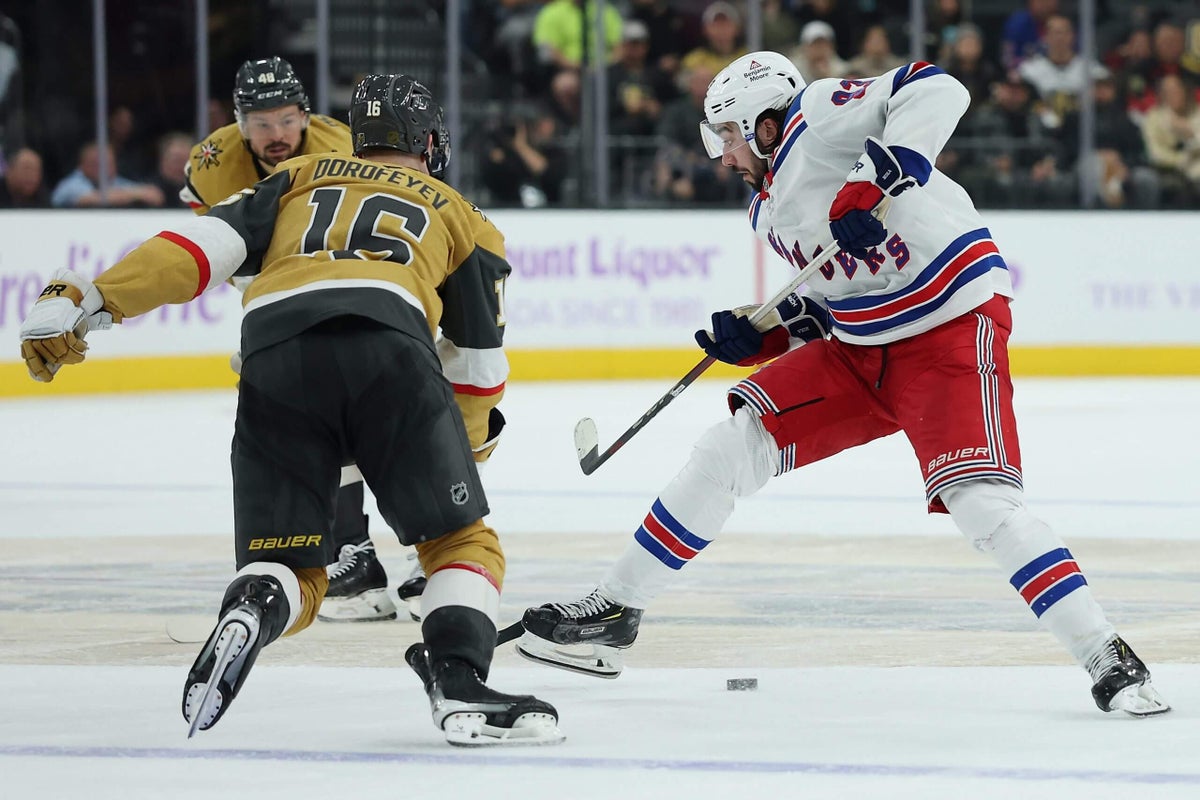
The big question revolves around where he wants to slot Pavel Dorofeyev. He’s the new goal-scoring centerpiece for a lineup that struggled to generate last season and should receive prominent placement, likely on the top line. But the Gabe Perreault-Mika Zibanejad-Alexis Lafrenière trio found encouraging chemistry in the final weeks of the season, fueling temptation to keep that unit intact.
I can see both sides, but getting Dorofeyev off to a strong start should be a high priority as he begins his seven-year, $77 million contract. And for the 25-year-old to maximize his elite finishing talent, he’ll need to play with linemates who can set him up with quality scoring chances.
Zibanejad remains New York’s No. 1 center and best offensive asset at that position, so that feels like a fairly obvious match. There’s a case for Perreault to play on the opposite wing since he has the highest upside as a facilitator, but I went with Lafrenière here because it feels like he unlocked a new level late last season, with a team-high 28 points (14 goals and 14 assists) in his final 27 games. He’s also primarily played right wing the last few years, so this scenario would allow him to continue down that path.
Believe it or not, Perreault had a slightly higher expected goals-for rate playing alongside J.T. Miller (55.02 percent, according to Natural Stat Trick) than Zibanejad (52.36 percent). It’s not a perfect solution because Sullivan tends to give Miller the toughest matchup assignments, which would be a lot to ask of the 21-year-old Perreault. The Rangers might have to shift those responsibilities to the third and fourth lines, mainly because their top-six wingers don’t have sterling defensive reputations.
Miller is the de facto 2C now that Trocheck has been traded to Utah, which the captain has stated as his preference after bouncing back and forth last season. Now the 33-year-old is pretty much locked in there, with unproven depth behind him.
Oliver Bjorkstrand stands out as the weakest link in the top six and a position the Rangers will eventually need to upgrade, but he’s a fine placeholder considering his manageable contract (one year, $4.5 million) and right-handed shot to balance out an otherwise lefty-heavy group. It will be easy to slide him into the bottom six if a better 2RW option is brought in.
Importantly, Bjorkstrand’s signing should allow Will Cuylle to slide back into a comfortable role. The 24-year-old is a strong third-liner, as he showed in 2024-25, but his impact diminished when he was asked to move up last season.
Noah Laba will return to the 3C spot where he showed some promise last season, at least until Cole Beaudoin proves ready to challenge for that role. (Which could eventually make Laba a very solid 4C, with Joe Veleno keeping the seat warm until then.) But who plays on his right side will likely be determined by camp competition.
Essentially, three of the four bottom-six winger jobs are up for grabs among five players: Jaroslav Chmelař, Tye Kartye, Taylor Raddysh, Matt Rempe and Adam Sýkora. Chmelař and Kartye seemed to separate from the pack late last season, but I wouldn’t write anything in ink quite yet.
Raddysh is a natural right wing among a collection of mostly lefties, which is why I penciled him in as 3RW. But after he was a healthy scratch in eight of New York’s final nine games, I wouldn’t be surprised if the 28-year-old is bumped from the lineup in favor of a younger player. I could envision Kartye or Chmelař moving up to the third line, which would open a spot for Rempe or Sýkora on the fourth.
Waiver status is another factor. Kartye, Raddysh and Rempe would all have to clear to be assigned to the AHL, whereas Chmelař and Sýkora can pass freely. The Rangers will want to keep an extra center around — likely Justin Dowling, Glenn Gawdin or Juuso Pärssinen — which would mean at least one of those wingers has to be sent down.
My projection of $7 million in available cap space accounts for Chmelař, Kartye, Raddysh, Rempe and Dowling making the cut while the rest head to Hartford, but the Rangers could push that number closer to $8 million if they decide to carry 22 players (including 13 forwards) instead of the maximum of 23.
Defensemen
Left defenseRight defense
Vladislav Gavrikov
Adam Fox
Marcus Pettersson
Sean Durzi
Matthew Robertson
Braden Schneider
Depth options: LD Dennis Cholowski**, LD Marc Del Gaizo**, LD Jackson Dorrington*, LD Drew Fortescue*, RD Vincent Iorio, RD Scott Morrow, LD Alberts Šmits***, LD William Trudeau**, LD Urho Vaakanainen
Out: RD Will Borgen, RD Casey Fitzgerald, LD Connor Mackey, LD Brandon Scanlin
Analysis: There’s less debate to be had now that Marcus Pettersson and Sean Durzi have been acquired to form a brand-new second pair. The former is viewed as a defensively conscious player, with the Rangers banking on the 30-year-old returning to form under Sullivan’s familiar guidance after spending seven seasons together in Pittsburgh, and the latter is expected to complement Pettersson because of his mobility (86th percentile in max skating speed, according to NHL Edge) and puck-moving skills. They’ll be pivotal to New York’s success this season while allowing Vladislav Gavrikov and Adam Fox to remain together (58.49 percent xGF) and pushing Matthew Robertson and Schneider into more fitting bottom-pair roles.
Schneider’s future remains somewhat up in the air. The Rangers’ decision to trade Will Borgen to the Boston Bruins seemingly increases the 24-year-old’s chances of sticking around, but a trade still can’t be ruled out if it helps Drury land a top-nine forward. If that were to happen, it would create an opening for Vincent Iorio or Scott Morrow to push for ice time.
On the other side, Robertson should get the first crack at the 3LD job after finally completing his first full NHL season, but Alberts Šmits is looming. Drury stressed taking their time with the No. 5 pick from this year’s draft, saying, “This is not a sprint for him.” It’s probably wise to let the 18-year-old Latvian get his feet wet in the AHL, but the expectation is he’ll be knocking on the door in short order. Whenever that happens, Robertson will likely shift into the seventh defenseman role.
He’s among several lefties who could experiment playing on the right, particularly if Iorio and/or Morrow falter. The left side was the bigger need heading into the offseason, but New York drafted five LD and acquired four others. Barring another addition, Hartford will require at least one to play on their off-hand side.
I have Urho Vaakanainen penciled in as the 7D to start, which was his primary role last season, but that’s subject to change. His spot appears to be at risk, especially once Šmits is deemed ready. Waiving him would clear $1.225 million in cap space (although whomever they recall would eat up most of those savings).
Goalies
StarterBackup
Igor Shesterkin
Joonas Korpisalo
Depth options: Dylan Garand*, Spencer Martin, Callum Tung*
Out: Talyn Boyko, Hugo Ollas, Jonathan Quick
Analysis: No one on the roster is as safe or critical to the team’s success as Igor Shesterkin, but his backup has become a source of intrigue.
The Rangers made the somewhat curious decision to surrender a fourth-round pick and low-ranking forward prospect Kalle Väisänen in exchange for Joonas Korpisalo, who will register a $3 million cap hit for the next two seasons. I expected them to bring in competition for Dylan Garand, whom they’ve been reluctant to trust with No. 2 responsibilities, but I figured it would be for a cheaper veteran free agent who didn’t cost any assets to acquire. (Even if they were minor pieces.)
Clearly, they preferred Korpisalo over the UFA options, which leads me to believe he’ll enter camp with the upper hand. Drury has always favored veteran backups, be it Jonathan Quick or Jaroslav Halák before him. That’s not to say Garand can’t win the job — I’ve been told he very much can — but it’s looking like an uphill battle.
Spencer Martin stands as the No. 4 goalie and another veteran fallback, and Callum Tung is a developmental project who struggled mightily in 16 games for Hartford last season (7-8-1, .855 save percentage, 3.94 goals-against average).