
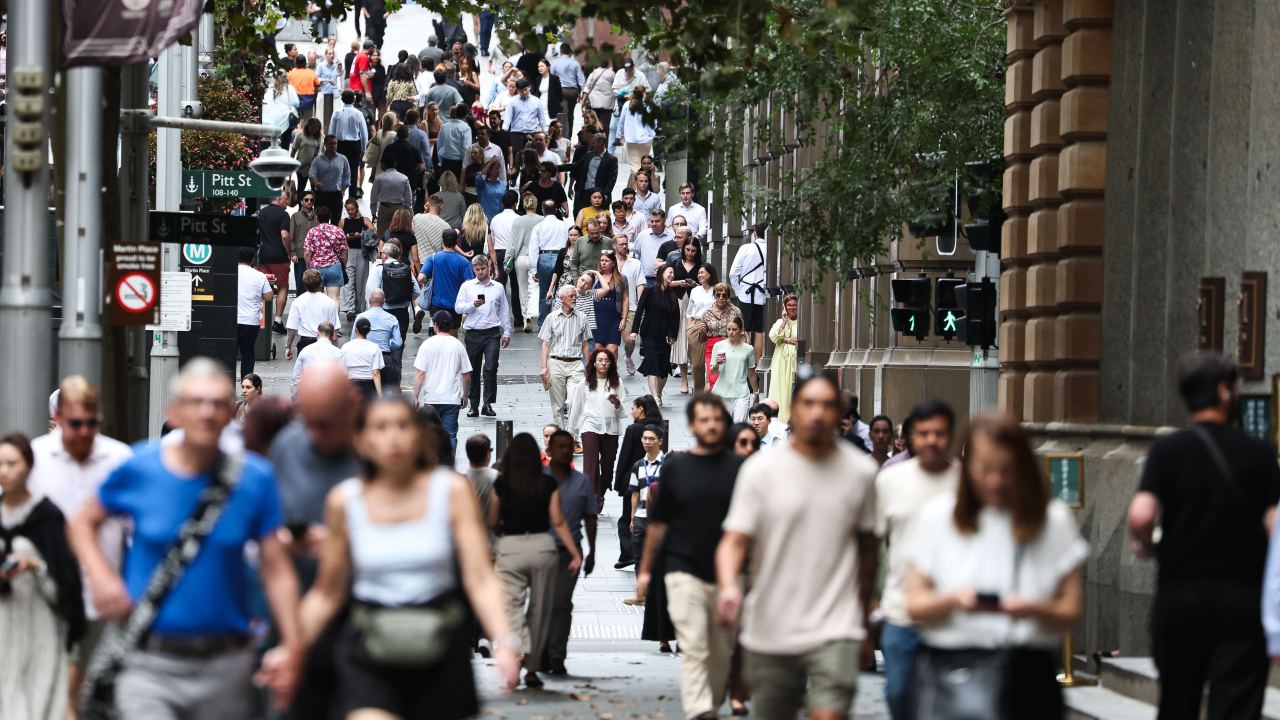
Australians have been delivered another warning the economy is declining as households and businesses battle rising inflation.
The International Monetary Fund has downgraded its 2026 growth forecast for Australia from two per cent to 1.9 per cent.
This ranks Australia’s growth 18th out of 30 major economies analysed by the IMF.
It follows Deloitte downgrading its own growth forecast and warning the nation could face the worst growth since the early 1990s recession and the Reserve Bank of Australia flagging further rate hikes if inflation continues to lift.
Treasurer Jim Chalmers brushed off the IMF downgrade and compared Australia’s economy to nations in the G7.
“These new IMF forecasts have Australia growing faster this year and next year than every major advanced economy except one,” Mr Chalmers in a statement on Wednesday.
Australia falls below major Asian economies including China and India, which are forecast to achieve 4.6 per cent and 6.4 per cent growth respectively.
Indonesia’s economy is forecast to lift five per cent, Pakistan’s is expected to rise 3.6 per cent and the IMF said Brazil’s GDP will grow 2.4 per cent.
The only nation out of the 30 which the IMF analysed forecasted to go backwards is Iran.
Australia’s economy grew just 0.3 per cent in the March quarter while the nation’s productivity dived.
Productivity, which measures Australia’s GDP against the number of hours worked, fell 0.6 per cent.
Improving Australia’s productivity is seen as crucial to tackling the rise of inflation while Australia’s GDP recovers from its post-pandemic slump.
Failing to tackle inflation, which was four per cent in the year to May, could force the RBA to deliver at least one more interest rate hike this year.
RBA chief economist Sarah Hunter said the central bank can “look through” temporary shocks, such as the recent oil price rise, but the cash rate could be undermined by persistent and more complex effects on global supply chains.
“If the shock is expected to be more persistent, it is likely to have larger impacts and create greater risks of inflation expectations shifting. And policy may come into play while the shock is still influencing inflation. In this world, it may not be right for monetary policy to ‘look through’,” she said.
“If some persistent inflationary pressure is expected, monetary policy may need to be tightened. But by how much depends on all the factors I have discussed so far and the trade-offs they create.
“The board will continue to act as needed to ensure inflation returns to target and the labour market to sustainable full employment.”
Meanwhile, Deloitte Access Economics downgraded its outlook for the Australian economy in its latest forecast amid higher inflation, interest rate rises and the oil shock.
It now expects the economy to grow 2.2 per cent in the 2026 financial year, 1.3 per cent in FY27 and 1.9 per cent in FY28.
This is down on previous forecasts of 2.4 per cent, 1.9 per cent and two per cent respectively.
Deloitte Access Economics partner Stephen Smith said the economy was expected to “limp along” at the longest stretch of sub-two per cent growth since the early-1990s recession.
“Australia’s growth outlook has deteriorated over the past six months,” Mr Smith said in a statement.
“The economy is still expanding, but growth has slowed and the outlook has become more fragile.
“Inflation has reaccelerated, interest rates have moved higher, and the oil price shock triggered by conflict in the Middle East is not yet fully resolved.”
Australians have also struggled with the three rate rises the RBA has delivered since the beginning of 2026.
This brought the cash rate back to 4.35 per cent and wiped out the rate cuts handed down in 2025.