
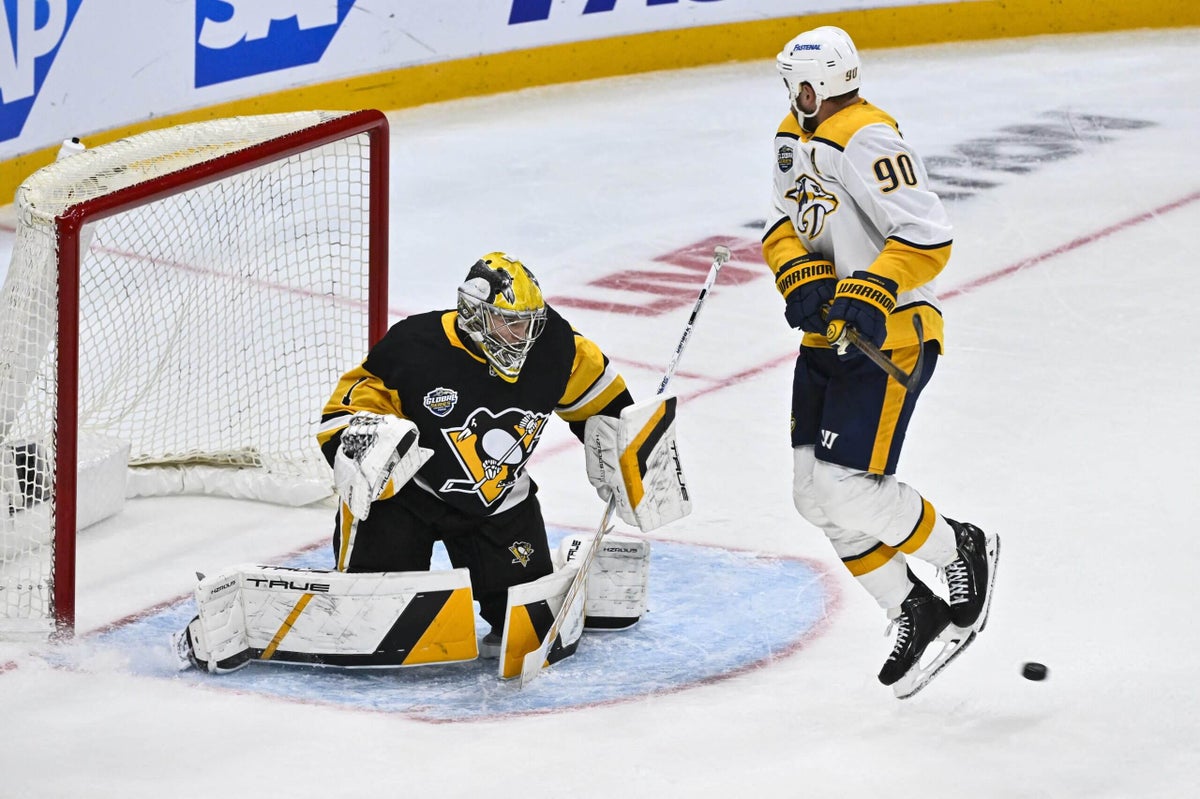
The Pittsburgh Penguins look a little different now than they did a few months ago, though most of the primary characters remain.
Is that a good thing? Can they reach the postseason again? Are young players being left out in the cold?
These are all legitimate questions without right or wrong answers. But let’s break it all down.
Much could change between now and puck drop on Sept. 29, of course, but here’s a look at the Penguins’ potential lineup as we begin to drift into the dark days of the hockey offseason.
Current best guess: Forwards
Left wingCenterRight wing
Rickard Rakell
Sidney Crosby
Bryan Rust
Egor Chinakhov
Tommy Novak
Evgeni Malkin
Andrei Kuzmenko
Ben Kindel
Nick Robertson
Connor Dewar
Blake Lizotte
Elmer Söderblom
The good
• Though Crosby, Rust and Rakell weren’t as effective as usual when playing together last season, they still managed to produce their typical numbers. The trio works as a legitimate top line, so long as regression doesn’t hit significantly.
• That second line was dynamite last season.
• It’s difficult to say how the third line would work because these players have never skated together. Still, there’s a lot of offensive punch there.
• We know Lizotte and Dewar are very good together. Söderblom was a pleasant surprise almost immediately after being acquired from the Detroit Red Wings. His size is real. His upside might be, too.
• This is a very deep forward unit that appears capable of replacing Anthony Mantha’s offense.
The bad
• When the average age of your top line is 35, you’re asking for trouble.
• Novak is a fringe top-six player.
• It might be a lot to ask Malkin, who gets hurt a lot, to perform at last season’s level.
• Chinakhov needs to prove he wasn’t a flash in the pan.
• Kuzmenko and Robertson are not good defensive players, which isn’t ideal for third-line wingers.
• Who is going to kill penalties? Lizotte and Dewar, for sure. Kindel looks qualified. Rust does, too, but you don’t want him expending all of his energy there. Who else? Not a lot of PK depth.
Odd man out
Justin Brazeau? It seems silly not to have him listed on the top four lines, but where does he fit? Söderblom played at a higher level last season. Brazeau, you’ll recall, was a healthy scratch for the first time all season in the playoffs against the Flyers. The Penguins’ top six appears pretty well set. They didn’t acquire Robertson and Kuzmenko to have them sit in the press box, nor did they give Lizotte and Dewar new contracts for that purpose.
The ugly
I believe the players listed above, along with Brazeau, are the top 13 forwards on the Penguins’ depth chart. Not mentioned, of course, are Rutger McGroarty and Avery Hayes, two of the team’s better prospects.
McGroarty, perhaps because of health issues in September, started last season slowly and never looked like the player the Penguins hoped to see. Still, he’s only 22 and brings plenty to the table. Is starting him in AHL Wilkes-Barre next season really for the best?
Hayes, whose ceiling might not be that high, has the look of a bottom-six pest who can score in the NHL. How exactly do McGroarty and Hayes make this team as currently constructed? And what about 24-year-old Hendrix Lapierre?
Going with the 12 best forwards is any coach’s job, yes, but aren’t the Penguins supposed to be getting younger? Wasn’t Dan Muse brought here to work with young NHL players?
Current best guess: Defensemen
Left defenseRight defense
Trevor van Riemsdyk
Erik Karlsson
Sam Girard
Kris Letang
Declan Carlile
Kaedan Korczak
The good
• So long as Muse has unlocked prime Karlsson, he’ll be a joy to watch and will make the Penguins better.
• Carlile may well have been president/GM Kyle Dubas’ best free-agency pickup, and along with Korczak, could give the Penguins a very young, dependable pairing.
• Girard was playing hurt last season and may have more to offer now that he’s had a full summer to adjust to the Penguins’ system.
• Van Riemsdyk is a dependable player.
The bad
• While they showed flashes in the last few games of the postseason, Letang and Girard generally were not good together.
• Van Riemsdyk shouldn’t be receiving top-pairing minutes. He’s 34 and will be asked to play on his off side.
• Letang should no longer receive substantial minutes but probably will again.
• Their arguably two best penalty-killing defensemen, Ryan Shea and Parker Wotherspoon, are gone.
Odd men out
The Penguins don’t want Ryan Graves in the lineup, which is understandable. Caleb Jones showed flashes early last season and appears to be a fairly strong bet to be the No. 7 defenseman if the Penguins enter the season healthy. Prospect Owen Pickering shouldn’t be forgotten and seemed to make some strides last season despite playing hurt. But there’s also little indication that the current front office has grandiose plans for him.
The ugly
Ugly might be harsh, but prospect Harrison Brunicke is the most important defenseman to the organization’s future. No, it’s not the end of the world if he starts next season in Wilkes-Barre. He’s only 20 and has played just 34 AHL games in his young career. Some more seasoning at that level isn’t necessarily the wrong move, though he looked a little too good for the AHL during most of Wilkes-Barre’s playoff run this spring.
Current best guess: Goaltenders
Goaltender
Sergei Murashov
Artūrs Šilovs
The good
• The Penguins have handled Murashov, 22, perfectly. He appears ready for prime time. His athleticism and overall talent are difficult to ignore.
• Šilovs is only 25 and has room to grow.
The bad
• That’s an awfully inexperienced goaltending duo. Going with youth is the right call, but it could lead to some short-term issues.
• The Penguins love to split goaltenders’ playing time 50-50, but in a non-Olympic schedule, does that make for too much downtime for developing goalies?
Odd man out
Joel Blomqvist was nearly as good as Murashov in Wilkes-Barre last season and is a legitimate NHL prospect. The net appears to be his in Wilkes-Barre this season, which is fine, but he’ll be wanting his NHL chance sooner than later.
The ugly
Šilovs … shootouts … I don’t need to get more specific.
The bottom line
In general, Dubas has done a good job of securing young pieces such as Chinakhov, Kindel, Söderblom, Robertson and Šilovs. That’s real progress. However, as things stand, the 2026-27 Penguins lineup feels a little disjointed.
Four players in the top six are 33 or older, which is a major red flag for a rebuilding team. Another player in the top six — Novak — turns 30 next spring and is rather ordinary. The left side of the blue line looks problematic, and the right side looks too old. Not enough defensemen are strong defenders, which is obviously a genuine concern.
The Penguins could compete for a playoff spot again next season with this roster, but only if Murashov proves to be an upgrade. Maybe he will be, but it’s a lot to ask of a rookie.
This roster feels overcrowded in some departments and missing a piece or two in others. The Penguins will be leaning heavily on the very old and the very young. Another transaction or two before the season could make this roster more sensible.