
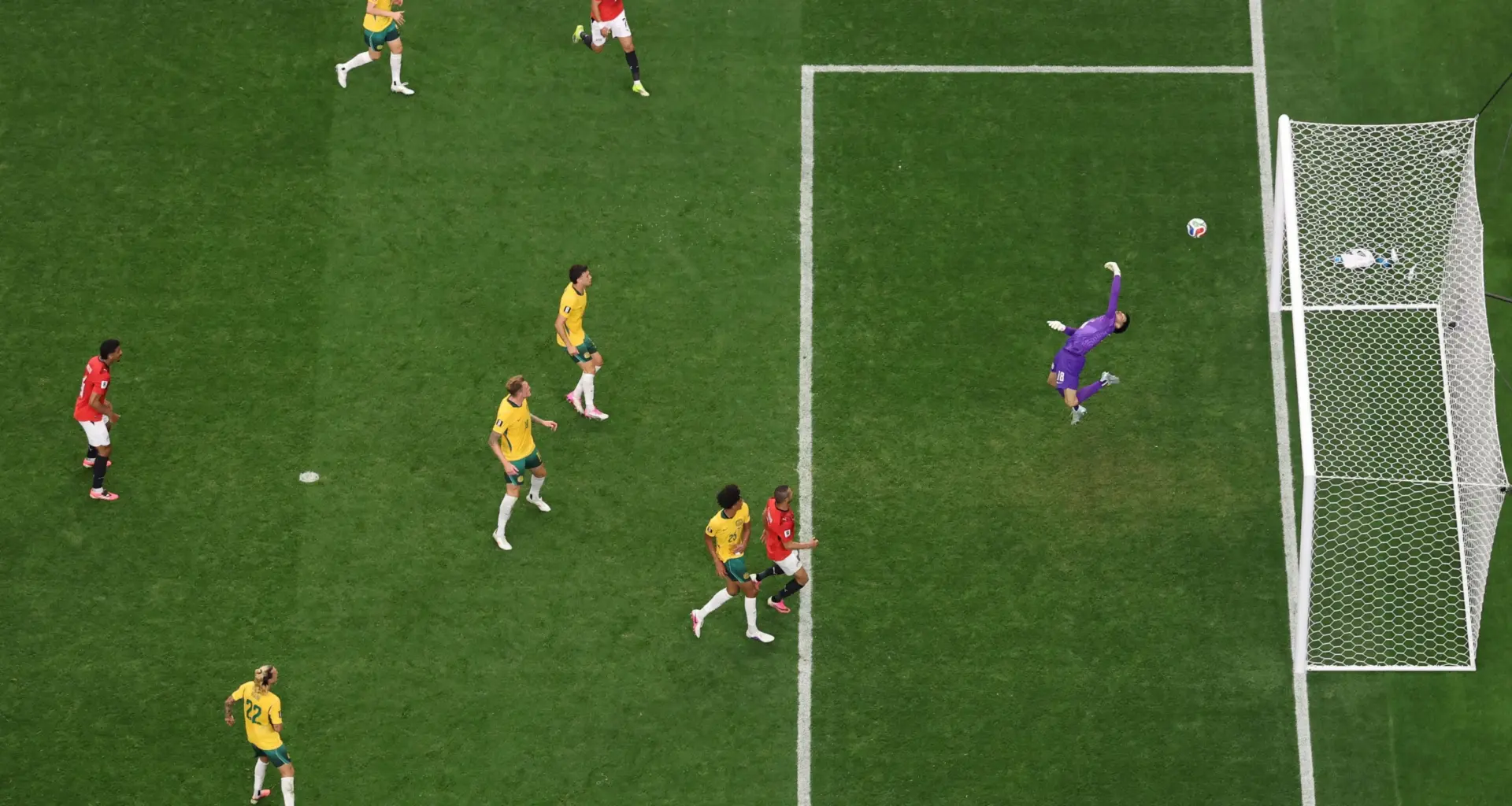
Maybe it’s just who we are, mate.
My nonna used to say, “The Brazilians are so good because all their men grow up dancing.”
It’s a sweeping generalisation from another era, but it contains a deeper truth worth considering.
A fascinating, hyper-specific cultural debate has ignited across social media platforms blending sociology, theology, and Brazil’s absolute obsession with football.
Following recent poor performances by the Seleção, a viral, half-serious/half-conspiracy theory has gained traction. The premise: Brazil’s historic drop in footballing dominance directly correlates with the country’s massive demographic shift from Catholicism to Evangelical Pentecostalism.
While some of the discourse is undeniably “tongue-in-cheek” internet banter, it has evolved into a serious debate regarding how changing religious cultures affect national identity, player psychology, performance, playing style and dressing room dynamics.
To understand Australian football, we first have to understand ourselves as a society and truly assess who we are and what we value. Football is a microcosm of life and our approach should not come as a massive shock.
Australia is, by nature, a realistic and pragmatic country. Some outliers have challenged this, but generally we value practicality over ideology, caution over boldness and certainty over experimentation. We are not generally flamboyant, overly open or audacious. We lean towards proven systems, measurable outcomes and reducing risk wherever possible. We like to have a go – within safe parameters. Those traits have helped build a stable, secure nation but they also have a downside.
They can create conformity and discourage innovation and they can make us uncomfortable with ambitious ideas before they have been validated by success.
There is evidence of that instinct well beyond football. Australian public life has often favoured incremental change over radical reform. We generally trust proven systems, value stability and remain sceptical of ambitious ideas until they have demonstrated success elsewhere. Fence-sitting could be a national sport.
Whether in politics, business or elite sport, we tend to minimise downside before maximising upside. Football does not exist outside that culture, it develops inside it – albeit as an outsider. It would be surprising if our national teams reflected anything different.
The Socceroos’ Round of 32 exit to Egypt should force a much deeper question:
Who are we trying to become as a football nation?
That question has been asked repeatedly over the past two decades – especially in the raw, reactionary moments following a World Cup exit – yet it remains unanswered.
Former Socceroo Mark Milligan put it plainly after the defeat.
“When are we as a nation and federation going to decide who we are? When we qualify, is that just always going to be enough? What do we want moving forward?”
He continued:
“You look at the continuity that other countries are trying to build because you see a clear goal in them trying to achieve something… I want to know when we’re going to put something together to know there’s something beyond that feeling (of losing).”
The numbers from Australia’s World Cup campaign only reinforce the notion of a cautious approach. After scoring twice against Turkiye in the opening match, Australia failed to score another goal from open play for the remainder of the tournament. The attack became increasingly reliant on set pieces and isolated moments rather than sustained chance creation.
Even more concerning was the quality of the chances being produced. Australia finished with one of the lowest expected goals per shot (xG/shot) figures at the tournament, indicating that even when chances were created, they were generally from poor locations or under heavy defensive pressure.
Yet Australia’s defensive organisation remained largely intact throughout the tournament. That has led some to argue that opening up tactically would inevitably weaken the defence. Former Socceroo Tommy Oar challenged exactly that assumption.
“I think it’s a misconception that you lose this defensive stability when you have more attacking content because it’s actually the opposite. You spend less time in the match defending.”
His point cuts to the heart of the debate. Defending well and attacking proactively are not mutually exclusive.
Spain are proving his point. They currently rank first for average possession (68.2%), first for final-third passes, second for touches inside the opposition penalty area and among the leading teams for expected goals and shots on target.
At the same time they also rank first for expected goals against per 90 minutes (0.21), first for xG conceded per shot (0.04) and second for shots on target conceded. Dominating the ball is not the opposite of defending. It is often one of the most effective forms of defending.
Equally, none of this should diminish one of Australian football’s greatest strengths. Few nations consistently compete with the same commitment, resilience and collective sacrifice. The Socceroos have built a global reputation for courage, discipline and refusing to give in against stronger opponents. Australian teams rarely lose because they lack effort. Competing with heart has become one of our defining sporting traits.
The question is whether grit is the foundation of our football identity or the ceiling of our ambition.
As Oar also observed:
“It’s a shame we do have this habit of going back into your shell in those moments when we do have the ascendency.”
That pattern has become familiar. Australia often earns momentum, then retreats back to safety. The instinct under pressure is rarely to become bolder and more proactive, it is to become more careful. Perhaps that reflects something much bigger than football.
The Egypt defeat was a perfect illustration. There were periods where Australia looked capable of taking control of the contest, yet rather than building on that momentum, the game gradually drifted back onto Egypt’s terms.
MORE REACTION TO AUSTRALIA’S WORLD CUP EXIT
AUSSIE SCOUT: Australia’s 2030 squad is amazing, but current to-do list is clear
BIG PICTURE: The lesson World Cup minnows taught Australia. Will we finally get it right?
NESTORY IRANKUNDA: Watford reveal ‘fight’ after World Cup
TRANSFER TALK: Which Socceroos have put themselves in transfer shop window?
FOOTBALL AUS: CEO promises to seize World Cup momentum
MARK SCHWARZER: The ‘lingering question’ I have on a Popa decision I ‘don’t see the logic in’
FA RESPONDS: Answer to ex-Socceroos skipper’s emotional call for football identity
The line-up, substitutions, tactical adjustments and overall mindset will all be debated, but they point towards the same underlying question: when the opportunity presented itself, did Australia truly believe it was there to be won?
Safe football is highly effective until the moment arrives when you need to flick a switch if the game is there to be won. If your identity has become so conditioned towards protecting yourself from risk, that instinct can remain even when the circumstances demand the opposite. In trying not to lose control, you can end up surrendering more than your opponent ever earned.
Football often becomes a mirror of national culture because pressure strips away pretence. When the stakes are highest, teams usually revert to their deepest instincts.
If the next match determined a World Cup, promotion or relegation, how would your first instinct be to play?
That’s probably your true football identity.
Argentina answered that question after winning the last World Cup. They openly embraced La Nuestra – “our way”. Rather than forcing players into an imported identity, they built around the qualities that naturally emerged from Argentine culture. Spain have done something similar for generations. Their football has evolved, but the commitment to technical superiority, courage in possession and controlling matches has remained remarkably consistent regardless of the coach or generation.
Of course, Australia should not expect to become Spain overnight, nor should anyone pretend we possess Argentina’s technical depth, footballing history or “potreros” where kids play each other for cash. Those nations are not comparisons, they are benchmarks. They demonstrate what is possible when an entire football ecosystem commits to a clear identity over decades. Australia’s challenge is not to imitate Spain or Argentina, but to establish its own version of that clarity and commit to it relentlessly.
So, what is our way?
More importantly, what do we actually want it to be and does that reflect who we truly are and what we value?
Qualifying for tournaments and competing bravely are not philosophies – they’re outcomes. A philosophy determines how those outcomes are pursued.
Competing bravely should never be viewed as the destination, it should be the minimum expectation. Australia has earned enormous respect around the football world because of its resilience and fighting spirit. Those qualities should never disappear. But if they become the primary measure of success, then we risk celebrating honourable defeats rather than demanding continual progress.
This debate is not about demanding reckless football or abandoning defensive organisation, but about deciding whether Australia wants to become a nation that consistently influences matches or one that primarily reacts to them because those are very different ambitions.
Anyone involved in NPL or youth football recently has probably felt this tension. Outside the A-League academy system, and a small blip when the National Curriculum was in vogue (what happened to that, by the way?), coaches who prioritise brave, proactive football, long-term player development and technical refinement often find themselves under immediate pressure when short-term results fluctuate. Patience is limited and winning next weekend frequently outweighs developing anything for long-term success – and that’s with very little on the line apart from pride and memories due to a disconnected pyramid.
Former professional footballer and now “Suited & Booted” co-host Rashid Mahazi posted a series of reflective comments following the loss:
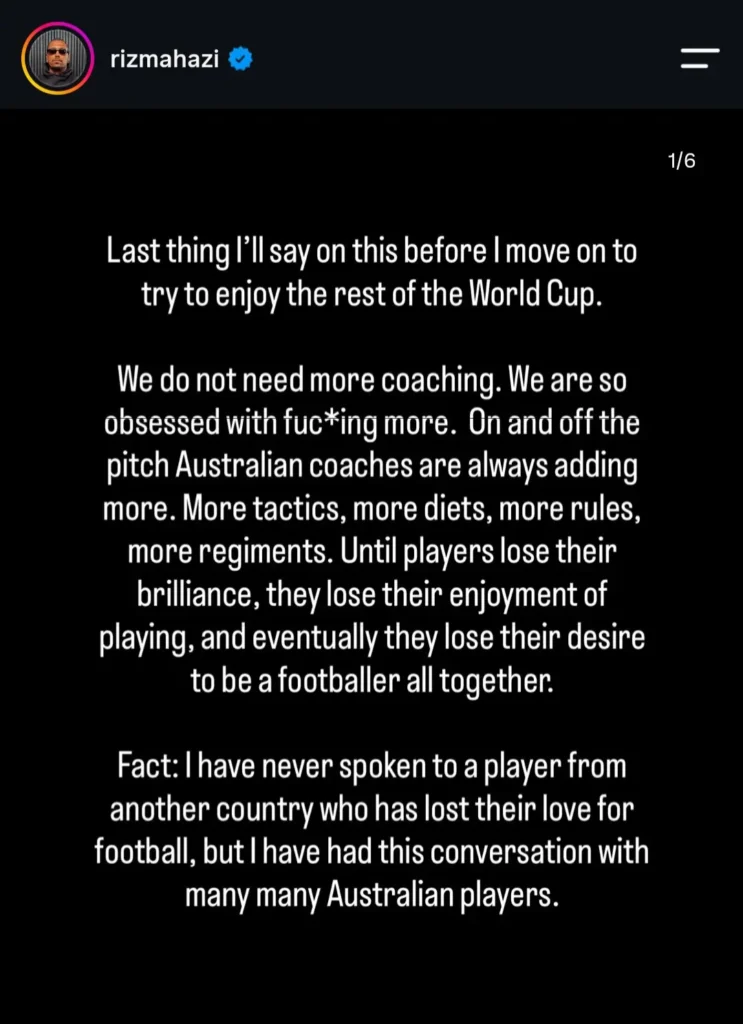
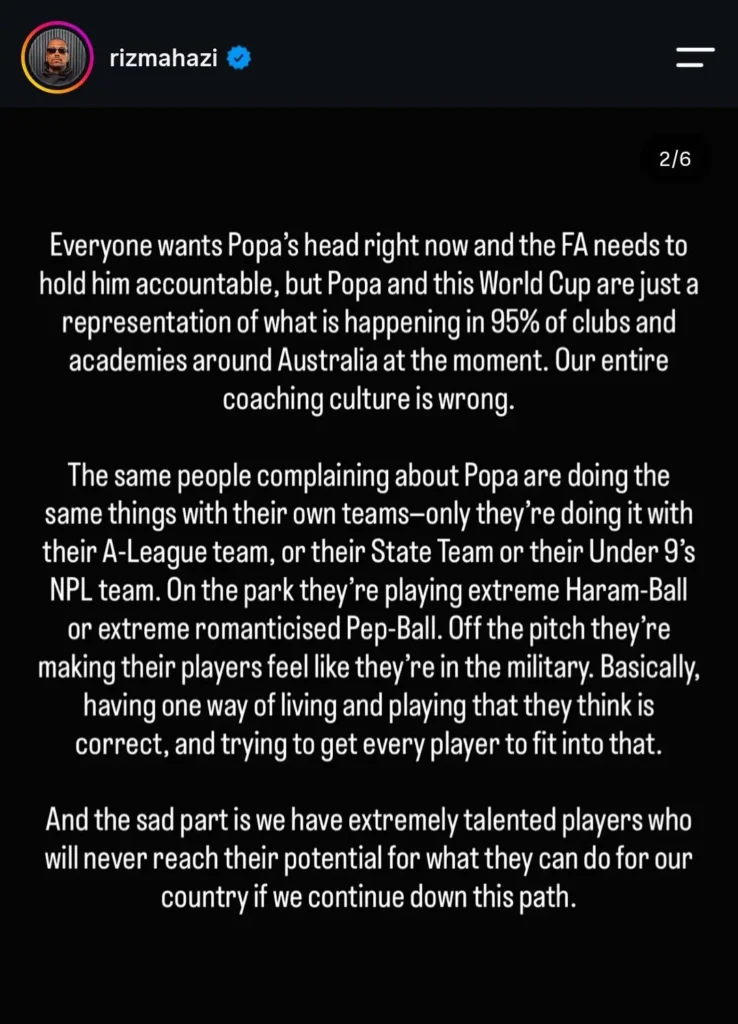
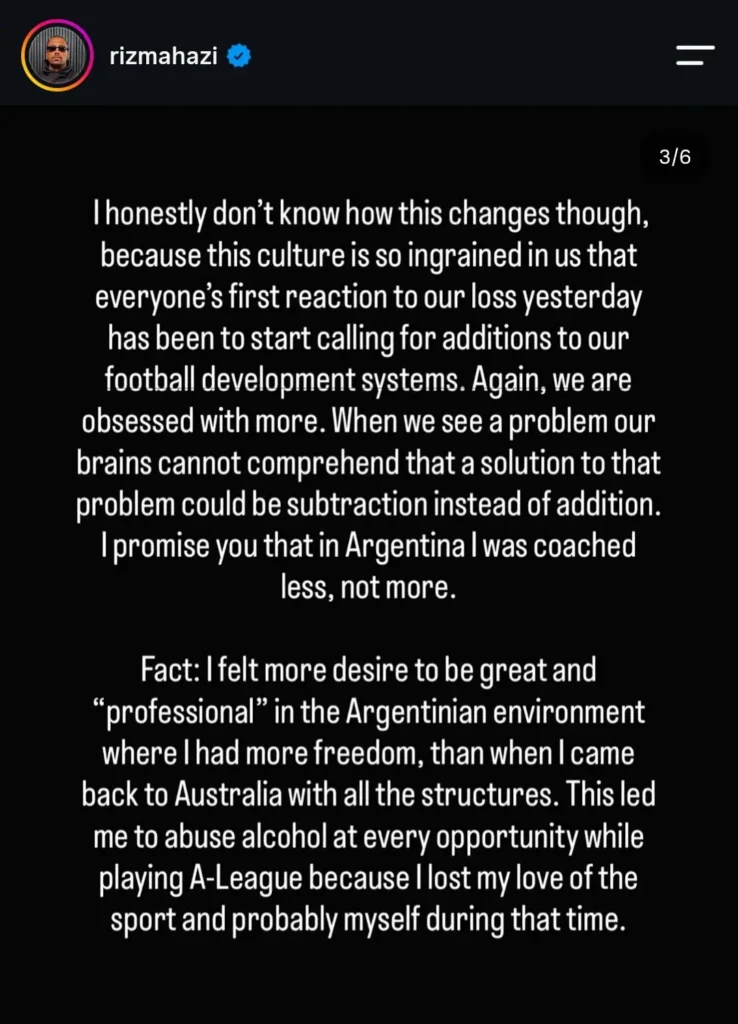
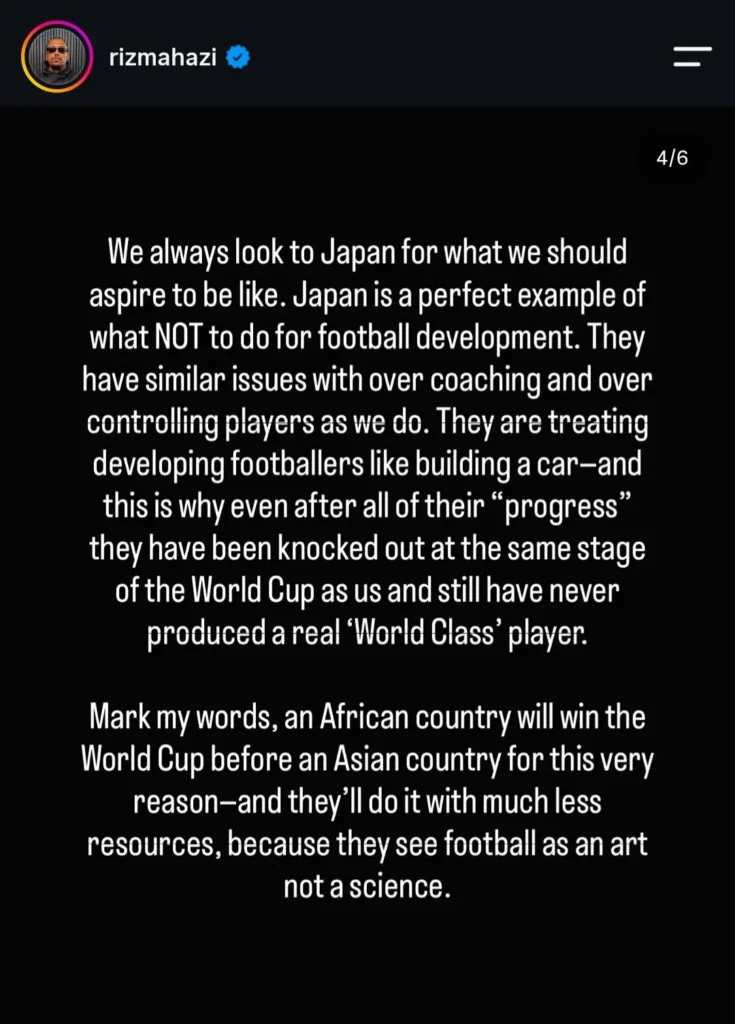
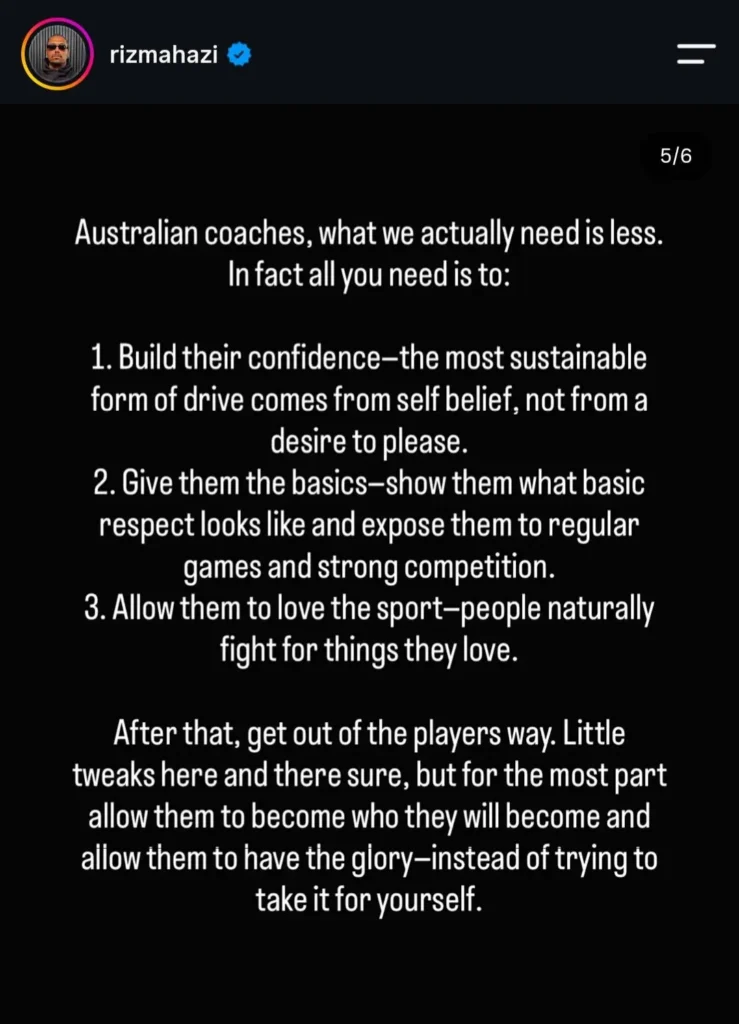

As an Australian coach, I must admit I have been guilty of this at times too. Despite having Juan Román Riquelme – the ultimate symbol of calm, controlled football wizardry – tattooed on my arm, I have still found myself embracing some of the very traits and behaviours that Mahazi laments.
Another aspect is the sport’s place in the cultural hierarchy and whether it’s still just a sport for “Sheilas, Wogs and Poofters” in the eyes of the mainstream. A cute spectacle that we loosely entertain whenever a World Cup circus appears on our TVs and then scrutinize, demonize and squash at every opportunity outside of that in the hope of minimizing the chances that young boys and girls grow up wanting to be Tim Cahill and Sam Kerr, and in reducing the number of kids who choose to spend their spare time with a round ball.
We need the game to be everywhere. We need it on every every screen, in schools, in public thought. We need more safe, accessible spaces where kids can gather to play at all hours. Safe, organized practice 3 or 4 times per week can only take you so far.
Most new housing estates across the country’s major cities have a central park or leisure area included as part of their urban planning. Why can’t there be a 5-a-side court in the middle? This is an idea we explored with Football Victoria and Gary Cole following our 2018 elimination. Areas close to homes, under lights where we let the kids play and get out of their way. This is only possible with a firm financial push for what should be a cultural pillar of our society.
Our environment inevitably shapes the football we produce and it also shapes the discourse.
Australia has never lacked hardworking players, committed coaches or passionate supporters.
The question is whether we are willing to support ambitious or unique ideas and people before they become fashionable, rather than celebrating them once overseas success validates them.
It’s not simply a discussion over formations or possession, but over belief and mentality. Belief that Australian football could aspire to become the protagonist and to shape matches rather than merely survive them.
Conversely, perhaps our caution isn’t a national character flaw. Perhaps it’s a rational response to being a middleweight fighting heavyweights with a relatively small player pool, finite resources and structural limitations. The philosophy debate matters, but it is secondary to the structural debate: pathways and a connected ecosystem, funding, coaching standards, talent identification and the long-term viability of our professional leagues.
We should acknowledge that reality. Identity without culture and infrastructure is just a slogan on a wall. We can declare ourselves to be brave, proactive and possession-based tomorrow, but without the foundations to consistently produce players capable of executing that vision, we risk becoming brave losers instead of genuine contenders.
How do we do that? After 2018’s disappointment, I canvassed as many people in the game as I had access to, and constructed the following as a suggested model to focus on. None of this is groundbreaking, but often some of these steps are forgotten.
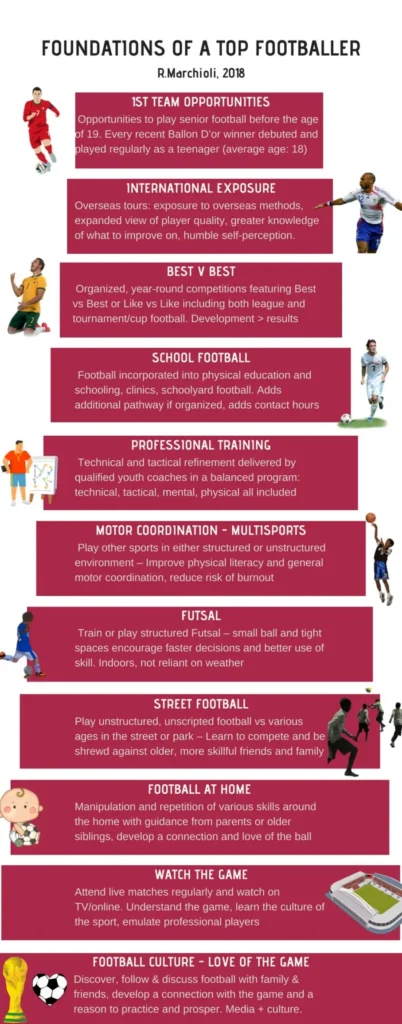
Yet infrastructure and identity are not separate. If we cannot articulate the football we ultimately want to play, how can we expect our development pathways to consistently produce players and coaches capable of playing it?
None of this guarantees future success and playing more proactively does not automatically produce World Cups. Nor does it suggest Australia should abandon the qualities that have earned worldwide respect. Our resilience, discipline, humility and willingness to compete against stronger nations should remain non-negotiable.
But fighting spirit should be Australia’s starting gun, not its finish line.
Continuing to prioritise safety above ambition almost certainly guarantees Australia remains a respected underdog rather than becoming an influential football nation.
Safe thinking produces respectable performances and occasionally it produces famous upsets but rarely does it produce sustained success or leadership.
The Round of 32 defeat to Egypt should therefore not simply trigger another coaching debate or arguments over who was selected or substituted at what time.
Had Australia won the penalty shootout, much of the conversation would probably have been about heroic effort, plucky youth and another famous display of the Australian spirit – and most of that would have been true.
But perhaps that’s part of the problem.
Eventually Australian football has to demand more than honourable defeats and admirable effort. The respectable underdog narrative has served us well for decades, but if we cling to it forever, we may never outgrow it. Perhaps it’s time to become something else.
The question is no longer whether Australia can compete because we already know we can.
The question is whether we want to become a nation that merely competes within safe parameters, or one that consistently believes it belongs among football’s protagonists.
As Milligan stated:
“It’s on us as a footballing nation, a federation, to be clear.”
Until Australian football decides exactly who it wants to become, every World Cup cycle risks ending in exactly the same conversation and we will keep spinning our wheels in the mud.