
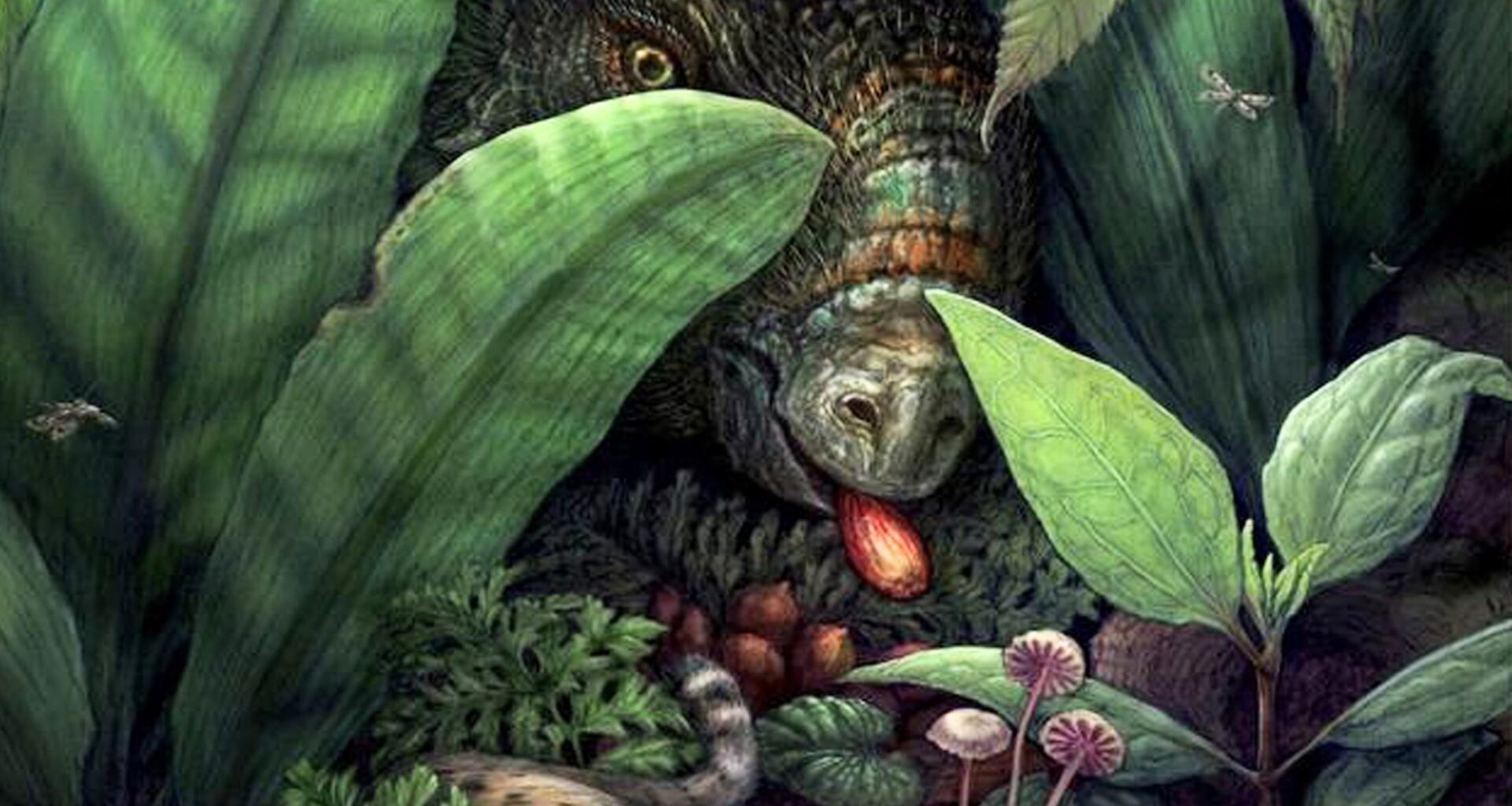
The timeline for fruit evolution has shifted dramatically. Researchers now suggest large, fleshy fruits evolved tens of millions of years earlier than expected.
This means that dinosaurs may have eaten them long before the mass extinction. The study was led by the University of Kansas.

The research pushes back on the idea that flowering plants didn’t develop large fruits and seeds until after the mass extinction that wiped out the dinosaurs roughly 66 million years ago.
A new narrative
Paleobotanists had generally assumed that flowering plants only picked up their modern reproductive tricks after the asteroid impact ended the Cretaceous.
“For much of their early history, they were relatively small, weedy plants that did not dominate forest canopies,” said James Saulsbury, a postdoctoral fellow at the University of Kansas.
Even as these plants spread and diversified over millions of years, the general assumption was that their seeds stayed tiny, riding the wind rather than tempting animals with fleshy fruit.
According to the researchers, early seeds and fruits probably ranged from about dust-particle size up to, at most, something like a poppy seed.
Compare that to today, where flowering plants use a huge range of tricks to get their seeds around.
Plenty produce big, fleshy fruit, such as apples, pears, avocados, olives, or coconuts. Such fruits are built specifically to lure animals into doing the spreading for them.
A unique fossil site
“The prevailing view has been that this more diverse reproductive ecology emerged only after the end-Cretaceous extinction,” said Saulsbury.
“The largest fruits in our fossil flora are about the size of a grape. That may not sound especially large today, but it is remarkably large for flowering plants of that period.”
That evidence comes out of an extraordinary fossil site near Truth or Consequences, New Mexico, where Saulsbury and his colleagues spent years doing fieldwork.
“The New Mexico fossil site is exceptional. My co-authors have referred to it as a ‘botanical Pompeii’ because of its remarkable preservation,” said Saulsbury.
“The site contains a layer of volcanic ash preserved as rock, known as tuff, that stretches for more than a kilometer. The deposits formed at essentially the same time, preserving many plants where they lived and died.”
Huge varieties of fruits
What makes the site remarkable isn’t just how well it preserved things, but also the sheer variety and size of the fruits and seeds found there.
“However, we don’t believe these findings are simply the result of preservation bias,” Saulsbury said.
This represents a very unusual forest. That distinction matters because fruit size ties into far more than plant reproduction alone.
“Large fruits tend to occur in moist environments with densely packed forests,” Saulsbury added.
“Our findings indicate that modern-looking forest structure and reproductive ecology were developing earlier than previously believed.”
Flowering plants did not wait until after the dinosaur extinction to evolve new ways of reproducing.
Original fruit-spreaders
The findings also challenge another widely accepted idea, that large fruits evolved specifically alongside the mammal boom that followed the dinosaurs‘ extinction.
“As mammals expanded into newly available ecological niches, flowering plants were thought to have diversified their seed dispersal strategies in response,” Saulsbury said.
Rather than emerging after the dinosaurs disappeared, large fruits appear to have evolved while dinosaurs still roamed the Earth.
Those animals likely helped spread their seeds. That’s a genuinely different way to picture Cretaceous forests.
Instead of a world of small, wind-scattered plants patiently waiting around for mammals to inherit the Earth, this research suggests otherwise.
Dinosaurs themselves may have been actively shaping how early fruiting plants spread and diversified.
Hundreds of tiny fossils
Saulsbury was out in the field for this one too, collecting fossils and handling much of the early classification, measuring, and analysis.
“We sorted hundreds of fossil seeds into what we call morphotypes,” he said.
“These are groupings based on form rather than confirmed species because it is often impossible to determine whether similar-looking fossils represent one species or several.”
That kind of painstaking, uncertain sorting work is exactly what let the team piece together a much more sophisticated picture of Cretaceous plant life than anyone had assumed.
This is a story where dinosaurs weren’t just wandering through the forest but actively helping build it.
The study is published in the journal Science.
Image Credit: Illustration by Brian Engh
—-
Like what you read? Subscribe to our newsletter for engaging articles, exclusive content, and the latest updates.
Check us out on EarthSnap, a free app brought to you by Eric Ralls and Earth.com.
——