
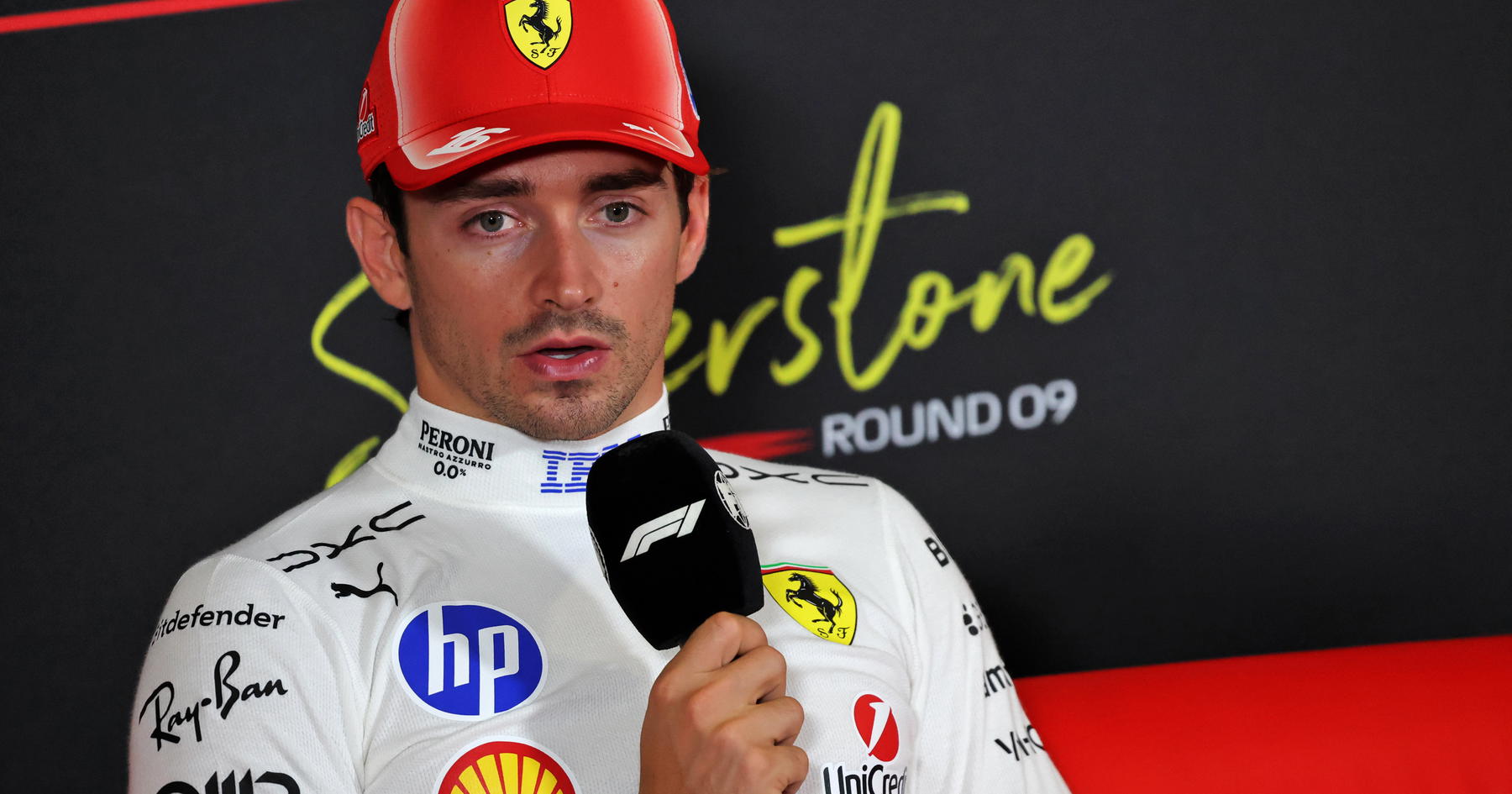
Charles Leclerc has credited “intuition mixed with feeling” for the set-up changes that transformed his Silverstone weekend and ended his long wait for an F1 victory.
A difficult sprint weekend could have been yet another chapter in Leclerc’s frustrating 2026 campaign. Instead, the Monégasque driver made it a turning point.
After qualifying on the second row for Saturday’s sprint and finishing a distant fifth, some 12.6 seconds behind winner Kimi Antonelli, Leclerc pored over the data on Friday night and identified a handful of set-up changes that he believed could unlock the SF-26’s performance for main qualifying and the grand prix.
By Saturday afternoon he was on the front row in P2, just 0.175 seconds behind Antonelli, and on Sunday he seized the lead with a superb launch off the line before controlling the race to claim his first victory since the 2024 United States Grand Prix, his ninth career win — albeit significantly aided by Antonelli’s late reliability issues.
“It’s just a few things that I saw in the data on Friday night, and I was like, ‘Okay, those might be things that just don’t fit with my driving style’,” he told media including RacingNews365, when asked how it was possible for things to change so drastically between the sprint and grand prix sections of the weekend.
“And we changed those few things from sprint race to qualifying, and that was a lot better.”
A breakthrough after months of struggle
The magnitude of the turnaround cannot be overstated in the context of Leclerc’s season. Before arriving at Silverstone, the 28-year-old had gone winless since Austin in October 2024, a drought spanning an entire blank 2025 campaign and the opening eight rounds of 2026.
He trailed team-mate Lewis Hamilton by 46 points in the championship, with the seven-time F1 drivers’ champion having already won in Spain and established himself as Ferrari’s primary title challenger.
Canada had been particularly painful; Leclerc described it as the most difficult weekend of his career, qualifying eighth and finishing well behind Hamilton.
Yet the changes made between the sprint and main qualifying at Silverstone proved transformative, and Leclerc was candid about how he identified them.
Leclerc built a lead of more than 20 seconds during the grand prix — in large part due to Antonelli’s problems — before a late safety car, triggered by a crash for Max Verstappen, compressed the field. He held on to win by 0.427 seconds from George Russell, with Hamilton completing a strong weekend for Ferrari in third.
Whether Silverstone marks a genuine and sustained upturn or simply a one-off alignment of car and driver remains to be seen.
But for a driver who had spent months struggling to unlock the SF-26’s potential, the combination of forensic data analysis and raw instinct proved the catalyst for a long-overdue return to the top step.
“So yeah, I was very proud of the work we’ve done to see that, because I think this kind of change is not really so black and white,” he added.
“You just don’t look at data and say, ‘My God, okay, this is what we need to change.’
“It’s intuition mixed with feeling. Then we went for it, and it was actually a very successful direction for me. I was very happy.”