
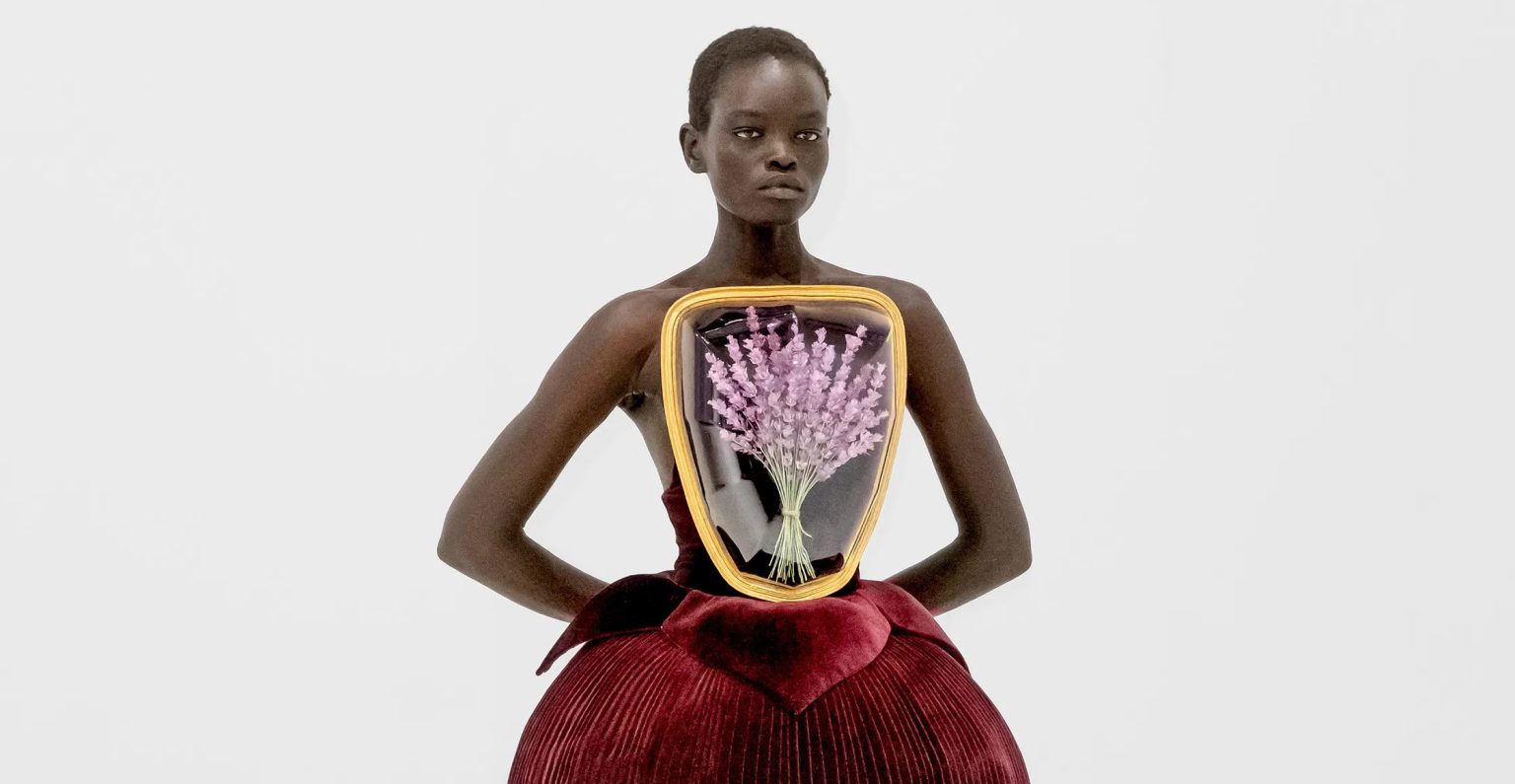
When Duran Lantink took over the creative direction of Jean Paul Gaultier, he faced a role that carried significant responsibility. His arrival marked a notable shift in the direction of the French fashion house: collections became less focused on directly repeating Jean Paul Gaultier’s recognizable codes and instead explored Lantink’s own creative language, defined by the transformation of existing silhouettes, material recycling, and the creation of entirely new forms. After three collections that gradually shaped his relationship with the house, Lantink presented the most complete expression of his creative vision in his fourth collection for Jean Paul Gaultier, which also marked his couture debut.
Related: Duran Lantink has surpassed all expectations with his new collection for Jean Paul Gaultier
For decades, Jean Paul Gaultier was known for entrusting its couture collections to guest designers, creating a space for diverse creative interpretations. Following the arrival of a new creative director, the future of this concept remained a subject of interest within the fashion world. Before Lantink’s arrival, the last couture collection was created by Ludovic de Saint Sernin, whose vision was among the most notable collections of that season. For this reason, Lantink faced the challenge of meeting high expectations while remaining faithful to his own creative direction.
Related: The standout moments from Robert Wun’s Fall 2026 couture collection
The idea of futurism ran throughout the entire collection, becoming the foundation of his vision. He found inspiration in the opulent clothing of Louis XIV and Marie Antoinette, historical silhouettes that he sought to reinterpret through a contemporary lens. He succeeded by creating a contrast between the past and the future: corsets, one of the most recognizable elements of haute couture tradition, received a new interpretation, while oversized tailoring and unexpected constructions gave the collection its futuristic character.
For Duran Lantink, couture is not merely a continuation of tradition, but a space where it is constantly questioned and reimagined. His approach combines the craftsmanship of Parisian haute couture with the possibilities offered by contemporary technologies, creating garments that do not simply follow the body but transform it and explore new possibilities of its shape.
One of the most striking examples of Lantink’s experimental approach was the creation he presented on model Leon Dame. Using 3D technology to precisely map his torso, the designer created an entirely new interpretation of the body through a sculptural piece featuring a corset-like structure. This futuristic form, which simultaneously resembles armor and a sculpture, reflects Lantink’s desire to free couture from traditional boundaries and transform it into a space for exploring the relationship between technology and clothing.
The collection was dominated by dresses featuring tulle details, which introduced a sense of necessary fashion drama. Lantink further emphasized his contemporary approach to fashion by incorporating tailoring into the couture collection, while plush lace and leather were among the most prominent materials. The collection also included a leather jacket and coat, pieces that further completed his interpretation of haute couture. I have no doubt that these creations will soon appear on numerous red carpets, where their sculptural quality will truly come to life.
Discover the most striking pieces from Duran Lantink’s debut couture collection for Jean Paul Gaultier.