
Happy Monday, G&GRs. Again, another long weekend of rugby. But this week, for some reason, the matchups lead to some wildly lopsided results. In fact, some absolute floggings. So let’s have a look at the six games. Pour a cup of liquid gold☕ and get that into you while we pick apart the floggings.

The Nations Championship – Round 2
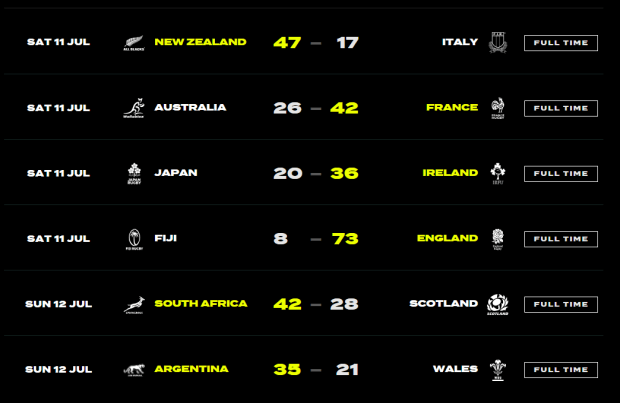
New Zealand 47 defeated Italy 17

Jordan Joins the Half-Century Club as Italy Become Latest Victims of the Black Machine – Well, that escalated quickly. For 40 minutes in Hamilton, Italy looked like they might be capable of giving New Zealand another uncomfortable afternoon. For the next 40 minutes, they discovered why nobody enjoys playing the All Blacks when they’re annoyed.
Will Jordan crossed for a hat-trick as New Zealand steamrolled Italy 47-17 in their Nations Championship clash, simultaneously collecting their second win under Dave Rennie and watching Jordan become the most prolific try-scorer in All Blacks history. Fifty tries in 56 Tests. That’s not a strike rate; that’s a software glitch.
Jordan’s third touchdown took him past Doug Howlett’s long-standing record of 49, and while plenty of great finishers have worn the black jersey over the decades, none have piled on meat pies quite as efficiently as the Crusaders flyer. Mind you, it didn’t exactly look like a record-breaking afternoon was on the cards early.
Italy came out breathing fire and landed the first punch almost immediately. Tommaso Menoncello busted through Billy Proctor’s tackle attempt, linked beautifully with Malik Faissal and finished the movement himself in the third minute. Suddenly the visitors were leading 7-0, and New Zealand were looking suspiciously mortal.
The All Blacks responded through lock Sam Darry, who crashed over from close range, but Italy continued to frustrate the hosts. A Tommaso Allan penalty restored the visitors’ lead and the Italian defence repeatedly forced handling errors and poor decisions. For a side ranked well below New Zealand and carrying an 0-17 record against them, the Azzurri were doing a remarkable job of making the locals uncomfortable.
Eventually Jordan arrived to restore order. The winger crossed shortly before halftime to give New Zealand a narrow 14-10 lead, but the scoreline probably flattered the hosts after a scrappy opening stanza. Then came the moment that effectively ended the contest. Ten minutes into the second half, Italian lock Niccolo Cannone decided that introducing his forehead to Cam Roigard’s head was a good idea. Referees, TMOs and basically everyone else disagreed. A 🧀quickly became a 🍷, Italy went down to 14 men, and the floodgates opened.
Josh Moorby, making his Test debut off the bench, injected immediate energy and was involved in the next two tries as Roigard and Ethan de Groot crossed. With Italy scrambling and tiring, Jordan sensed blood in the water. He bagged two more tries in rapid succession to complete his hat-trick and put the record beyond doubt.
From there it was little more than a procession. Italy’s afternoon worsened when veteran fullback Tommaso Allan left the field on a stretcher after a concerning chest injury, compounding a difficult second half for the visitors. To their credit, the Italians continued to throw the ball around, and replacement Leonardo Marin grabbed a late consolation try, but by then the result was well and truly settled.
Tupou Vaa’i added the final flourish in the dying seconds as New Zealand ran in seven tries all told and finished with a scoreline that looked significantly more comfortable than the match had felt an hour earlier.
Dave Rennie’s side are now two from two in the Nations Championship and appear to be finding their rhythm, while Italy are left wondering what might have been had they managed to stay at 15 men. Still, they can take some comfort from the first half. The second half, meanwhile, will be receiving the “don’t open until Christmas” treatment.
Three Things We Learned
1. Will Jordan is rewriting the record books – Fifty tries in 56 Tests is absurd. Not impressive. Not excellent. Absurd. Jordan doesn’t just finish opportunities; he seems to manufacture them from thin air. Every time the All Blacks create even a half-gap, he somehow appears in the right place at the right time. Doug Howlett’s record stood for years and felt untouchable. Jordan has cleared it before many players have even reached 60 Test caps.
2. Italy can compete — but only for so long – For 40 minutes Italy were organised, physical and brave. They defended with real intent and forced New Zealand into mistakes. The problem is that against the All Blacks, especially at home, maintaining that intensity for 80 minutes is incredibly difficult. Once Cannone was sent off, the cracks became chasms. The first half showed how far Italy have come; the second half showed how far they still have to go.
3. Dave Rennie’s bench is becoming a genuine weapon – Josh Moorby’s debut cameo changed the game. His pace and energy immediately lifted New Zealand’s attack and helped spark the decisive scoring burst. The All Blacks have always relied on depth, but Rennie appears to be building a squad capable of maintaining intensity when the replacements arrive rather than merely holding the line. That should concern the rest of the Nations Championship field.
France 42 defeated Australia 26

Wallabies crumble as France channel 1967 and turn Suncorp into their own personal playground – Well, that, to be honest, from one of the many of us GAGRs that were at the game, was very, very disappointing. For 40 minutes in Brisbane, the Wallabies looked every bit the side capable of squaring the series. They defended bravely, disrupted France at the breakdown, and rode the brilliance of Fraser McReight to a deserved 21-12 halftime lead.
Then the second half happened. What followed was one of the most brutal momentum swings seen at Suncorp Stadium in years, as France piled on 30 unanswered second-half points before a late consolation try flattered the final scoreline in a 42-26 victory. The win secured the Trophée des Bicentenaires for Les Bleus, gave them a fourth consecutive victory over Australia for the first time since 1967, and delivered their first-ever triumph at rugby’s spiritual home in Queensland.
For Joe Schmidt and the Wallabies, it was another case of “so close, yet somehow so far.” “We’re gutted,” Schmidt admitted afterwards. And gutted they should be.
French muscle lands first punch – France wasted little time reminding everyone why they arrived in Australia with confidence. Straight from the kickoff, the visitors won a penalty after Josh Canham was pinged for a high tackle. Moments later, giant lock Emmanuel Meafou did what giant locks do best: run directly through several defenders and score.
At 7-0 after three minutes, it looked ominous. Fortunately for the Wallabies, France temporarily reverted to their traditional pastime of giving away penalties at the least convenient moments. An overly enthusiastic cleanout provided Australia with field position, and Brendan Paenga-Amosa — on early for Josh Nasser after a HIA — finished off a clever lineout move to level proceedings.
The game settled into a fascinating arm wrestle. France dominated possession and territory, but the Wallabies defended with desperation. Eventually, something had to give, and when Romain Ntamack grubbered through for debutant Aaron Grandidier-Nkanang to score in the corner, it looked like the pressure had finally broken Australia’s resistance. Instead, the Wallabies responded.
McReight takes control – The turning point of the first half arrived courtesy of two men: Tom Wright and Emmanuel Meafou. Wright’s superb 50-22 kick gave Australia a platform, while Meafou’s high shot on Rob Valetini earned him ten minutes in the naughty chair. Fraser McReight immediately made France pay.
The Queensland flanker crashed over from a quick tap to level the scores before adding a second try later in the half following sustained Wallaby pressure and a dominant rolling maul. Suddenly Australia had all the momentum. The Wallabies won scrum penalties, forced French errors and looked sharper, fitter and more composed than their visitors. By halftime they held a deserved 21-12 lead, and Suncorp was starting to believe. That would prove to be the high-water mark.
Les Bleus find another gear – Whatever was said in the French sheds at halftime deserves to be framed and hung in the Louvre. The opening exchanges of the second half still belonged to Australia. McReight continued terrorising French ball carriers and the Wallabies looked reasonably comfortable. Then France woke up.
A penalty from Maxime Lucu reduced the gap before Aaron Grandidier-Nkanang grabbed his second try to bring the visitors within a point. Tom Wright’s 🧀 for a late hit didn’t help matters. Three minutes later, Ntamack spotted space down the blindside and suddenly France were back in front. Before anyone wearing gold had time to process what was happening, replacement lock Florian Verhaeghe barged over beneath the posts, and the French lead had ballooned to 13.
The Wallabies looked shell-shocked. France’s bench had transformed the contest. Their physicality increased, their line speed sharpened, and their attack suddenly carried genuine menace. Meanwhile Australia’s composure disappeared faster than free beer at Mad Monday.
Defence wins championships – The final quarter offered several opportunities for a Wallaby revival. The problem was France simply refused to cooperate. Twice Australia launched lengthy attacking sequences. Twice the French defence stood firm. Sixteen phases? No problem. Multi-phase attacks from deep? Bring them on. Every turnover, every tackle and every defensive set seemed to sap a little more belief from the Wallabies.
When Theo Attissogbe finally finished a sweeping long-range movement in the 72nd minute, the contest was over. A late try to Williams reduced the margin but changed nothing. France had scored 30 second-half points, equalling one of their best performances against Australia in more than half a century and underlining why many see them as genuine contenders for rugby’s biggest prizes over the next few years.
For the Wallabies, the challenge is painfully simple. Play 80 minutes. Because right now, 40 isn’t getting the job done.
Three Things We Learned
1. Fraser McReight is Australia’s most influential player – The Queensland flanker was magnificent. Two tries, multiple breakdown steals and relentless work rate made him the Wallabies’ standout performer by a considerable margin. Every time Australia looked dangerous, McReight seemed to be involved. If the Wallabies are going to turn this series around, he’ll need another monster performance.
2. France’s bench is an absolute weapon – The match completely changed once the French replacements arrived. The physicality lifted, the tempo increased, and Australia’s forwards struggled to respond. Good teams have depth. Great teams use it to win matches. France’s finishers did exactly that.
3. The Wallabies still have an 80-minute problem – This isn’t the first time Australia have produced an excellent half of rugby only to fade badly after the break. The Wallabies led by nine points at halftime and looked in control. Forty minutes later they’d conceded 30 points and lost by 16. The ability is there. The consistency still isn’t.
Ireland 36 defeated Japan 20
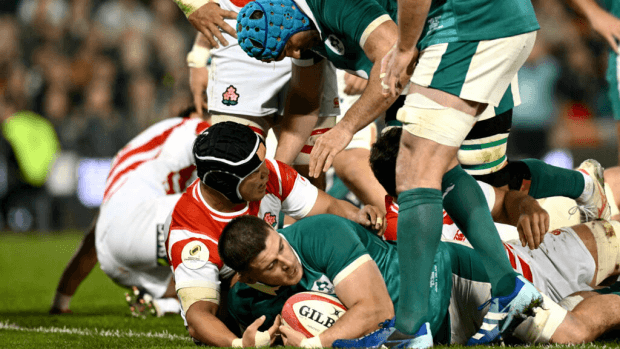
Ireland survive Brave Blossoms scare as Newcastle gets painted green – If anyone thought Ireland were going to roll into Newcastle, collect two competition points and spend the evening discussing real estate prices in Dublin, Japan had other ideas. The Brave Blossoms arrived with pace, ambition and absolutely no interest in reading the script. For long stretches they had Ireland looking distinctly uncomfortable before the world’s number three side eventually pulled away for a 36-20 victory and maintained their unbeaten start to the Nations Championship.
Despite being played on neutral territory, Newcastle sounded more like a provincial Irish home game, with over 11,000 fans creating a sea of green in the stands. Unfortunately for them, it took only three minutes for Japan to spoil the party. Winger Taira Main sliced through Ireland’s defence as someone had accidentally left the gate open, crossing for an early try and giving the Brave Blossoms a dream start.
Ireland responded the way Ireland usually does when things get awkward: they sent large men carrying the ball directly at other large men. The forward pack began grinding out metres, and eventually flanker Nick Timoney crashed over to level things up. It was a sign of things to come. Japan had speed and movement; Ireland had power and patience.
The contrast in styles made for a fascinating first half. Japan repeatedly stretched the Irish defensive line and earned territory through their willingness to move the ball. Takuro Matsunaga restored the lead with a penalty after sustained pressure, and for a while the Brave Blossoms looked the more dangerous side. But every Irish visit into scoring territory felt threatening.
Prop Tom O’Toole muscled his way over after a powerful sequence from the forwards before Robbie Henshaw finished off another period of sustained pressure late in the half. Despite Japan enjoying plenty of possession and territory, Ireland headed to the sheds with a 19-13 advantage.
The opening stages of the second half suggested the contest was far from over. Japan pinned Ireland deep inside their own territory and threw everything at the defence. The Irish line bent repeatedly but refused to break. That defensive stand would prove one of the pivotal moments of the match. Having survived the storm, Ireland struck next.
Debutant Sean Jansen announced himself to international rugby in style, finishing off a well-worked attack in the 50th minute to extend the lead and give Ireland some breathing space. Japan refused to disappear. Replacement hooker Hayate Era crossed just after the hour mark, and suddenly the margin was back to six points. The Brave Blossoms were matching Ireland physically, competing fiercely at the breakdown and creating genuine scoreboard pressure.
For a brief period, Newcastle started wondering whether an upset might actually be on the cards. The problem for Japan was that opportunities kept slipping away. A handling error here. A missed connection there. A promising attack that somehow ended with Irish hands on the ball. Against top-tier sides, those moments tend to come back and bite.
Sure enough, Harry Byrne punished an offside penalty with nine minutes remaining to push the margin beyond a converted try. It wasn’t the knockout blow, but it felt like one. Ireland suddenly regained control of territory and possession, forcing Japan back into their own half. When Era was 🧀 late for repeated infringements, the result was effectively settled.
Tom Stewart added the final touch after the siren, crashing over for Ireland’s fifth try and putting a slightly flattering gloss on what had been a much tougher afternoon than the final score suggests. The 36-20 result keeps Ireland perfect in the competition, but they’ll know they were made to work for every inch of it.
Japan, meanwhile, once again showed why nobody enjoys playing them. They challenged Ireland for 70 minutes, played with ambition throughout and left Newcastle with plenty of respect despite leaving without the win. As Brave Blossoms captain Walter Dearns admitted afterwards, Japan executed their plan well in the first half but struggled to stop Ireland imposing their preferred style after the break.
That’s generally what elite sides do. You hang around, frustrate them, make them uncomfortable and maybe even get ahead on the scoreboard. Then eventually they find a way. Ireland found theirs.
Three Things We Learned
Japan are becoming a genuine nuisance for everyone – Nobody is going to enjoy seeing Japan on the fixture list. Their speed, ball movement and fitness continually create problems for bigger nations. They may not have collected the win, but they spent most of the afternoon asking Ireland questions that few sides have managed to ask in recent years.
Ireland’s depth continues to impress – The Irish bench once again made a significant impact. Sean Jansen marked his debut with a try, the replacements lifted the physical intensity, and Ireland looked stronger as fresh bodies entered the contest. That’s a dangerous weapon in a long tournament.
Missed opportunities separate contenders from challengers – Japan created enough chances to make this an upset. The problem was converting pressure into points. Ireland, by contrast, were ruthless when opportunities presented themselves. At this level, that’s often the difference between a six-point game with twenty minutes remaining and a sixteen-point defeat on the scoreboard.
England 73 defeated Fiji 8
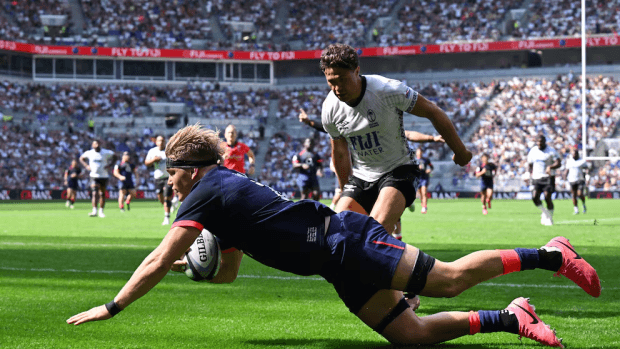
England’s answer to the critics? Well, for one week at least, they found a team willing to help. After being given a proper rugby lesson by South Africa in Johannesburg, England returned home to Liverpool and took out their frustrations on a Fiji side that looked less like the entertainers of the Pacific and more like a group of blokes who’d accidentally wandered into the wrong stadium.
The result was a brutal 73-8 demolition job at Everton’s shiny new Hill Dickinson Stadium, with England piling on 11 tries and recording their biggest victory since flattening Chile at the 2023 Rugby World Cup. Now, before England fans start booking hotels for the Nations Championship final, a little perspective. Fiji were dreadful. Not “a bit off” dreadful. Not “one of those days” dreadful. Properly dreadful.
They couldn’t hold the ball, couldn’t handle England’s set-piece, couldn’t cope with the defensive pressure and, most damagingly, couldn’t stay out of the referee’s notebook. Twelve penalties, including nine in the first half, ensured they spent most of the afternoon either retreating 10 metres or defending their own tryline.
The moment that summed up Fiji’s day arrived just before halftime when scrumhalf Simione Kuruvoli decided that kicking Ellis Genge while he was on the ground was somehow a good idea. Unsurprisingly, the officials disagreed. Red card. Game over. Not that it was particularly competitive before then.
England were already cruising at 35-3 by the break thanks to tries from Marcus Smith, Jamie George, Guy Pepper, debutant Benhard Janse van Rensburg and Seb Atkinson. The opening score was pure Fiji self-destruction. Salesi Rayasi casually allowed the ball to bounce near the corner flag as though he was waiting for a bus rather than defending a Test match. Marcus Smith gladly accepted the gift and England never looked back.
Jamie George added another from a rolling maul that looked about as difficult as pushing an empty shopping trolley downhill. With Levani Botia spending time in the sin-bin and Fiji’s discipline falling apart, England simply kept turning pressure into points. Every scrum seemed to earn a penalty, every maul looked dangerous, and every attacking set appeared to end with another English player celebrating.
Any faint hopes Fiji had of regrouping disappeared when Kuruvoli’s 🍷 reduced them to 14 men for the entire second half. To their credit, Fiji opened the second period with a try to captain Tevita Ikanivere. Unfortunately for them, that was about the last positive moment of the afternoon. England responded by throwing the ball around and running up the score.
Replacement flanker Henry Pollock helped himself to a hat-trick as tired Fijian defenders increasingly resembled training cones. Fin Smith knocked over nine conversions, and England’s rookie brigade got in on the act as well. South Africa-born centre Benhard Janse van Rensburg marked his debut with a try and an assist, while teenage winger Noah Caluori crossed after a lovely piece of support play. Prop George Kloska also earned his first cap as Steve Borthwick emptied the bench with the result safely secured.
Borthwick was particularly pleased with England’s defensive effort, and he had a point. Fiji are usually capable of producing attacking magic from anywhere on the park, but England squeezed them relentlessly and rarely allowed them any rhythm. The real examination, however, arrives next weekend.
Beating a 14-man Fiji side that spent most of the afternoon handing over possession is one thing. Facing Argentina away from home is something entirely different. England have bought themselves a week of peace. Whether they’ve genuinely solved any of the problems exposed by the Springboks remains to be seen.
Three Things We Learned
England’s set-piece remains their biggest weapon – When England get on top at scrum and maul time, everything else becomes easier. Fiji simply had no answer to the physical pressure, and England built their entire afternoon off dominance up front. Against stronger opposition, that platform will be even more important.
Fiji’s discipline can still be their own worst enemy – The Fijians conceded a mountain of penalties, and the red card to Kuruvoli completely ended any chance of a contest. Talent has never been Fiji’s problem. Consistency, accuracy and discipline remain the barriers preventing them from regularly knocking off Tier One nations.
Argentina will tell us far more about England than this result – A 65-point win looks terrific on the scoreboard, but context matters. England were expected to beat Fiji at home and were handed an enormous advantage when the visitors went down to 14 men. The trip to Argentina next week will provide a much clearer indication of whether England’s Johannesburg nightmare was merely a bad day or evidence of deeper issues.
South Africa 42 defeated Scotland 28
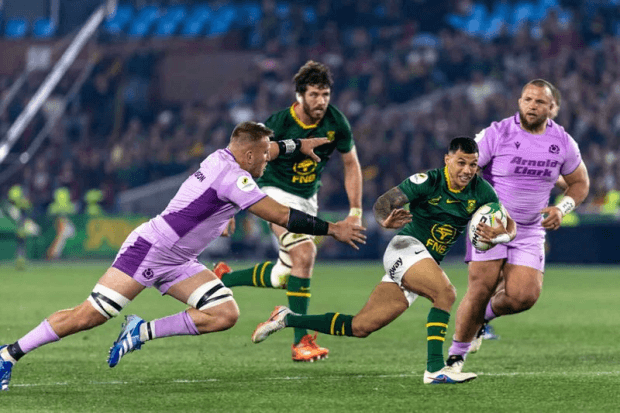
Scotland push the Boks to the brink before South Africa’s champions find another gear – If you’re looking for evidence that Scotland have finally graduated from “dangerous on their day” to “genuine heavyweight contender”, then Saturday night in Pretoria provided plenty.
Unfortunately for Gregor Townsend’s men, it also provided a reminder of why South Africa remain the benchmark for everyone else. The Springboks eventually emerged 42-28 winners in a cracking Nations Championship contest at Loftus Versfeld, but the scoreline doesn’t quite tell the story. For long stretches Scotland looked capable of doing something no Scottish side has ever managed: win a Test in South Africa.
And that’s not something many touring teams can say after visiting the Republic. The afternoon began exactly as most expected. The Boks came charging out of the sheds, all muscle, momentum and menace, racing to a 14-0 lead while Scottish supporters briefly contemplated switching over to watch the golf. But this Scottish side has developed a habit of refusing to read the script.
Matt Fagerson crashed over to get the visitors on the board before Kyle Rowe finished off a superb movement to level proceedings at 14-all by halftime. Suddenly the crowd had gone a little quieter, and the Scots had started believing. More importantly, so had everyone watching.
Townsend’s side weren’t just hanging on. They were causing problems. Their attack was asking questions. Their defence was holding firm. Their forwards were matching one of the most intimidating packs in world rugby. Then came the moment Scotland will spend the flight home replaying.
Springbok lock Ben-Jason Dixon was given a slice of 🧀 after a collision with Scott Cummings. Townsend later suggested the incident looked suspiciously close to a head clash and felt fortunate not to be upgraded to 🍷. Regardless of the disciplinary debate, Scotland had a golden opportunity. A man advantage. Momentum. Territory. And they came away with nothing. Against lesser teams you might get away with that. Against South Africa, it’s basically handing them an invitation to punish you.
The world champions accepted immediately. The Boks exploded into life with three tries across a devastating ten-minute period either side of the hour mark. One minute Scotland were pressing for the lead; the next they were staring at a 21-point deficit wondering what had just happened. Classic South Africa.
Absorb pressure. Survive danger. Then hit you with the rugby equivalent of a freight train. To Scotland’s enormous credit, they refused to fold. Josh Bayliss crossed. Ben White followed. The deficit shrank. The nerves inside Loftus started to return. Suddenly the possibility of an historic upset was alive again.
Townsend later admitted that with ten minutes remaining he genuinely believed Scotland were going to complete the comeback. You could see why. The Scots were playing with confidence and courage while the Springboks, for perhaps the first time all evening, looked uncomfortable. But championship teams find ways to kill games.
Enter Jesse Kriel. With three minutes remaining, the Bok skipper crossed for South Africa’s sixth try, finally extinguishing Scottish hopes and allowing the home side to breathe again. The final score read 42-28, but Scotland left Pretoria with considerably more respect than they arrived with. After being held scoreless against South Africa in both 2023 and 2024, they not only crossed four times but secured a valuable bonus point. More importantly, they demonstrated they can physically and tactically compete with the very best teams in the world.
Townsend’s post-match assessment summed it up perfectly. There was pride. There was frustration. And there was the lingering feeling that a massive opportunity had slipped away. The encouraging part for Scotland supporters is that this wasn’t a brave defeat built on heroic defence and lucky breaks. They created opportunities through skill, ambition and intelligent rugby. The frustrating part?
Against the world champions, “almost enough” still isn’t enough.
Three Things We Learned
1. Scotland belong at rugby’s top table – This wasn’t a plucky underdog performance. Scotland went toe-to-toe with the world champions in Pretoria and genuinely looked capable of winning. Their attack created chances, their forwards stood up physically, and their fitness allowed them to keep fighting until the final whistle. The gap between Scotland and the elite has never looked smaller.
2. You cannot waste opportunities against South Africa – The defining period of the match came while Ben-Jason Dixon sat in the sin-bin. Scotland had territory, possession and a numerical advantage but failed to score. Within minutes the Boks had flipped the script and piled on three tries. Against South Africa, momentum swings are brutal, and mistakes are punished immediately.
3. The Springboks still have the champion’s instinct – For all the praise Scotland deserve, the biggest takeaway may be that South Africa continue to find ways to win when challenged. They weren’t at their ruthless best for 80 minutes, but when pressure arrived they responded with a devastating burst that decided the contest. That’s what world champions do.
Argentina 35 defeated Wales 21
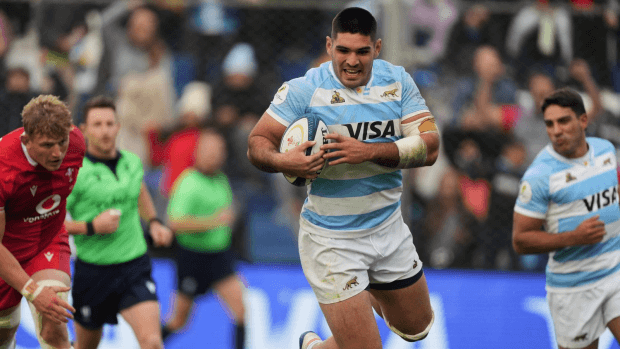
Los Pumas finally get on the board as Wales wilt in San Juan – If Round One of the Nations Championship left Argentina wondering what might have been, Round Two delivered exactly the response Felipe Contepomi would have demanded. After coughing up 47 points in their opening loss to Scotland, Los Pumas bounced back in front of a passionate San Juan crowd, running in five tries to defeat Wales 35-21 and register their first victory in rugby’s shiny new international competition.
It was also a fitting occasion for veteran lock Guido Petti, who celebrated his 100th Test cap by helping steer Argentina to a performance that mixed flair, physicality and enough defensive grit to shut the door whenever Wales threatened to make things uncomfortable. The visitors couldn’t have asked for a better start.
Just three minutes in, skipper Dewi Lake crashed over from a lineout maul and for a brief moment it looked like Wales might continue the momentum from their opening-round win over Fiji. The brief moment lasted about two minutes.
Argentina hit back immediately through Joaquín Oviedo after some slick work from the Carreras brothers down the left edge. It was classic Pumas rugby: fast, instinctive and just chaotic enough to leave opposition defenders wondering what had happened.
The home side then began to dominate territory and possession. A spectacular aerial take from Bautista Delguy ignited the movement that led to Justo Piccardo crossing for Argentina’s second try, and suddenly Wales were chasing the game. To their credit, the Welsh refused to disappear. A TMO intervention denied them one score before Rhys Carré barged over shortly afterwards to level things at 14-all.
That should have been a warning sign for Argentina. Instead, it became the launchpad for their best rugby of the afternoon. Marcos Kremer powered over after sustained pressure before Santiago Carreras finished a sweeping passage of play that had the San Juan crowd roaring and Wales scrambling. By halftime, the Pumas held a commanding 28-14 lead and looked every bit the more dangerous side.
The second half began much the same way. Piccardo, enjoying a breakout afternoon, sliced through the Welsh defence with a brilliant individual run before feeding Oviedo for his second try of the match. At 35-14, Argentina looked capable of putting the result beyond doubt. They nearly added another when Matías Moroni thought he’d scored, only for the TMO to intervene again and spot a knock-on.
From there, the contest settled into an arm wrestle. Wales managed one final breakthrough through Ben Warren after catching the Argentine backfield napping, but unlike previous seasons where the Pumas might have found a way to make life difficult for themselves, Contepomi’s side remained composed.
The defence stiffened, the forwards tightened their grip on possession, and Argentina calmly strangled the final quarter. No late collapse. No unnecessary panic. Just a professional finish and a well-earned 35-21 victory.
For Wales, it was a frustrating afternoon. Their maul looked dangerous, and there were moments when they threatened to swing momentum, but too many defensive lapses and an inability to contain Argentina’s strike runners ultimately proved costly.
For the Pumas, meanwhile, this looked much closer to the side capable of beating anyone on their day. Physical at the breakdown, dangerous out wide and ruthless when opportunities presented themselves. That’s a combination that will make the rest of the Nations Championship field sit up and pay attention.
Three Things We Learned
1. Justo Piccardo may have announced himself on the international stage – Every tournament seems to produce a player who goes from “Who?” to “How do we stop him?” in the space of 80 minutes. Piccardo’s afternoon was outstanding. He scored one try, created another and repeatedly challenged the Welsh defensive line. Argentina have never been short of talented outside backs, and the youngster looks ready to join a very impressive production line.
2. Wales still struggle when the game gets loose – When Wales could turn the match into a set-piece contest, they looked competitive. Their maul caused problems, and their forwards carried strongly.
But once Argentina started moving the ball and playing with tempo, the visitors were exposed. Defensive spacing became an issue, support runners appeared from everywhere and Wales simply couldn’t match the Pumas’ attacking variety.
3. Argentina’s defence is improving under Contepomi – Conceding 47 points to Scotland wasn’t exactly an endorsement of the defensive system. This week was a different story. While Wales scored three tries, Argentina looked significantly more organised, particularly during the final 20 minutes when previous Pumas sides might have leaked multiple scores. The ability to close out games has often been Argentina’s Achilles heel. If they’ve genuinely improved in that area, they’ll become a dangerous proposition for every team in this competition.
The ladders
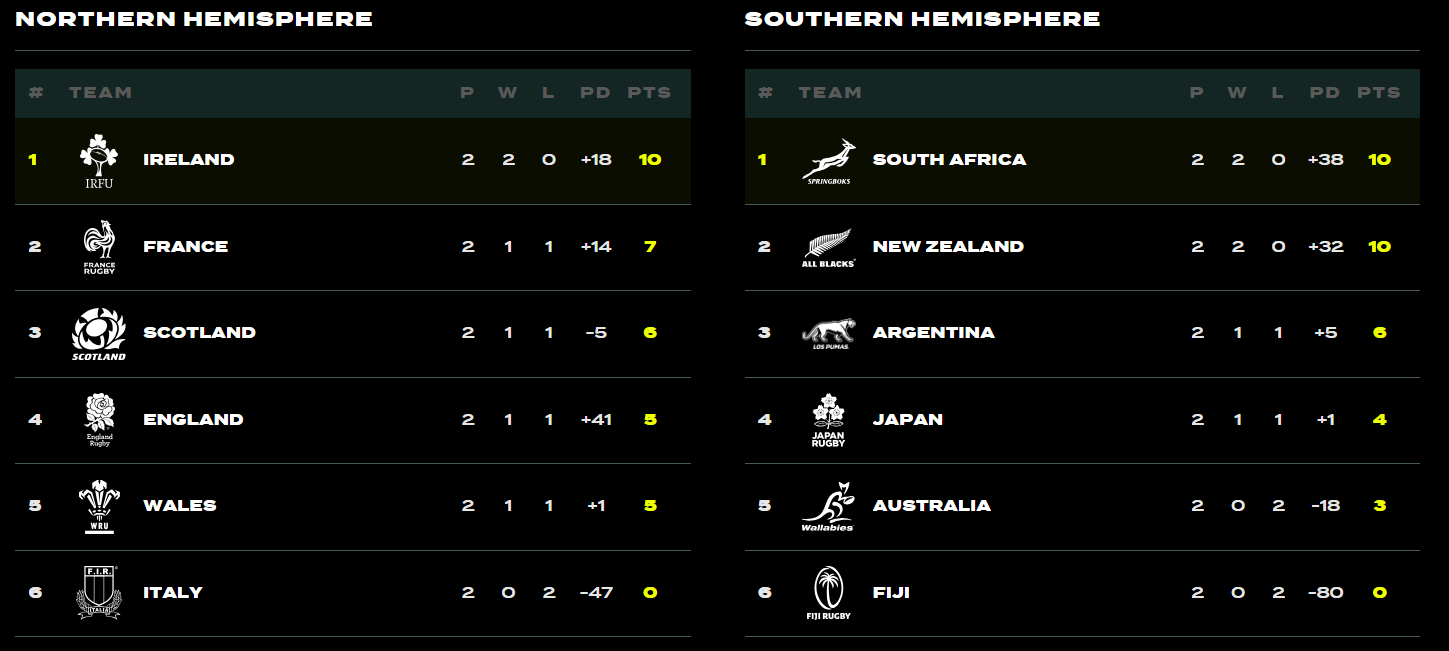
Well, after the first week, it looked like there might be some surprises. Instead, the TNC has resumed the normal programming. The strong teams look stronger. The weaker teams are looking worse. And yes, Wallabies, I mean you. I also think Fiji must really be regretting moving on Mick Byrne as coach, as they have really regressed.
That, my dear G&GR friends, was a lot of rugby to watch and write up. And a lot of it looked like watching baby seals getting clubbed to death. Any GAGRs! Over to you. Have at it!
Stay in the loop with G&GR