
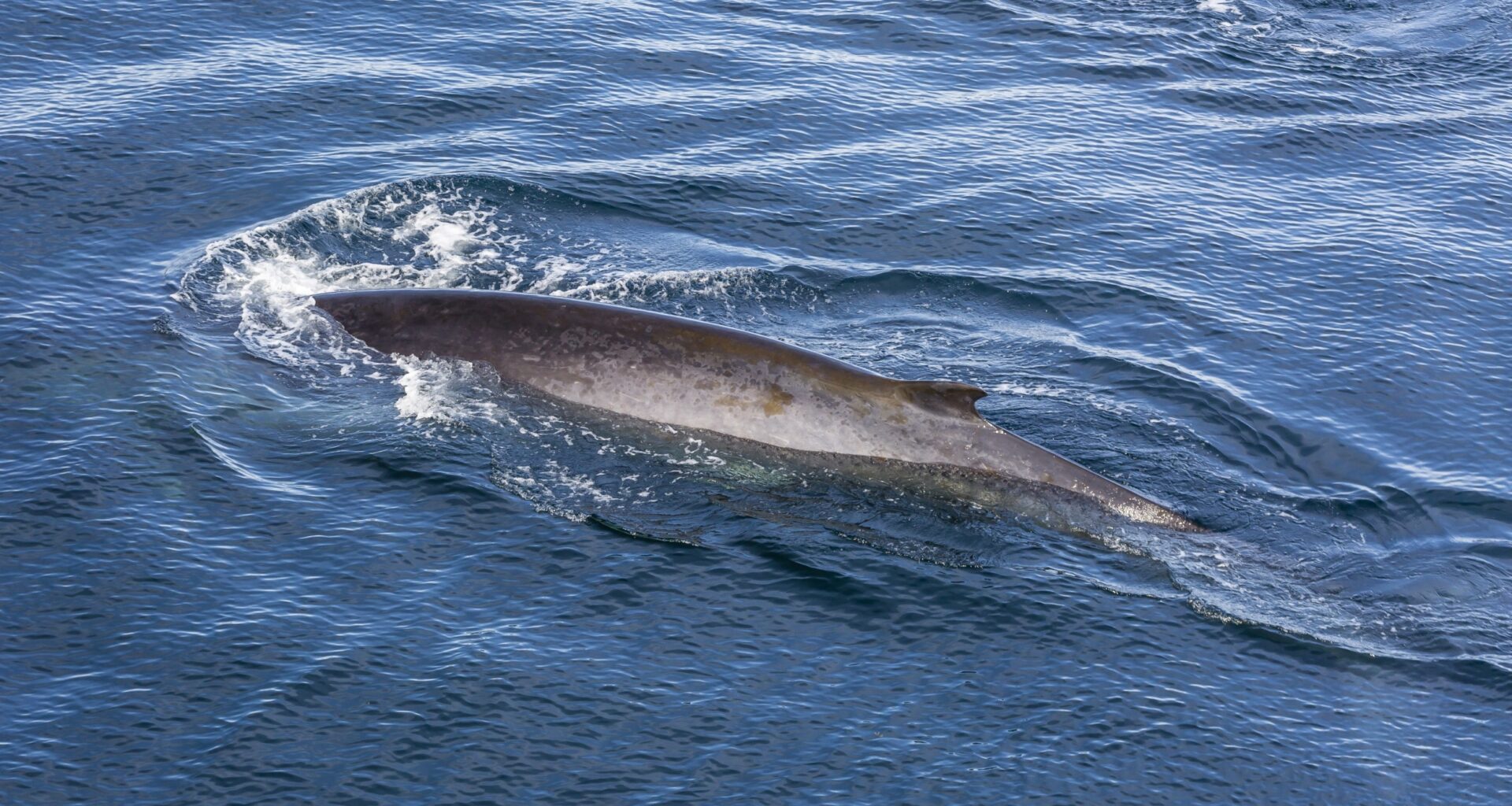
There is usually safety in numbers. For a swarm of krill, that comfort can vanish in a single moment. A fin whale, Balaenoptera physalus, can swallow an entire shoal in one gulp.
These animals rank among the largest ever to live, yet they survive on some of the smallest prey in the sea.

The feeding trick looks simple from a distance. Look closer and a strange physics problem comes into view.
That problem sits at the heart of a new set of calculations. The answer touches on how the biggest animals on Earth manage to eat at all.
Giant gulps of krill
When a fin whale lunges, it drops its lower jaw and lets the ocean pour in. The mouth balloons into a huge pouch that runs from the chin back toward the navel.
“When fin whales lunge, their lower jaw hinges open and water floods into a pouch stretching from their lower jaw to their belly button,” said Ingrid Ackermann of Stanford University.
A 66-foot fin whale can take in roughly 2,100 cubic feet of seawater at once.
As the pouch fills, its surface stretches from about 328 square feet to roughly 850 square feet.
That is a mouthful close to the size of a small room. Water rushes in, and then all of it has to come back out through the baleen.
A clogged filter
Racks of baleen hang from the roof of the mouth. These fringed plates work like a strainer that traps prey while letting water slip away. Here is where the trouble starts.
A single gulp can hold up to 317 pounds of krill. When pressed flat against the baleen, a layer would form about 2.5 inches deep.
It would blanket a filter covering only 31 square feet. Normally, a whale clears its mouth in 31 seconds.
Any blockage could stretch that window and cut into feeding time.
The pouch pushes water
Ackermann teamed up with her colleagues David Cade, Jeremy Goldbogen and Mark Denny at Stanford University to work it out.
The team calculated the force made as recoiling blubber and muscle press on the trapped water.
The pouch could push with pressures between roughly 0.6 and 2.6 pounds per square inch.
On paper, that push looked strong enough. It could empty a clean mouth in the target 31 seconds.
Krill from a pet store
Krill happen to be a common food in the pet trade, so Ackermann simply bought a frozen bag from a local shop.
She packed the bottom of a five-foot clear tube with krill. The layers ranged from three-quarters of an inch to about 2.2 inches deep.
Filling the tube with water created pressures close to what a whale can manage. A camera tracked how fast the water trickled through each krill plug.
The team then scaled those speeds up to whale size. What they found was not kind to the whales.
Slowing to a dribble
To clear its mouth in 31 seconds, a whale needs water moving at about 2.2 feet per second.
Through even the thinnest krill layer, the flow crawled at roughly 0.13 feet per second instead.
With the thickest plug of krill, the trickle fell to about 0.07 feet per second. That is a dribble, not a purge.
“The krill might really be a problem,” said Ackermann.
Far too slow to work
At those speeds, emptying a full mouth would take about 16 minutes. That is roughly twice as long as a normal feeding dive.
Even at full muscular effort, the numbers still fell short. The push needed to drive water through packed krill runs close to twice what the pouch can supply.
A fin whale cannot hold its breath and linger that long.
Sieving prey the simple way clearly does not match what these giants do in the wild.
The price of a crowd
There is a deeper irony buried in these numbers. The giant lunge only pays off if the whale scoops up a thick crowd of prey at once.
Yet a thick crowd is exactly what clogs the baleen. The very meal that makes the effort worthwhile might also be the thing that jams the strainer.
Scientists have long thought that dense swarms cover the huge cost of each lunge. If clogging slows every meal, that bargain starts to look shakier.
A helpful, clear window
The team looked for a way out. What if the krill did not spread evenly across the baleen?
If part of the filter stays open, water can rush through the gaps.
The math showed that keeping about 15 percent of the baleen clear would let a whale empty its mouth in 31 seconds.
Another option is to keep the krill afloat inside the mouth rather than settled on the filter. Either trick would hold the strainer open long enough to work.
The mystery of how fin whales feed
How a real fin whale pulls this off is still unknown. The tongue might sweep the baleen clean as the pouch empties.
Swirling water inside the mouth might also keep the krill moving. The krill themselves swim, though far too slowly to outrun the rush of water.
The finding leaves a gap in a much bigger story. Whales grew to record size partly by gulping dense prey, so fast filtering matters more than it might first seem.
For now, the answer stays out of reach. What is clear is that a fin whale must keep its filter from clogging to feed on cloud after cloud of krill.
The study is published in the Journal of Experimental Biology.
—–
Like what you read? Subscribe to our newsletter for engaging articles, exclusive content, and the latest updates.
Check us out on EarthSnap, a free app brought to you by Eric Ralls and Earth.com.
—–