
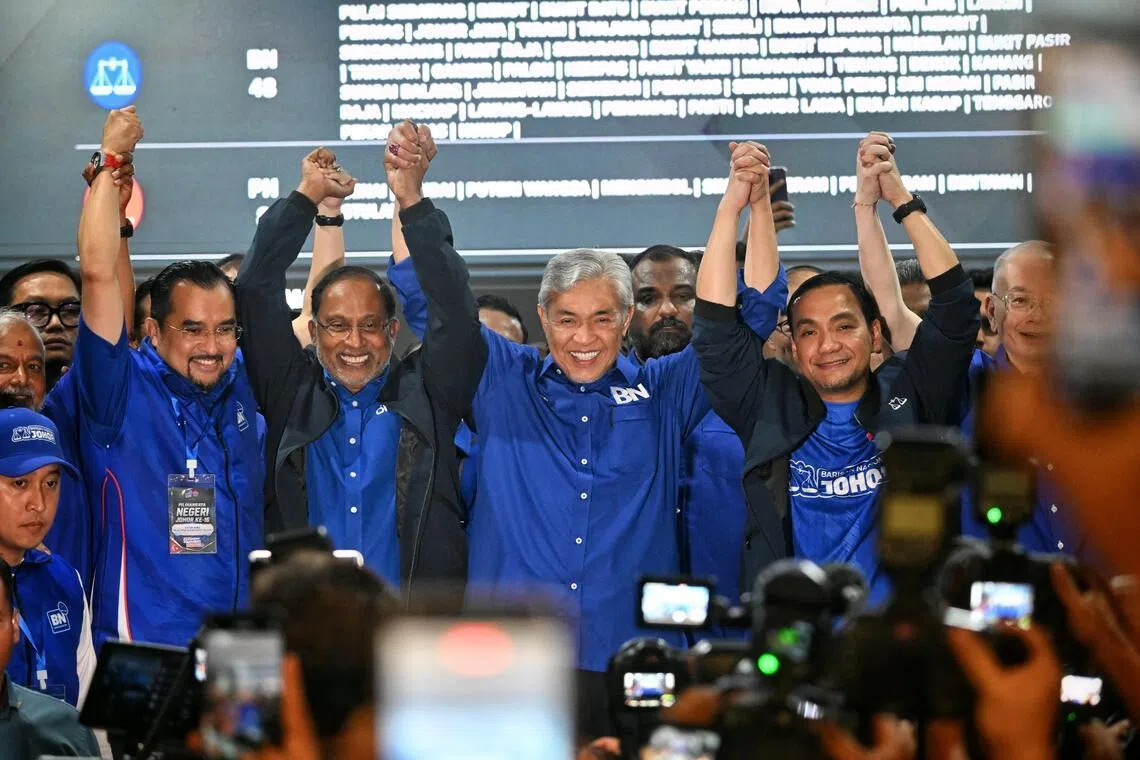
KUALA LUMPUR – A victorious Onn Hafiz Ghazi was sworn in for a second term as Johor’s chief minister on July 12, just hours after the Election Commission declared a landslide win for the UMNO-led Barisan Nasional (BN) in the southernmost state.
At one of the most anticipated state elections in recent Malaysian history, BN won 48 seats, meaning six of every seven assemblymen in the 56-strong legislature will hail from the long-ruling coalition.
Prime Minister Anwar Ibrahim’s Pakatan Harapan (PH) will make up the rest of the numbers after dropping from 12 to just eight seats.
This is the first vote since the November 2022 general election where PH and BN have openly clashed, marking the end of their electoral pact whereby only one candidate from either coalition contests a seat, usually with the backing of the other during the campaign.
The pact had been in place since the so-called unity government of the former rivals was formed after Malaysia’s first-ever hung Parliament, and PH’s disappointing outing will be food for thought for Anwar, who must ensure his alliance bounces back by the time he calls a general election due by early 2028.
Johor’s demography closely mirrors that of Peninsular Malaysia as a whole, which is home to 165 of the nation’s 222 parliamentary seats.
The Straits Times looks at the winners and losers after nearly two million Johoreans cast their ballots.
WINNERSBarisan Nasional
Let’s start with the obvious. BN was already in command of a two-thirds supermajority before the state assembly was dissolved in June. Despite not much headroom for improvement, it managed to secure a significant 20 per cent jump from 40 to 48 seats.
More importantly, BN also nearly doubled its tally of votes to 1.1 million, from fewer than 600,000 in March 2022.
This was a key watchpoint as it indicates its electability outside of its hardcore supporters. The 600,000 tally – give or take a few thousand – has been consistent since 2018 when UMNO lost both state and federal power for the first time in history.
That was the culmination of a decade of ebbing support for the grand old party as it suffered under the growing weight of corruption scandals.
Having failed to entrench itself among new cohorts of voters who have typically been fence-sitters, the Johor result offers the first signs that UMNO is finally on the rebound.
While the stains of graft have not been completely washed away, BN’s track record of being capable administrators has likely gained traction with an electorate that consistently cites cost of living and job opportunities as its top concerns in various opinion polls.
Malay Unity Proponents
Nonetheless, BN’s haul can also be attributed to external factors such as disappointment with Anwar’s PH (more on that later).
Perhaps the most significant development was Parti Islam SeMalaysia (PAS) – which has more elected representatives than any other party – telling its supporters to back BN in the 23 seats that the opposition Perikatan Nasional (PN) coalition was not contesting.
The move was framed by the Islamist party as a strategy to defend Malay political power. PAS framed PH as a threat to the Malay-Muslim majority: the secular Chinese-dominated Democratic Action Party (DAP) contributes half of the three-member ruling coalition’s MPs.
PAS and its current allies are unlikely to win the next general election on their own. Meanwhile, BN’s electoral pact with PH has not helped UMNO win back the crucial Malay vote from the opposition.
A significant faction in PAS and UMNO – as well as pro-Malay and Islamic interest groups – believe that the community must unite politically. For them, the Johor result is proof that the combined support for the two main Malay-Muslim nationalist parties can ensure victory against PH.
Johor Palace
No other royal family has as much say over the running of their state as Johor’s. While it has waded into politics before – famously asking Malaysians not to abandon BN in 2018 – this is the first time it actively stumped for a party.
Regent Ismail Ibrahim made headlines just weeks before the July 11 vote by going after BN’s opponents, including Anwar.
The palace has been muted following an online backlash against Ismail, who is Crown Prince and Sultan Ibrahim Iskandar’s son. But the fact that most Johoreans still picked BN goes to show that royal activism, at least in the southernmost state, is increasingly normalised.
LOSERSPakatan Harapan
PH’s election strategists may claim that the coalition increased its vote share compared to the 2022 edition. But one-third of the 1.8 million ballots cast is still a smaller share than the 42 per cent garnered in Johor at the general election in November the same year.
Tellingly, the constituencies that had the lowest turnouts were those where PH was the incumbent, indicating that many of its supporters boycotted the vote in protest.
It continues a negative trend since 2023 – when six states went to the polls – that deepened in Sabah in 2025. In that poll, PH won just one of the 73 seats at stake.
Parti Keadilan Rakyat (PKR) president Anwar and his allies need to do something to change their fortunes and do it quickly. A general election must be held by February 2028, giving them 1½ years to reverse the damage done over more than twice that timespan.
‘Fourth Force’
This was supposed to be the window of opportunity for smaller parties to emerge as an alternative to the three main coalitions, which have struggled with infighting and grassroots disenchantment.
In fact, the debut of Parti Bersama Malaysia, former PKR deputy Rafizi Ramli’s new vehicle, was a direct consequence of a power struggle in Anwar’s own party.
Meanwhile, the youth-focused Malaysian United Democratic Alliance (MUDA) was also defending its only state seat, which it won in 2022 as a PH partner.
But all 15 candidates from Bersama and four from MUDA, as well as the sole contestant from MUDA’s ally, the Socialist Party of Malaysia, ended up losing their RM5,000 (S$1,580) deposits as they failed to garner at least an eighth of the votes cast in their constituencies.
Malaysians have voted for new parties before – Anwar’s own PKR emerged only at the 1999 general election and former prime minister Muhyiddin Yassin’s Parti Pribumi Bersatu Malaysia debuted in 2018.
But they began their political journeys cooperating with other opposition parties.
For Bersama and MUDA, their forays without erstwhile PH comrades have fallen flat.
Parti Pribumi Bersatu Malaysia
After the exodus of most of its MPs when it sacked deputy president Hamzah Zainudin in February, this election in president Muhyiddin Yassin’s home state was a chance for Bersatu to show it remains a force.
But it lost all 16 wards it contested and questions will surely be raised over whether it remains relevant without the backing of PAS.
The polls came amid a tussle with the Islamist party over whether to admit former home minister Hamzah’s new party into PN. It resulted in PAS and Bersatu merely using the coalition logo but effectively campaigning separately.
PAS also went home empty-handed. It is clear that neither can go at it alone in the future in more multicultural states like Johor.
But PAS brings to the table dominance in the northern states, especially Kelantan and Terengganu on the east coast. Bersatu, unfortunately, no longer has any such base.
Sign up for our weekly Asian Insider Malaysia Edition newsletter to make sense of the big stories in Malaysia