
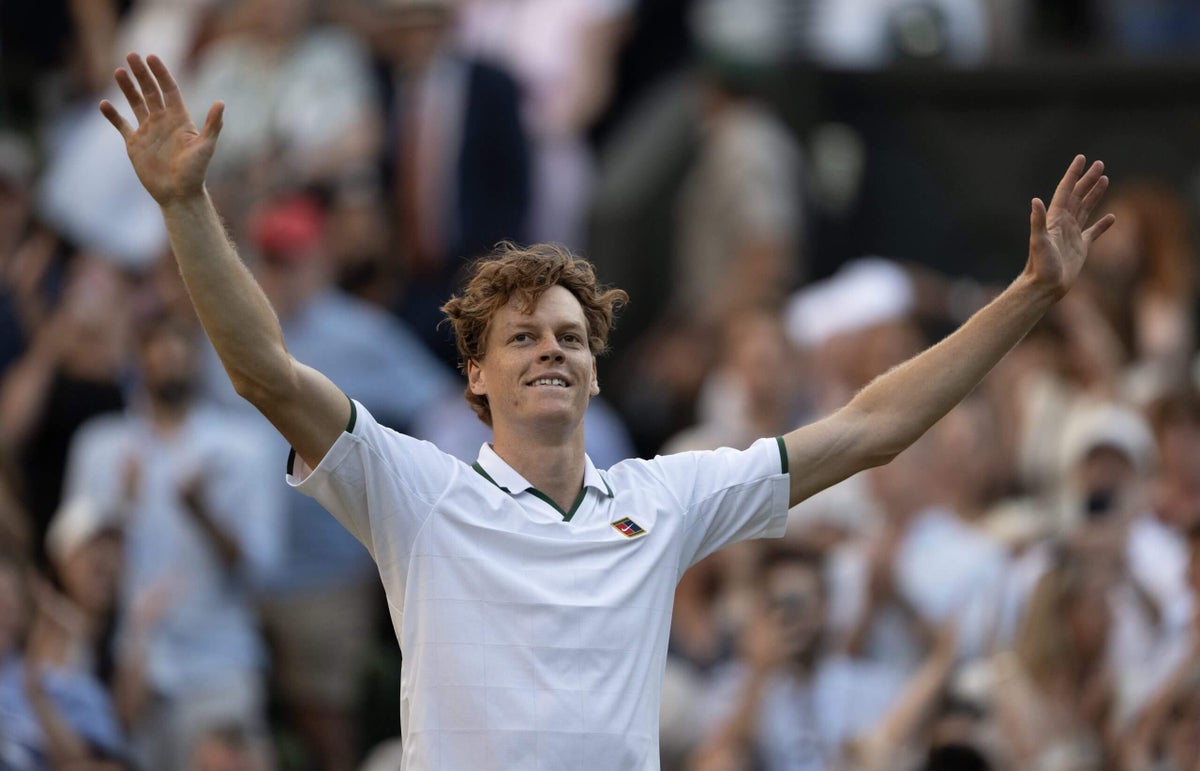
THE ALL ENGLAND CLUB, London — All the greats have been in this spot before. The one where winning one of the biggest titles in tennis, even the biggest, is par.
It is where Jannik Sinner found himself as he arrived in London last month, to play a second consecutive Grand Slam with his main rival, Carlos Alcaraz, on the sidelines. The previous one, the French Open, had turned into a catastrophe. A heat-and-illness-induced collapse felled Sinner, the top seed and overwhelming favorite, when he was a game away from victory in the second round against then-world No. 54 Juan Manuel Cerúndolo.
Immediately afterward, Sinner downplayed the impact of the weather. But as he arrived to defend his Wimbledon title, he reversed course, saying in a news conference at an exhibition event that he and his team had changed elements of his preparation in order to better manage hot conditions, which have troubled him too severely at too many tournaments.
After a long spring that included a winning streak of five tournaments and 30 matches, first on hard courts and then on clay, he opted not to play a tuneup on grass. He needed to rest, because one of the biggest tests of his career to date was coming up. It was pass or fail, and there was only one way to pass it.
The key to tennis commentating? Feeling the moment
Charlotte Harpur
Sunday on Centre Court, Sinner defended his Wimbledon title, fending off an emboldened Alexander Zverev after dropping the first set to win 6-7(2), 7-6(7), 6-3, 6-4.
“There is no failure if you don’t win a Grand Slam,” Sinner said in his news conference. “You just want to enjoy it. Today was a very tough day. If I lose, it’s still a great day. Playing a Grand Slam final, it’s so rare and so special.”
The 24-year-old Italian’s celebration after clinching victory with a forehand winner down the line told a slightly different story. Sinner has won massive titles and celebrated them with nothing more than a raise of his arms and a pump of a fist. With the most hallowed stage in the sport almost totally enveloped in shadow, he collapsed on the grass on his back and stared at the sky.
Sinner’s coach, Darren Cahill, had a different take again.
“It was just one of those things we don’t really have answers for,” he said of the Paris loss to Cerúndolo in a news conference.
“It goes to show the maturity of the player that we’re working with in Jannik, that he can take a kick in the guts like that, come back here, work his ass off.”
He talked about Sinner arriving 12 days before the start of the tournament, following long days in the heat of June on the French Riviera.
“He’s going to have a long, distinguished career,” Cahill said. “He’s going to put himself in a position to win more of these majors. I don’t think this one was any more important than any of the others that he’s played, but it felt damn special, that’s for sure.”
A year ago on Centre Court, Sinner came back from a set down to smother Alcaraz. Before it was over, Alcaraz turned to his coaches and all but waved a white flag, telling them he simply wasn’t able to hang with him on this day.
The loss sent Alcaraz back to his workshop, searching for the power and precision that could set him apart. He arrived in New York with a souped-up serve and a swaggering buzzcut. When they walked onto Arthur Ashe Stadium for the U.S. Open final, Sinner was three sets away from nearly matching Alcaraz in Grand Slam titles. By the time he walked off it, he was three back, having suffered the kind of loss that made him feel miles away.
Sinner then retreated to his own workshop, optimized his already fearsome serve again and got back on track. But then Novak Djokovic caught fire in their semifinal at this year’s Australian Open, beating Sinner in five sets. Alcaraz won the title two nights later, completing the career Grand Slam.
Sinner responded again. After a difficult period in February, in which his serve propelled him through tough moments as his baseline game wobbled, without getting worse in any meaningful way, he went on that run of irrepressible winning as the two elements of his game clicked in tandem.
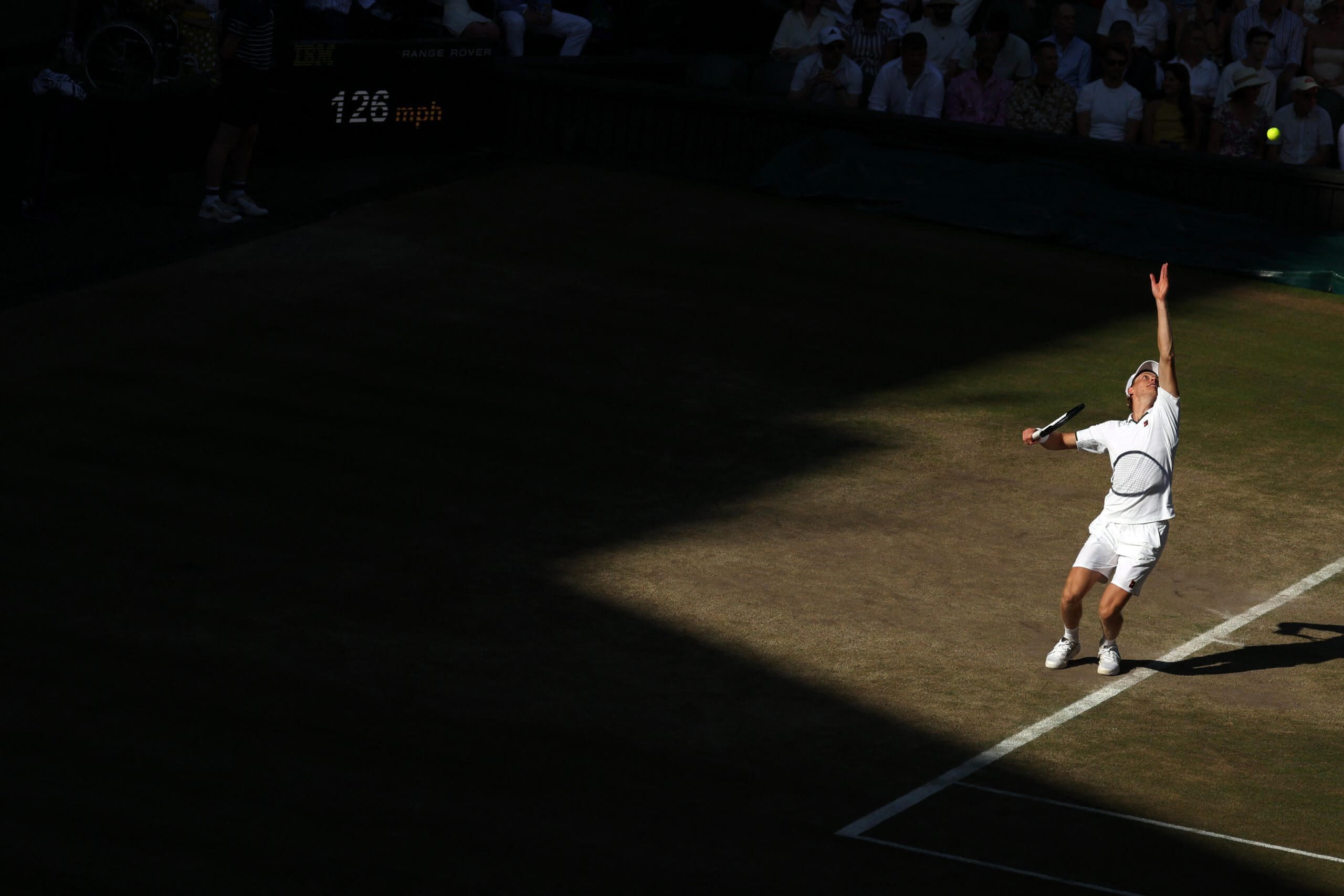
Jannik Sinner’s serve has been a buzzsaw this past fortnight. (Adrian Dennis / AFP via Getty Images)
He arrived at the French Open as world No. 1, undefeated in three months and with Alcaraz out indefinitely with a wrist injury that he is deliberately taking a long time to rehabilitate.
Winning any tournament is hard. There is depth and talent that can cause problems in any round. Still, given the distance that Alcaraz and Sinner had put between themselves and everyone else the past three years, the French Open and every ensuing Grand Slam without Alcaraz looked like a page in the history books waiting to be written, even if it changed the pressure equation for Sinner.
“It’s normal if your big opponent is out, to maybe feel a little more pressure,” Simone Vagnozzi, who, along with Cahill, has helped guide Sinner to the top of the sport the past four years, said in a news conference.
And then Paris went another way entirely. As Zverev was winning his first Grand Slam title at 29, Sinner and his team were trying to make sense of what had happened against Cerúndolo. He went for tests. They resolved to chase the heat in training. They also tweaked his match routines, Cahill said, keeping his core cool before taking the court, and taking breaks when they were available to get brief respites in air conditioning and to change his clothes, even if he didn’t seem to need to do anything like that.
All that came in handy, especially after his decision to eschew a tuneup tournament for Wimbledon. He knew his early matches at the All England Club might be messy. They were. Miomir Kecmanović pushed him to five sets and nearly four hours in the opening round. He never totally found his forehand through the fortnight, especially his down-the-line kill shot, and he often needed his brutally precise serve to carry the day.
But there was something else at work too as Wimbledon approached. Sinner was at risk of not being in possession of any of the sport’s most important titles while dominating it by every other metric. After Sinner beat Djokovic Friday in his best performance of the tournament, he made a rather stark comment in his news conference.
“It’s nice to be back in a Grand Slam final,” he said.
He entered it having won 10 of his 14 meetings with Zverev, as well as all of the past nine. He had won 12 consecutive sets against the player whose run to the final has lifted him to world No. 2, ahead of Alcaraz.
But as the first set wore on, Zverev, the 6-feet-6-inch German with a 135 mph serve that feels like it’s coming down from a skyscraper, was showing off the aggressiveness and initiative that has only recently become the central component of his game.
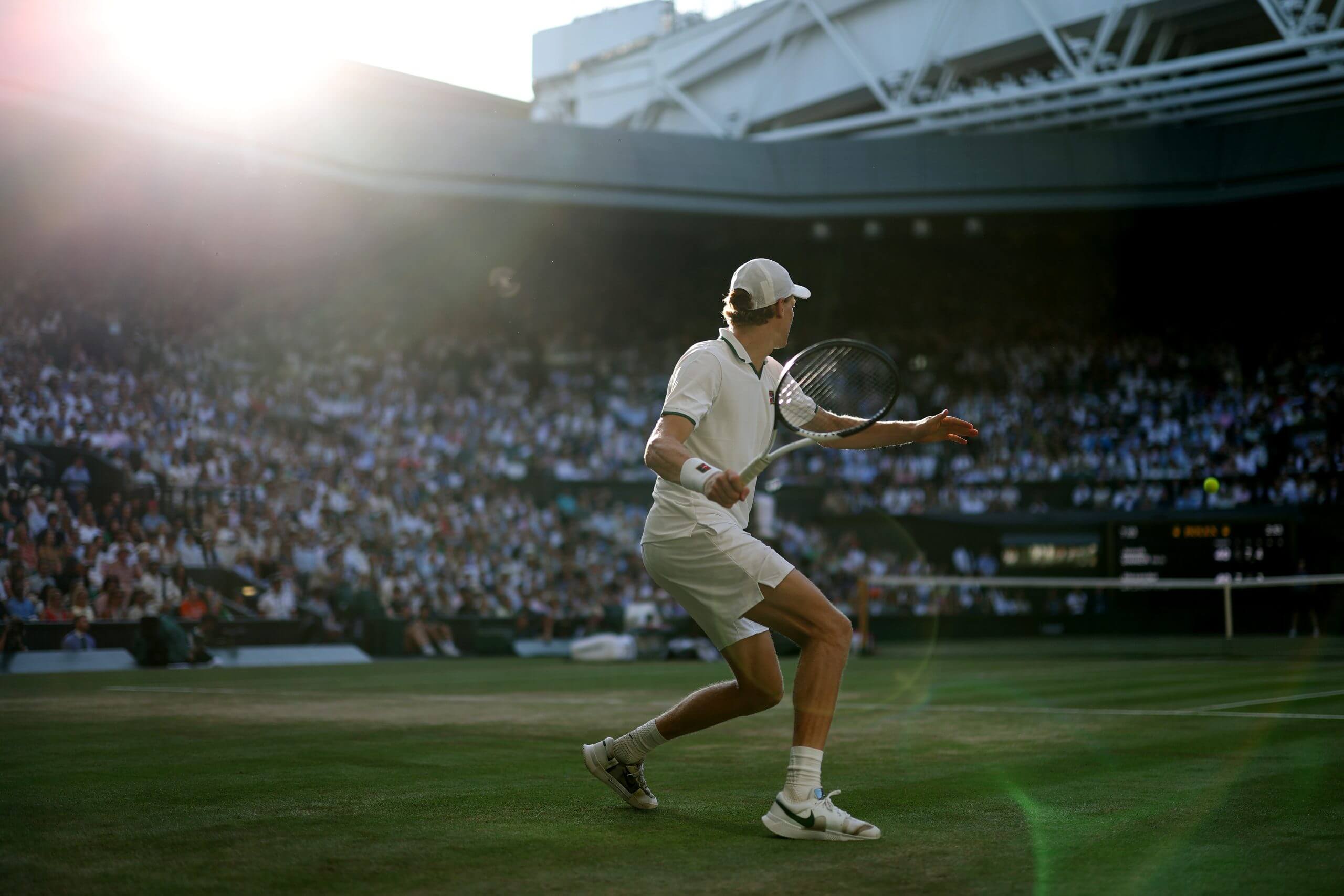
Jannik Sinner won the Wimbledon title without truly finding his baseline rhythm. (Cameron Spencer / Getty Images)
Sinner spent the first two-plus hours wandering the back of the court, searching for an effective return position. Zverev served perfectly in the first-set tiebreak and finished it with a massive forehand to the corner. He turned to his box as the crowd erupted and pumped his fist.
It was more of the same in the second set, up until the very end. Sinner was the world No. 1 and the defending champion. Zverev looked like the tennis protagonist, the one whose play was going to determine who won and who lost. But in the second-set tiebreak, the difference between them, the one that makes Sinner the dominant champion, came out in the wash. Zverev made five booming first serves, three to the center line and two wide, the latter both into Sinner’s forehand.
But none of the five scared the lines. Zverev and Sinner can both crank their serves. But only Sinner can combine that liquid power with devastating placement. Having decided to stick with a return position closer to the baseline, he middled his returns and won four of the five points. That gave him the tiebreak, as well as a decisive edge.
“We were playing on a very, very similar level, which is extremely high,” Zverev said in his news conference.
Then Zverev slipped and hyper-extended his knee near the end of the third set, allowing Sinner a momentary edge. His serve lost some pace and he couldn’t extend up to it fully. Sinner took the set, and held steady in the fourth, even as Zverev launched another barrage of forehands.
He did. But that was the margin. A bad forehand or two and a slip. Even as Sinner served out the match, he needed to survive a fierce backhand exchange and make a rather miraculous angled slice off a Zverev drop shot to get him to the point for the championship.
Then the test had one more question. He answered it, with that down-the-line forehand, and collapsed to the grass.