
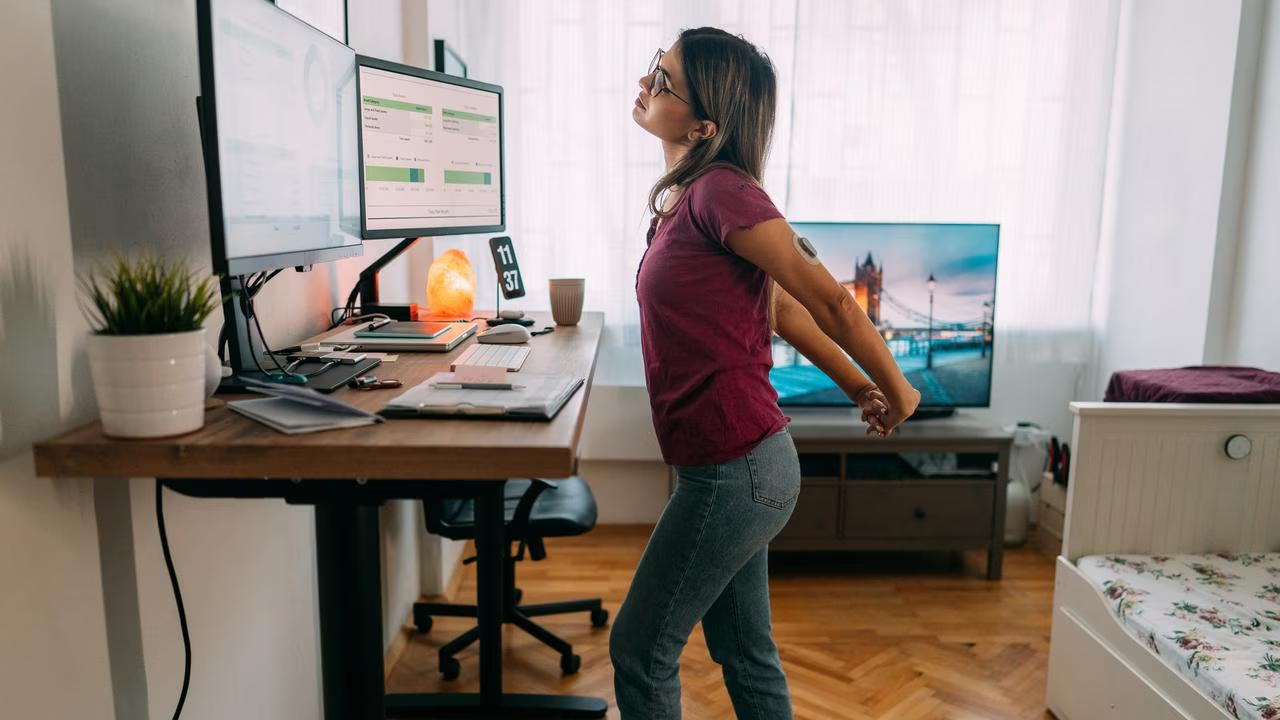
As debate once again heats up over working from home rights, a new Aussie study has confirmed everyone’s worst fears — WFH is making us fat.
RMIT academic Opoku Adabor, in a study published in the journal Economic Papers, crunched the numbers using data from the Household, Income and Labour Dynamics in Australia (HILDA) Survey, a long-running annual panel of around 17,000 Australians, from 2006 to 2021.

“Using household panel data from Australia, we find that working from home increases the likelihood of being obese over time,” Abador writes.
The study cross-referenced reported body mass index (BMI) with hours worked from home, which averaged 20.581 hours per week in 2021.
It found that each additional hour worked from home per week was associated with a rise in body mass index (BMI) of between 0.064 and 0.085 — equating to 200-250g for a typical man and 170-210g for a woman.
Each additional hour increased the likelihood of being obese by 7.5 to 9.1 percentage points.
BMI is calculated by dividing the person’s weight in kilograms by the square of their height in metres.
A person is defined as obese if they have a BMI score of more than 30, while overweight is between 25 and 30.
For an Australian man with the average height of 175cm, they would be considered obese after they tip over 92kg.
For a 162cm average-height Australian woman, 79kg is obese.
More than two-thirds of Australian adults are overweight or obese, at 36 per cent and 31 per cent respectively.
Covid restrictions saw the proportion of Australians who regularly work from home rise sharply between August 2019 and August 2021, from 32 per cent to 40 per cent, with that figure settling to roughly 37 per cent as some level of WFH arrangements become the new normal.
Investigating the drivers of WFH workers’ bulging waistlines, Abador’s analysis of the HILDA data found working from home was associated with increased expenditure on meals eaten at home and reduced physical activity.
“Working from home reduces physical activity associated with taking transport, especially public transport in Australia,” the paper states.
“A second potential explanation for this finding is that people who often work from home can develop poor eating habits, which can lead to obesity over time because of a lack of strict office rules like lunch breaks and no-smoking orders, among others.
“Thus, those who work from home exercise absolute control over their eating habits compared to their counterparts working in the office. Hence, people who work more hours from home and cannot exercise restraint over their eating behaviour can become obese over time.
“The final potential explanation for this finding is that employees working from home can get access to their kitchen, leading to more frequent snacking or eating out of boredom.”
Adabor further broke down the analysis into six different sub groups — males, females, people with a bachelor’s degree or higher, those without a degree, and high-income households.
He found the rise in BMI associated with working from home was strongest for women, high-income households and people with a bachelor’s degree or higher.
“Working from home is prevalent in many developed countries; however, its impact on obesity has received far less attention in the literature,” Abador writes.
“This study fills an important gap in the literature by examining the impact of working from home on obesity while considering the mediating effect of physical activity and eating habits using nationally representative longitudinal data for Australia.”
The study officially adds WFH to the long list of factors that contribute to obesity, joining the literature alongside unhealthy foods, sleep, smoking, age and eating behaviour, among others.
It recommends establishing a daily schedule that includes short, frequent breaks for physical activity such as stretching, walking and engaging in mini-workouts, as well as daily exercising at the gym while working from home.
Similarly, setting regular meal times to help regulate frequent, unplanned eating could also help reduce obesity over time.
“Since working from home provides easy access to the kitchen, employees need to stock their kitchen with healthy snacks like fruits, vegetables, nuts and yoghurt,” the study says.
“Avoid keeping high-calorie, low-nutrition snacks and others in the kitchen.”
It comes as Victoria moves to enshrine working from home in law, with a bill making its way through state parliament that would give all Victorians the right to work from home two days per week if it is reasonable to do so, with pro rata arrangements for part-time or casual workers.
The Allan government intends to have the laws ready to go by September 1, but a peak business group has called for an urgent overhaul of the proposed laws and delay of the start date to March 1 to give employers more time to prepare.
While Victoria ploughs ahead, employees with working from home arrangements more broadly are facing a reality check after a series of landmark rulings handed down by the workplace tribunal in recent weeks made it clear WFH is not an automatic right.
Under the Fair Work Act, employers can only refuse a flexible work request on “reasonable business grounds”.
The Fair Work Commission is now actively testing the boundaries of what constitutes a reasonable refusal, and the balance of power is shifting back toward the office.
Last week, the tribunal sided with Victoria’s Macedon Ranges Shire Council in its decision to keep a senior planner in the office two days per week.
The council had rejected Steven Polak’s request for an extra day working from home, after he said he was suffering work-related fatigue and argued he could still perform his duties effectively through Microsoft Teams.
That came after the FWC ruled in June that AGL customer service worker Mele Taunisila would have to go into the office for just four hours every two weeks, after she had rejected the offer and took her demand for full WFH rights to the tribunal.
— with NewsWire