
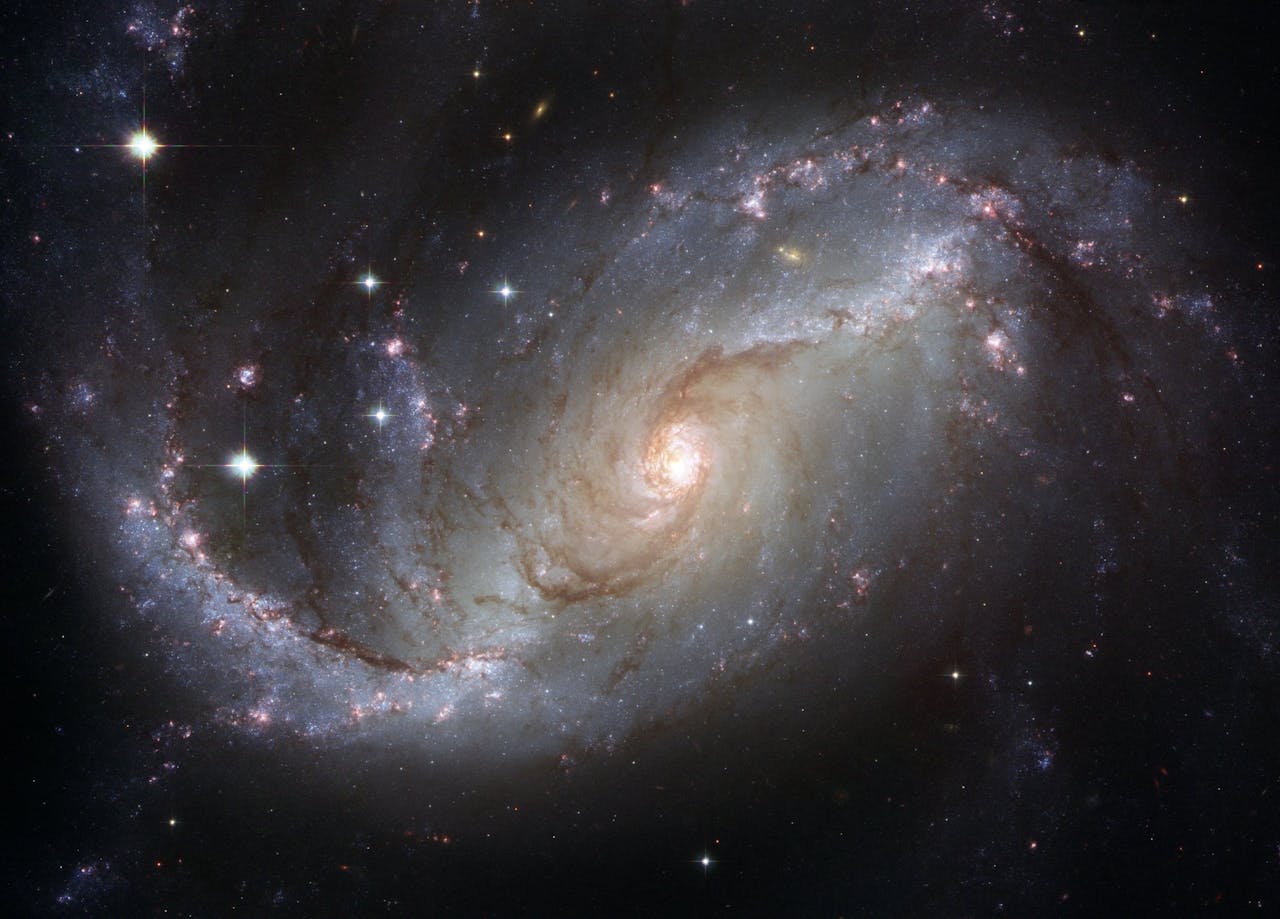
High atop a mountain in Chile, under some of the world’s clearest, darkest skies, a new era of astronomy has begun. Since June 30, 2026, the Vera C. Rubin Observatory has been conducting its ten-year Legacy Survey of Space and Time (LSST). The project includes a team of Hungarian researchers and a telescope with Hungarian roots, the Hungarian Research Network (HUN-REN) reported.
What makes the Rubin Observatory unique is not a single record-breaking specification, but the combination of three technological achievements: enormous light-gathering capacity, exceptional agility, and an unusually wide field of view. Most of the world’s largest telescopes excel in only one or two of these areas because of physical constraints. The new observatory in Chile is the first to combine all three. The project is funded by the U.S. National Science Foundation (NSF) and the Department of Energy (DOE).
In practice, the facility pushes the boundaries of modern astronomy.
Equipped with an 8.4-meter primary mirror and the world’s largest digital camera, boasting 3.2 billion pixels, the system captures a razor-sharp image roughly every 40 seconds. Within just a few nights, it surveys the entire southern sky.
Over the course of its planned ten-year mission, the telescope will observe every point in the sky about 800 times. The result will not be a static snapshot, but a high-resolution, full-color “movie” of the universe. Only this continuous repetition allows astronomers to detect and study slow, unpredictable, or rare cosmic events.
The volume of data is unprecedented. Every night, the observatory collects around 10 terabytes of raw data.
Fully automated systems, known as alert brokers, analyze the images in real time and generate up to seven million alerts each night, flagging changes in the sky—from newly appearing light sources and fluctuations in brightness to moving objects. This enables astronomers around the world to respond within minutes, directing other telescopes toward exploding stars (supernovae), collisions involving compact objects, and other transient phenomena.
The system has already demonstrated its capabilities during the commissioning phase.
In just a few weeks before official operations began, the telescope discovered more than 11,000 previously unknown minor planets, including 33 near-Earth objects and 380 bodies beyond Neptune’s orbit.
By the mid-2030s, the project is expected to deliver the most complete inventory of our Solar System ever assembled, detecting millions of asteroids and comets—including interstellar visitors from other planetary systems.
Beyond mapping the sky, the survey aims to answer some of the most fundamental questions in physics:
What holds the universe together, and what is driving its accelerating expansion?
By measuring the weak gravitational lensing effect—tiny distortions in the shapes of distant background galaxies—researchers hope to produce the most detailed map yet of the universe’s invisible dark matter. They also aim to determine whether dark energy is truly a constant property of space or has evolved over cosmic time.
The project is a global collaboration involving scientists from 43 countries alongside teams from the United States and Chile. Among them is a 25-member Hungarian research group made up of experts from the HUN-REN Research Centre for Astronomy and Earth Sciences, Eötvös Loránd University (ELTE) in Budapest, and the Gothard Astrophysical Observatory in Szombathely.
Through the project’s in-kind contribution program, the Hungarian team is developing software for the survey and, in return, receives direct access to its data streams.
Our researchers will be at the forefront of the science—from studying variable stars and mapping the Solar System, to carrying out large-scale cosmological analyses of the universe,”
said Róbert Szabó, head of Hungary’s LSST team.
Hungary will also become a focal point for European astrophysics later this year. At the end of September 2026, Budapest will host the eighth LSST@Europe conference, welcoming around 150 leading researchers from around the world.
The survey telescope at the heart of the observatory bears the name of Hungarian-American software pioneer and entrepreneur Charles Simonyi.
His generous private donation made development of the telescope’s primary mirror possible before public funding was secured.
The observatory itself is named after American astronomer Vera Rubin (1928–2016), whose pioneering work on the rotation of galaxies in the 1970s provided the strongest evidence to date for the existence of dark matter.
When the ten-year LSST concludes, its final data archive will contain observations of billions of celestial objects and trillions of individual measurements. Never before has an astronomical dataset of this scale been made available to the public. While the real-time alerts will be issued immediately, the fully processed survey data will be released two years after collection, giving professional astronomers, amateur skywatchers, and the wider public unprecedented access to one of the richest scientific datasets ever created.
Related article
Tracing Dark Energy: Researchers Map Hundreds of Millions of Galaxies
The methods developed during the experiment will serve as direct models for major upcoming sky surveys in the coming years.Continue reading
Via hun-ren.hu, Featured image: Pexels