
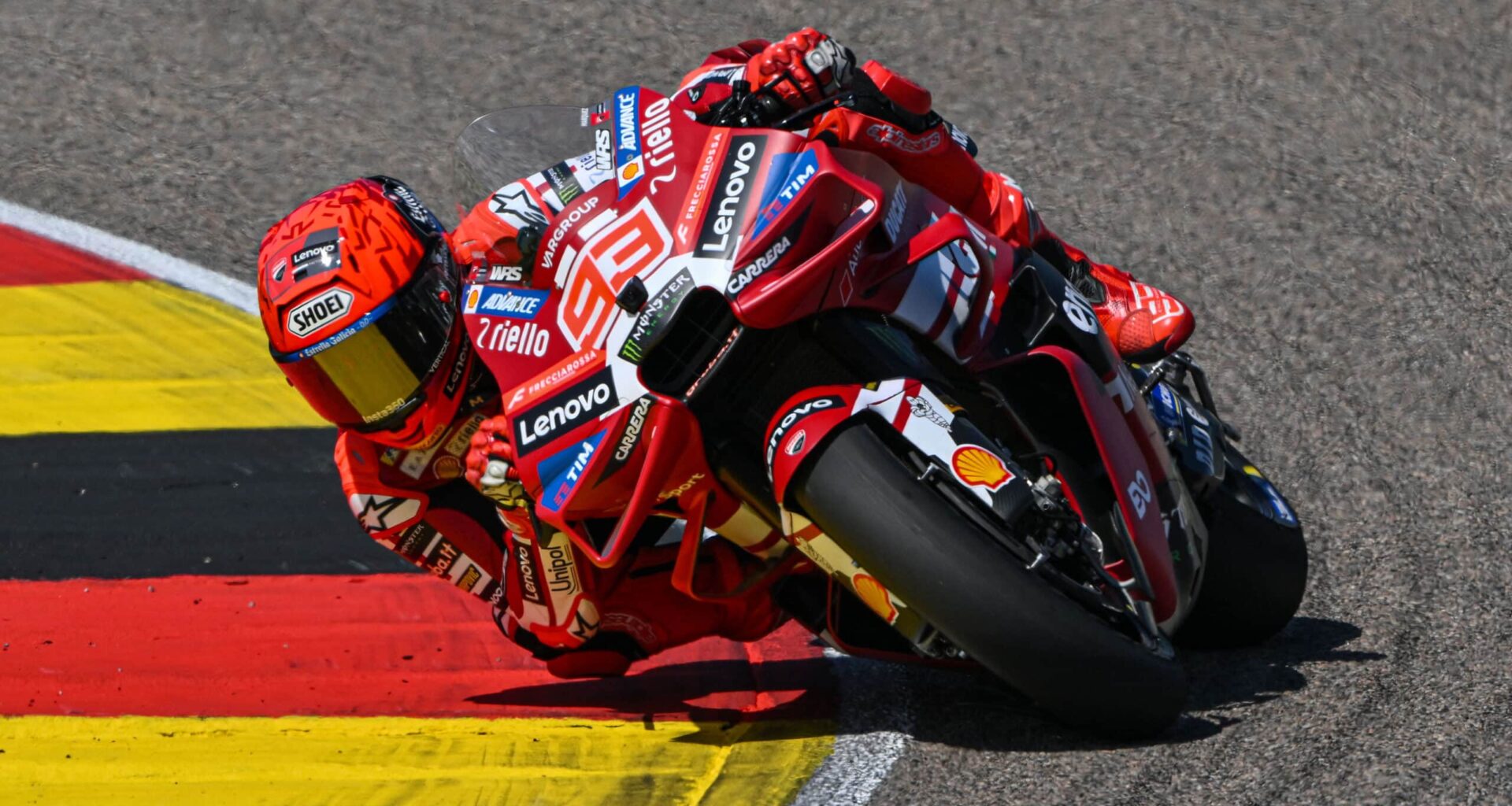
Sachsenring is Marc Márquez’s happiest hunting ground – on Sunday he equalled the all-time circuit wins record of ten victories, set by Giacomo Agostini at Finland’s Imatra street circuit – so it was a weekend to attack, but this was a cautious offensive, not a full-blooded, tyre-smoking, sideways assault.
This was minimum Márquez, not maximum Marc, so he only looked on the edge once all weekend, when he tipped over it on his third lap of FP1. The rest of the time he never did more than was absolutely necessary, because he is fully aware of his fragility.
“I already said the last race – we are trying to attack where I feel okay and survive when we have difficult tracks,” he explained. “If we want to fight for the championship I need to improve my right arm. It’s the only point I need to improve. So this summer break, I will take a rest, of course, because I need it for the mental side, but I need to work very hard on the right arm, because sometimes I’m just sat on the bike, I cannot play with my body, so that’s there where I want to work.”
Currently, Márquez has two hours of physio per day, seven days per week.
“From January to before Brno, a lot of hours of physio. But since Assen I try to train more in the gym and do less physio, because now the arm doesn’t have any inflammation. We are working a lot on the left arm also, because [when I ride] I’m compensating a lot with my left side. I have a lack of power in my right side but more pain in the left side.”
The completion of the first half of the 22-round 2026 championship gave Márquez the chance to reflect on another physically traumatic period in his battle-scarred career. He went into the season with his much-mangled right arm and shoulder still recovering from a crash at Mandalika last October, when he was taken out by Marco Bezzecchi. That fall required yet more surgery, which should’ve fixed this latest injury, but it didn’t. A loose screw – lurking in the upper arm – was blocking his radial nerve.
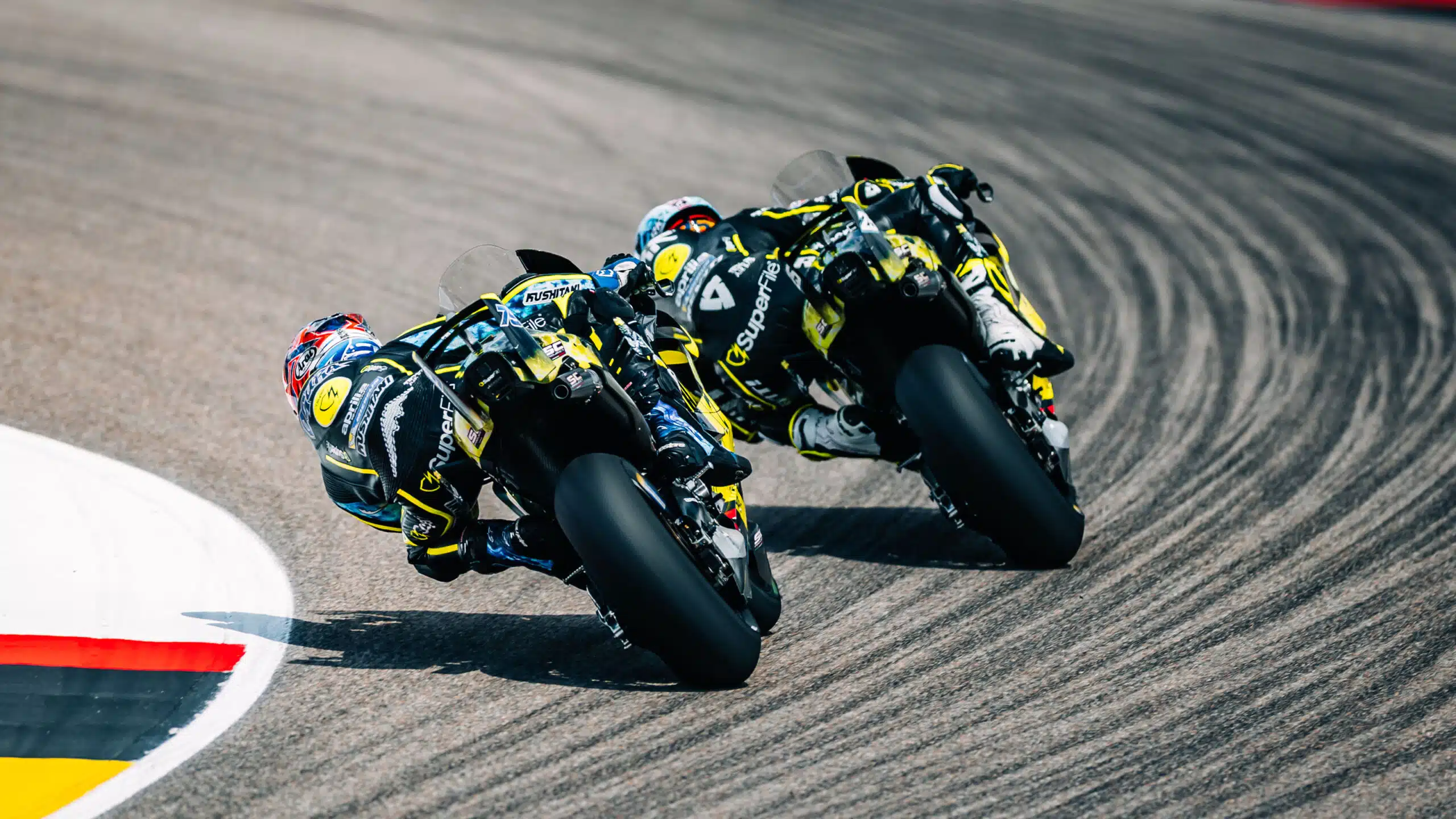
Trackhouse Aprilia’s Ogura and Fernández scored their second double podium in as many races
MotoGP
“You cannot imagine how stressful the first part of the season was for me, because I didn’t understand anything,” he added. “I was crashing without knowing what was going on, because the arm was disconnecting, so I was crashing in a strange way many times and I made some mistakes.”
The weak, iffy arm caused him to crash out at Jerez and again at Le Mans, after which he underwent further surgery to remove the rogue screw. He missed two races, returning at Mugello, which he ended in seventh, leaving him eighth overall, 102 points down on points leader Bezzecchi, apparently out of the championship fight. Now he is third overall, 18 points behind current leader Jorge Martin and four behind second-placed Ai Ogura.
Just a few points behind Márquez stand Bezzecchi and Fabio Di Giannantonio. This top five is covered by just 25 points, after fighting for the 407 points available at the first 11 rounds.
They’re all riding the razor’s edge… sometimes pushing riders over the precipice
This is the closest halfway top five in MotoGP history, by a long way, which makes 2026 a freak year. The racing may not be exactly thrilling but the championship contest has never been tighter.
By comparison, the halfway top-five gap in 2016 was 87 points, in 2006 it was 47 points and in 1996 it was 88 points. If we adjust these scores from the former maximum of 25 points per weekend to the current maximum of 37 (12 for Saturday, 25 for Sunday), those old numbers are even more out of whack with today’s points: gaps of 129, 69 and 130 points. It’s the same story going all the way to MotoGP’s earliest days – the 1950s – the championship was always much more spread out.
What explains this phenomenon? Two factors – Aprilia and Ducati – each with several very fast riders, plus spec tyres, spec electronics and the rest of MotoGP’s performance parity regulations.
And plenty of no-scores: Bezzecchi has crashed out of six sprints/races (one of those not his fault), Martin and Márquez have fallen in three, Di Giannantonio in two. Ogura? He hasn’t crashed out once.
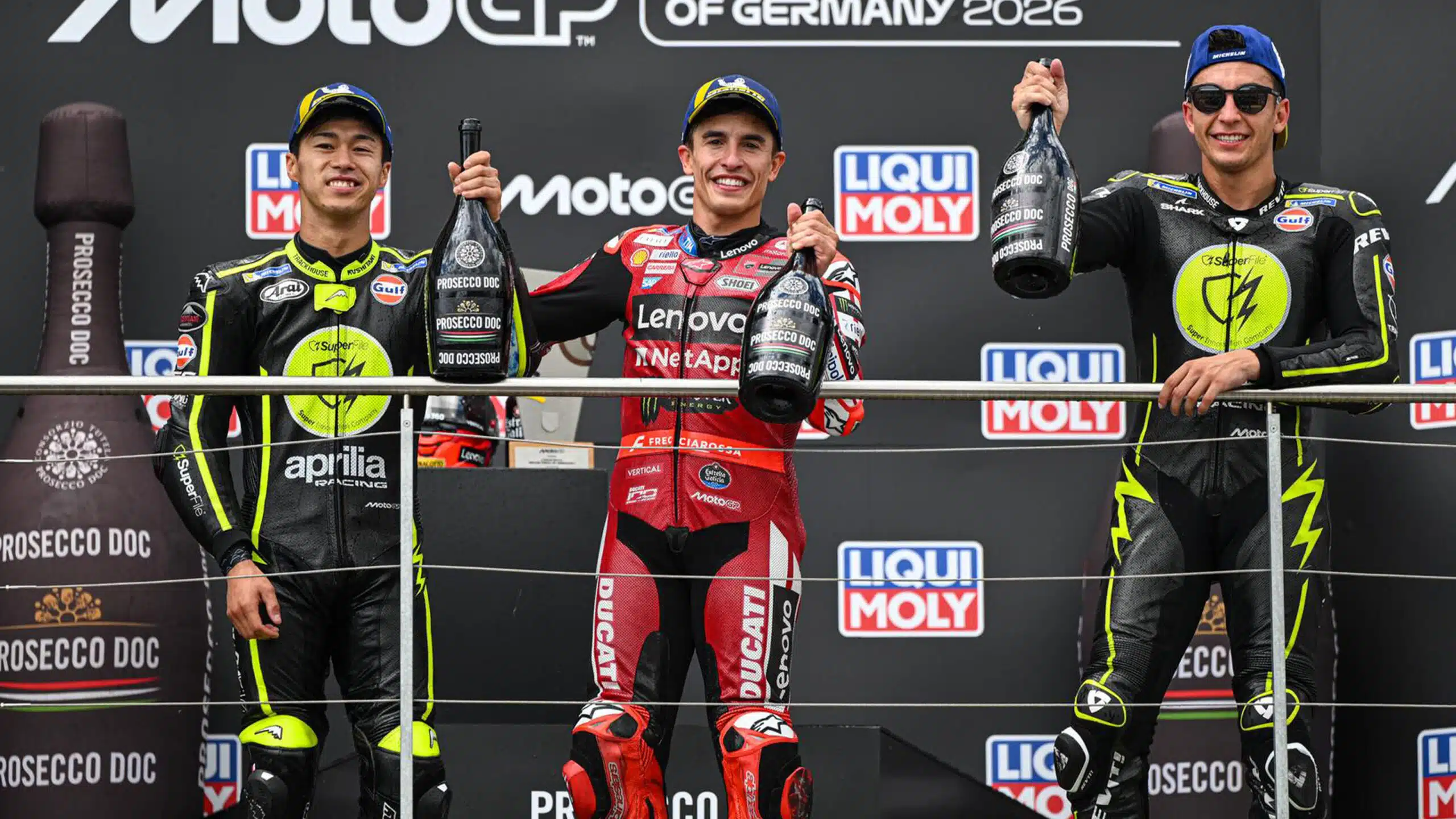
Ogura, Márquez and Fernández on Sunday – Ogura is Márquez’s biggest threat
MotoGP
Why so many crashes? Because they’re all riding the razor’s edge, all the time managing a tricky misbalance of grip between front and rear tyres, with the rear often pushing the front into corners, sometimes pushing riders over the precipice.
With 11 rounds done and 11 to go, it’s Martin on an Aprilia, Ogura on an Aprilia, Márquez on a Ducati, then Bezzecchi on an Aprilia and Di Giannantonio on a Ducati. And Raúl Fernández on another Aprilia in sixth, 25 points behind Di Giannantonio. The top rider on another brand is the ever-entertaining Pedro Acosta, plying his trade on a KTM, 60 points off the lead.
Most riders and other pitlane people rate Márquez as the favourite.
“We all know who’s the best rider and I think he will win the championship,” said LCR Honda sub Cal Crutchlow, who on Sunday was close to scoring his first points since 2023 until he fell.
Márquez is favourite for obvious reasons: his talent, his speed, his strategy, both on and off the track, and his ability to build a championship. And his Desmosedici GP26 is much friendlier than his GP25, although sometimes not quite as good as Aprilia’s RS-GP.
Who should he fear most?
Martin leads the way but in unconvincing fashion. He crashed out of both Catalan races and caused the Turn 1 pile-up in Hungary. He also withdrew from the Spanish GP with brake problems.
The 2024 champ has been very up and down: winner in France, second in Brazil, the USA and Italy, then off the podium more times than on it. At Sachsenring, he fought a long duel for fifth with Ducati’s Pecco Bagnaia, half a second off Márquez’s winning pace.
Why? Because he still hasn’t tailored the Aprilia to his riding style.
“The characteristic of Jorge is to try to somehow force the corner entry,” says Aprilia’s technical director Fabiano Sterlacchini. “This is probably a strong point, but sometimes it’s also his kryptonite. Where we have the problem with the front tyre is when the hard spec is a bit on the limit.”
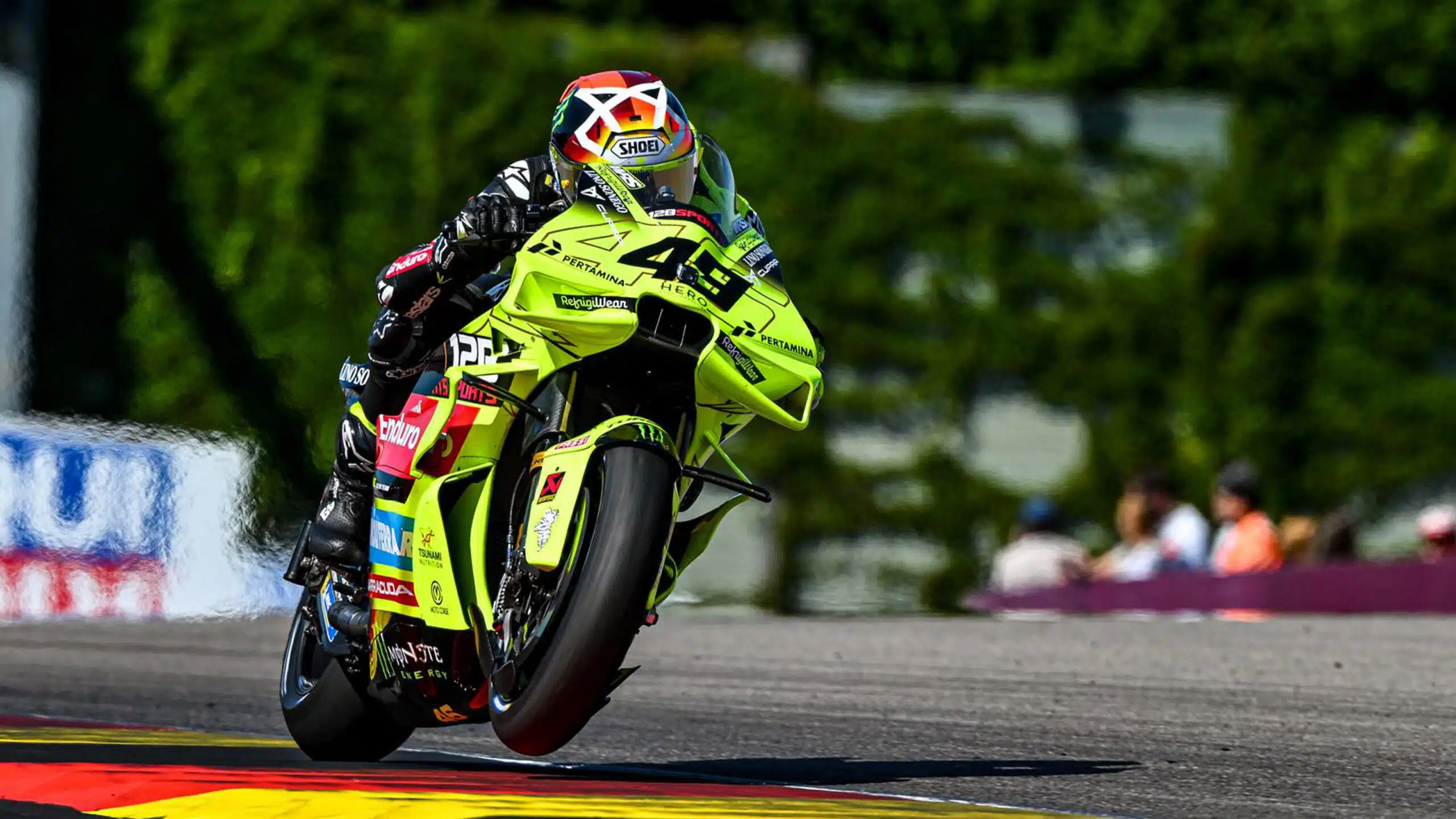
Di Giannantonio made the podium in the sprint, then crashed out of the GP
MotoGP
And the hard was a bit on the limit at Sachsenring, so Martin struggled with front grip all weekend, leaving him unable to get close to fighting for podiums.
Martin felt better in the earlier stages of the season and thinks his crash-marred Catalan weekend – where he fell six times in four days, may have started the rot.
“I think Barcelona, after so many crashes, something clicked,” he said on Sunday. “But today wasn’t because I don’t feel confident, it’s because I’m losing the front. We need to work on that, and maybe work on my style, and try to understand how to be faster.”