
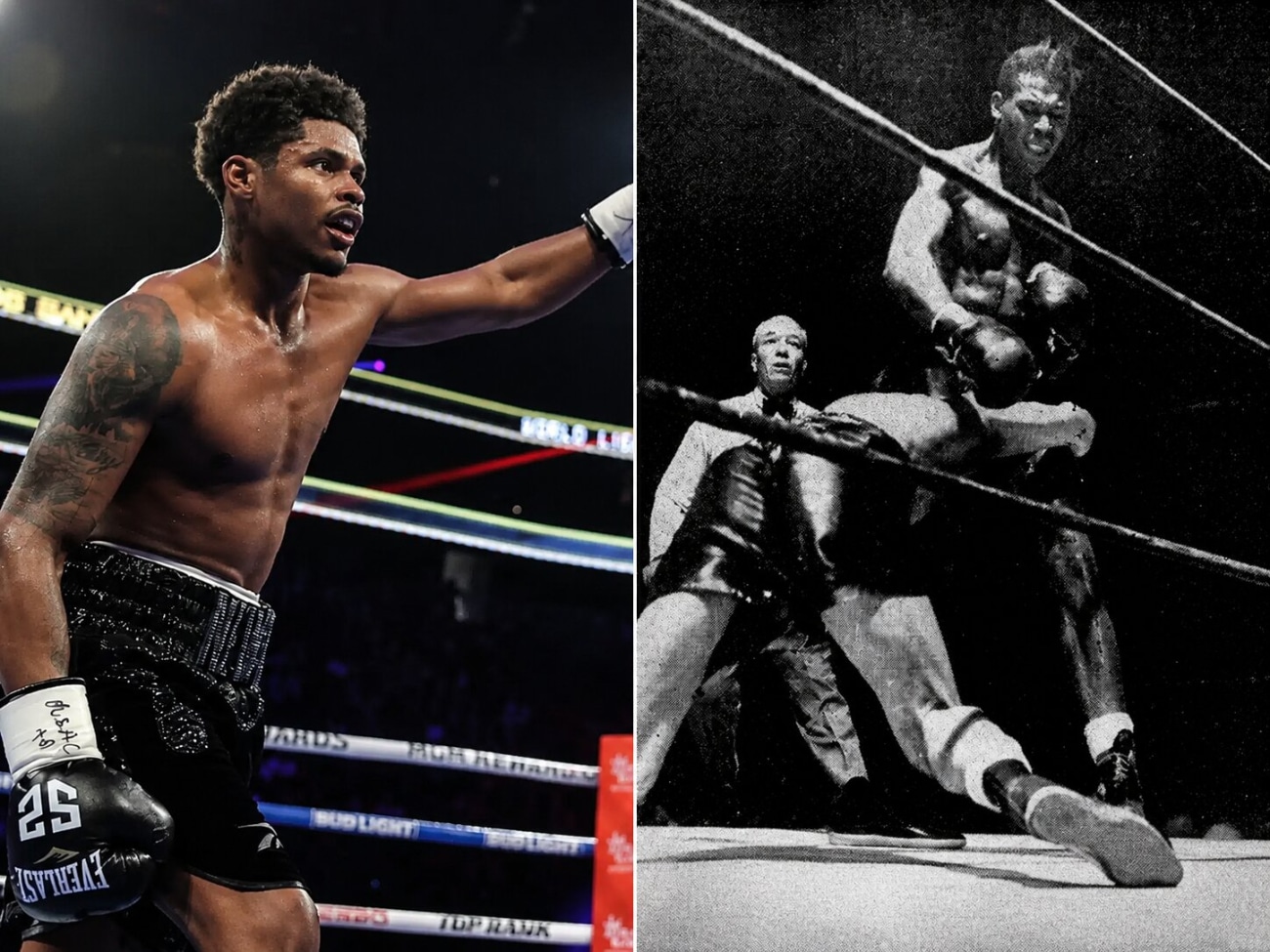


The post comes after weeks of debate over his support for catchweight fights, including the previously discussed 144-pound bout with Devin Haney instead of meeting at the full 147-pound welterweight limit.
Shakur has maintained that negotiating a catchweight is a practical decision rather than a sign of fear. His latest message doubled down on that position, arguing that he has spent his career defeating opponents with natural size advantages.
Critics, however, point to boxing history.
When Sugar Ray Robinson moved up to light heavyweight to challenge Joey Maxim for the title, he didn’t demand Maxim strip off a few pounds to accommodate him. Robinson weighed in at just 157 and a half pounds, giving up nearly 16 pounds to the champion, and fought in the blistering 104-degree heat. He didn’t ask middleweight champion Jake LaMotta to meet him down at a catchweight.
The legends of that era believed that if you wanted the glory of conquering a higher division, you had to beat the man at his weight.
Roberto Durán similarly moved from lightweight through welterweight, junior middleweight and middleweight, taking on elite opponents such as Sugar Ray Leonard, Thomas Hearns, Marvin Hagler and Iran Barkley at the divisions’ established weight limits.
The comparison isn’t perfect because catchweights are far more common in today’s boxing landscape than they were during Robinson’s and Durán’s eras. Modern super fights frequently involve negotiated weights to satisfy both camps.
Still, the debate surrounding Shakur centers on perception. If he believes he can consistently beat naturally bigger fighters, some fans question why a catchweight is necessary in the first place.
Shakur appears unconcerned by the criticism. His message made clear that he believes the doubts will disappear once he gets the opportunity to prove himself in the ring.
Ken Woods has been a senior writer at Boxing News 24 since 2013, covering the sport from every angle. With years of ringside reporting, he delivers fight news, results, and analysis that cut through the noise. Ken’s work consistently spotlights champions, contenders, and rising prospects, giving fans a sharp, knowledgeable view of the global boxing scene.