
Paris has become one of the world’s leading cycling cities, and a new study explains exactly how it happened. Researchers found that bicycle traffic in the French capital increased by 240% between 2018 and 2023, driven not by a single bike lane or policy, but by a coordinated strategy that combined protected cycling infrastructure, restrictions on car traffic, better public spaces, and sustained political commitment.
The findings offer an important lesson for cities across North America. As communities from Toronto and Montreal to New York, Chicago, Vancouver and Los Angeles invest in safer streets and active transportation, Paris demonstrates that dramatic increases in cycling are achievable—even in a city once defined by congestion and car traffic. The research suggests the biggest gains come when cities make cycling both easier while making driving less convenient.
That transformation would have seemed unlikely just a few years ago. Not long ago, Paris was better known for traffic jams than bike lanes. Cycling through the city meant weaving between buses, taxis and scooters, while most residents relied on cars or transit. Today, protected bike routes criss-cross the city, parents take children to school by cargo bike, commuters ride comfortably along the Seine, and bicycles have become a normal part of everyday life.
The study shows this wasn’t a cultural accident. It was the result of deliberate, data-driven policy—and it offers a roadmap for any city hoping to reduce congestion, cut emissions and get more people riding bikes.
“Paris is an incredible example of how a city can transform when political will meets smart data,” says one of the report’s lead authors. “We wanted to understand exactly which factors made this happen.”
How the Study Was Conducted
To get those answers, researchers gathered and analyzed a range of data to see what truly drove Paris’s cycling boom. They tracked daily bike counts from 114 permanent bicycle counters scattered across the city—sensors that detect only bicycles, providing a precise, long-term view of cycling traffic patterns.
Because weather and events can skew short-term data, the researchers removed outliers and focused on median daily values to represent overall trends. They paired that with weather data from Paris-Orly’s WMO station, factoring in temperature, rainfall, humidity, and wind, as well as holidays, lockdowns, and strikes that could influence travel behavior.
But it was the policy data that told the real story. Drawing from sources like OpenStreetMap, Vélib’ Nocle, INSEE, and the City of Paris open data portal, the team assembled a detailed timeline of public policy changes: the creation of new bike lanes and parking, e-bike sales growth, rising fuel prices, and the introduction of low-emission zones. They also tracked more indirect urban improvements like expanded pedestrian areas, new green spaces, and traffic-calming initiatives.
Altogether, the analysis covered 13 policy factors across five key areas:
Targeted cycling policies
Restrictions on motorized vehicles
Disruptions to other transport modes
Livability improvements
Economic conditions
Because these policies often overlapped—for instance, a bike lane might coincide with a pedestrian street or nearby green corridor—the researchers used dependence-aware statistical methods to untangle how much each variable actually mattered. Two advanced tools, StratIMPORT and kernel SHAP, helped estimate the relative influence of every factor on daily cycling traffic.
StratIMPORT looks at real-world data distributions to see how strongly each variable affects an outcome, while kernel SHAP—a model interpretability tool often used in machine learning—compares how each factor shifts traffic relative to a baseline year (2018).
When both models largely agreed, it gave the researchers confidence: the most important driver wasn’t a single intervention, but rather the cumulative effect of consistent, coordinated policies.
The Recipe for a Cycling Boom
The study’s findings show that targeted cycling policies, such as building dedicated lanes and improving bike parking, were major contributors to the rise in ridership. But equally important were measures that discouraged car use—like low-emission zones, traffic restrictions, and fuel price changes. The two forces worked hand-in-hand: making biking easier and driving less convenient.
In other words, it wasn’t just about infrastructure. It was about changing the city’s DNA.
When streets became calmer and safer, more people felt comfortable trying a bike commute for the first time. Families who might have once stuck to sidewalks began pedaling to the park. Local businesses saw new life as streets opened up to foot and bike traffic. And over time, cycling stopped feeling like a niche activity—it became part of everyday Parisian life.
The researchers also found that “livability” policies—like adding trees, pedestrian zones, and public plazas—had a measurable indirect impact. When people enjoy being outside, they’re more likely to move through the city under their own power.
Paris: From Policy to Culture
It helps, of course, that Mayor Anne Hidalgo made cycling a centr
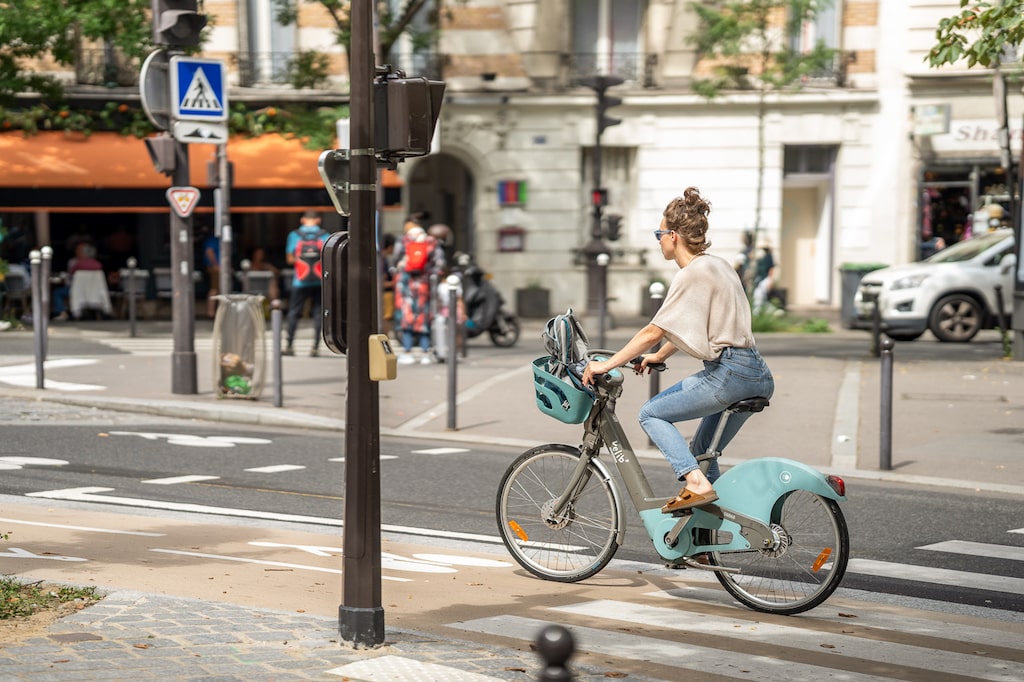
Bike share in Paris, France
al political goal. Her administration’s “Plan Vélo” didn’t just aim to build bike lanes; it set out to reshape how Parisians move. Since 2020, Paris has built more than 1,000 kilometres of cycling infrastructure, removed thousands of parking spaces, and committed to spending €250 million on cycling through 2026.
The city’s Vélib’ bikeshare system, once struggling, has exploded in popularity, with more than 400,000 subscribers and millions of trips each month. Meanwhile, the streets around schools have been redesigned as car-free zones, encouraging children to walk or bike safely.
The cultural shift is now visible everywhere. Stylish commuters ride step-through city bikes in suits. Delivery riders and parents with cargo bikes share the same lanes. Cafés are full of folded helmets and reflective vests. Cycling in Paris has gone from daring to delightful.
Lessons for Other Cities
The Paris study offers more than just a success story—it’s a blueprint for transformation. For cities that still believe “people here won’t bike,” the data says otherwise.
The lesson is clear: change is possible when policy, infrastructure, and public space all point in the same direction. It’s not enough to paint a few bike lanes and hope people come. Cities need to design environments where cycling feels natural—where the fastest, safest, and most enjoyable way to get across town happens to be by bike.
It also requires persistence. Paris didn’t achieve this overnight, and not without pushback. Critics warned that removing car lanes would create chaos. Yet, traffic didn’t collapse—it simply adjusted. Commuters shifted to bikes, transit, and walking. The air got cleaner, noise levels dropped, and neighborhoods came alive.
Cities like London, Bogotá, Montreal, and New York have all seen similar gains when they’ve committed to sustained, data-backed cycling policies. Paris just happens to have taken it further—and faster—than most.
The Road Ahead
Paris’s cycling revolution isn’t finished. The city is still planning to become “100% cyclable” by 2026, connecting every neighborhood with a safe route and training thousands of residents in urban cycling.
But perhaps the most inspiring takeaway is psychological: it shows what’s possible.
For decades, cities around the world have said they’re too spread out, too cold, too hilly, too car-dependent to make cycling mainstream. Paris proves that narrative wrong. Change the street, and people will change with it.
In the end, the French capital didn’t just build bike lanes—it built belief.
And that, more than anything, is what other cities should take from this study: not just a roadmap, but the confidence that transformation can happen anywhere, if you’re brave enough to start pedaling.