
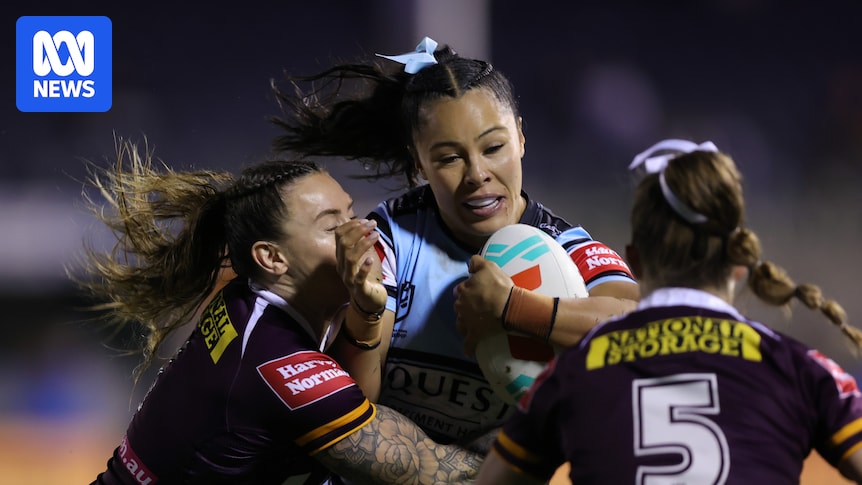
Women’s rugby league players are calling for more fixtures and better pay packets as the NRL considers how to spend the billions of dollars broadcasters are dumping into the game.
It comes as the agreement governing NRLW salary caps and minimum wages, in force since 2023, edges closer to expiry at the end of the 2027 season.
Negotiations on a new deal are yet to begin, but on the 20th anniversary of the NRL’s Women in League round, Cronulla captain Tiana Penitani-Gray knows what she wants included.
“Being able to expand the salary cap, being able to make the women players full time is definitely a step in the right direction,” she said.
“Take away financial insecurity, take away having to juggle multiple jobs or study alongside the expectation of putting out a professional product.”
The agreement gradually increased female players’ minimum wage from $30,000 to $50,600 per season, taking a team’s total salary to more than $1.5 million by 2027.
By contrast, the top 30 male players in every NRL club will collectively earn $12.1 million that year.
Apart from raising wages, lengthening the NRLW’s season would boost the quality of games and reduce the risk of injuries, Canterbury-Bankstown captain Tayla Preston said.
“We have such a long off-season, girls are going to come and pick up injuries quite quickly,” she said.
“We’d love to have a bigger pre-season … because some of us might take a couple of rounds to get going.
“You kind of don’t have that time on your side.”
From a three-round debut NRLW season in 2018 featuring just four teams, the tournament now boasts 12 clubs playing nine regular fixtures and a three-week finals period.
On his second-last day at the helm, outgoing NRL CEO Andrew Abdo’s heart was on more expansion, and his mind on the $5.3 billion broadcast rights deal he had inked the week before.
Do you have a story idea about women in sport?
Email us abcsport5050@your.abc.net.au
“It’s not just about investment, which only enables the salary cap to grow, but it’s also going to fuel the growth of the number of teams that we have … taking it to new markets and winning new fans,” he said.
“I think the [Australian Rugby League Commission] will be very strategic about where those licences are awarded, and there’s no shortage of interest.”
But female players have warned adding teams willy-nilly while ignoring the grassroots level risks creating a lopsided, hollow competition.
Penitani-Gray and Preston said while the goal was to have a women’s team for every NRL club, it should not be a target to be achieved at all costs.
“Expansion, but the right kind of expansion, not always adding new teams,” Penitani-Gray said.
“We probably need to invest a little bit more in pathways and development to be able to bring up that level of athletes.”
AAP