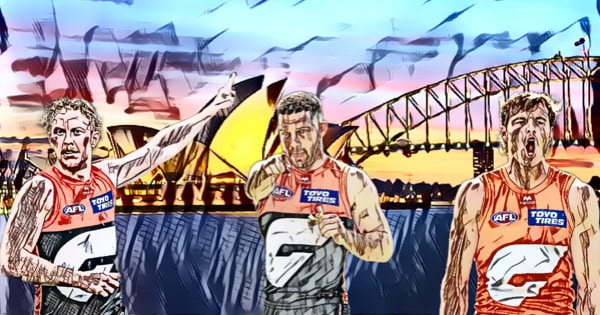
12 Critical Steps to Make the Giants a Success
The AFL has a Giants problem.
Not because the Giants are a bad team. They are not. Not because the idea of a second Sydney team is inherently wrong. It is not. And not because Australian Rules Rootball has no future in Sydney. The opposite is true.
That is what makes the whole thing so frustrating.
The GWS Giants are, on the field, one of the most watchable teams in the competition. They are talented, volatile, dangerous, stacked with genuine stars, and capable of producing must-watch football that can make any neutral stop scrolling and pay attention. Even in a near-unprecedented injury-ravaged season, they have shown they can beat anyone: Hawthorn in Opening Round, the high-flying Melbourne, Brisbane by 78 points after producing a ludicrous 14.2 third quarter – one of the best quarters of football in modern history – and Fremantle in Canberra last week, when they comfortably knocked off the ladder-leading Dockers by 21 points.
They have a blockbuster list. This includes one high-profile player in Clayton Oliver putting together one of the more under-discussed elite seasons in the competition, something I wrote about earlier this year in The Mongrel Punt. They have other elite footballers like Tom Green, who has sadly been a permanent fixture on the injury list this year, and Finn Callaghan, who is one of the most exciting footballers in the game in terms of run and gun playing style. Then there are the likes of Brent Daniels, Jake Stringer, Lachie Ash, Lachie Whitfield and, love him or hate him, Toby Greene – all amongst the most exciting players to watch in the league. They are certainly not short of exciting youth either, with Phoenix Gothard, Aaron Cadman and Harvey Thomas just a few of the future stars on the list.
It is a box-office team playing a box-office style under Adam Kingsley.
And yet, commercially and culturally, the club remains a long way from where it needs to be.
That is the AFL’s Giants problem.
The game’s popularity in Sydney has grown substantially, and the Swans have capitalised on it brilliantly. The Sydney Derby at the SCG this year drew 43,986 people, the highest-attended Swans-Giants cross-town clash, and came during a season in which the Swans raced to 70,000 members in record time. The Swans are the hottest ticket (and team) in town, regularly selling out the SCG which is a sea of red every fortnight in stark contrast to the empty seats of ENGIE Stadium.
So Sydney does not have an AFL demand problem.
GWS has a market-access problem, a venue problem, an identity problem and, above all, an activation problem.
The Giants have not been positioned to properly access the demand that now exists. That is the uncomfortable truth. The good news is that these problems are fixable.
I am also reasonably well placed to throw my two cents in here. I am a Sydneysider, a lifelong AFL fan, an SCG member, and frankly, exactly the type of person the Giants should be trying to tap into but have not yet properly reached. I live in the market they need to win, I understand the game they are playing in, and I know there is a huge amount of untapped opportunity sitting in front of them. Professionally, I help young companies grow, so I understand how difficult it is to penetrate markets, find traction, build product-market fit and turn attention into genuine growth. The good news for the Giants is that, unlike most technology startups trying to do all of that on a shoestring budget, they have the backing, infrastructure and strategic importance of the AFL behind them. This is not a lost cause. It is a turnaround opportunity. And with the right decisions, I think the AFL and the Giants can absolutely turn the ship around.
Here are the 12 ways that can be achieved:
1- The Greater Western Sydney Giants need to become the Sydney Giants
The first move is the simplest and arguably the most symbolically important: rename the club the Sydney Giants and rebrand accordingly. This club desperately needs a facelift in the form of a new, fresh chapter.
“Greater Western Sydney” has always sounded more like a planning region than a football club. It is clunky, bureaucratic and emotionally vague. It does not roll off the tongue. It does not feel tribal. Worst of all, it has no direct engagement or appeal to anyone – nobody resonates with being from “Greater Western Sydney.”
That matters. Football clubs are not administrative catchments. They are emotional institutions.
This does not mean abandoning Western Sydney. Quite the opposite. The Giants should proudly retain Western Sydney as their place of origin, their academy base, their community mission, and a meaningful part of their story. But the name has to stop limiting the club’s ceiling. The new name also needs to acknowledge an important reality – that this team has not captured anywhere near enough hearts and minds in the region they set out to win. That narrative is unlikely to change drastically – certainly not by continuing with the same, failing status quo.
The Sydney Giants would be exactly what the AFL needs them to be: the clear second Sydney AFL club, with Western Sydney roots, Canberra ties, NSW-wide reach and a city-wide invitation.
That rebrand would give the club a fresh start without destroying what little equity has already been built. The colours can stay. I personally don’t love it but the “Big Big Sound” can even stay. The orange can stay. The Canberra connection can stay. The academy can stay. But the name needs to become bigger, cleaner and more commercially useful.
This re-brand should be treated as a re-foundation opportunity too. Tasmania showed the power of giving people (incredibly around 150,000 signed up within their first few days) a cheap, symbolic and emotionally clean way to say: “I was there at the start.” The Giants need their own version of that.
A Sydney Giants foundation campaign – low-cost, mass-market, proudly marketed and tied to a new, bigger, fresh chapter – would give the club another bite at the cherry. Not as a gimmick, and not as another inflated database exercise, but as a genuine invitation for Sydney, NSW and the ACT to get on the Giants train and toss an orange scarf around the neck to be a part of an exciting new chapter for what should be (but is clearly not) the AFL’s shiny new toy.
The Giants need to be trying to make as many people as possible fall in love with them. They should be making a passionate plea for as much of Sydney as possible to join them – not isolating themselves to a name nobody resonates with in a region where few people would recognise a Sherrin, and where a bland Toyota Corolla would get more attention on main street than Toby Greene strolling on by.
The Dolphins in the NRL offer the obvious Australian precedent. They did not enter the NRL as the Redcliffe Dolphins, even though Redcliffe was their history, their base and their emotional origin. They became simply The Dolphins because expansion clubs cannot afford to let geography become a ceiling.
That is the lesson for the Giants. Western Sydney should remain part of the club’s story, academy, community work and identity, but “Greater Western Sydney” should not be allowed to severely limit the club’s ambition. The Dolphins kept their roots while broadening their reach. The Giants simply need to do the same.
2-Fish where the fish are: play the majority of home games at the SCG
This is the main event.
The Giants need to play the majority of their home games at the SCG.
That sentence will annoy people. It will annoy Swans supporters. It will certainly annoy the Swans Chairman, Andrew Pridham, who is staunch and stubborn on this very issue. It will annoy those who still believe the Western Sydney experiment must be defended in its original form indefinitely, regardless of the overwhelming evidence.
But serious strategy requires honesty and it requires data-driven decision making.
The SCG is where the AFL demand in Sydney is exceedingly obvious. It is central. It is both a historic and popular venue. It is atmospheric. It is easy to sell. It feels like an event. It is already the premier AFL venue in the city. Its capacity is around 48,000, and Swans games there have become one of the strongest regular sporting products in Sydney – AFL at the SCG is quite literally the hottest ticket in town.
ENGIE Stadium is not delivering the same outcome. Far from it.
That is not an insult to the people who do attend Giants games there. The loyal Giants fans who have stuck fat deserve genuine respect. But the numbers tell the story. AFL Tables has the Giants averaging just 11,473 across eight home games so far in 2026, while Austadiums lists ENGIE Stadium’s 2026 average crowd at 11,345, with several AFL crowds below 10,000. To be brutally honest, crowds often look considerably smaller than that to some viewers (as comments sections would often speculate) but that aside, it is an obvious problem and permanent pain point for the game.
Footy at ENGIE Stadium as the main base is not a sustainable foundation for the AFL’s second Sydney club.
The Swans’ own long-term SCG arrangement is the obvious obstacle. They signed a 30-year deal to play all home games at the SCG from 2017, with the AFL also retaining the ability to schedule finals there.
But if the AFL is serious about the Giants, this is exactly the kind of problem it must be prepared to step in and help solve.
The league should sit down with the Swans, Venues NSW, the SCG, the Giants and the NSW Government and negotiate a new Sydney football model. The Giants do not need to take over the SCG. They do not need to become the Swans. They do not need to erase Western Sydney. But they need regular access to the venue where Sydney AFL demand is already proven.
A sensible model could look like this:
The Giants play seven or eight home games at the SCG.
They play one or two games in Canberra.
They play one or two games at ENGIE Stadium, Henson Park or another western/inner-western Sydney venue as deliberate community fixtures.
That would be a genuine Sydney-NSW-ACT footprint.
It would give the Giants access to the biggest AFL audience in the city while still protecting the club’s original heartlands. It would also give Sydney something it clearly has room for: live AFL at the SCG almost every week, rather than every second week to what is currently a starved, underserved audience showing a clear appetite for more.
The Swans may not love that. Commercially, one can understand why. But the AFL simply cannot sit back and allow one club’s territorial comfort and in my opinion, petty, shortsighted position to limit the growth of the game in Australia’s largest city.
Shortsighted because a healthy same-town rivalry is not bad for the Swans. It is good for them. Collingwood does not suffer because Carlton, Essendon, Melbourne and Richmond exist. Arsenal are not diminished because Tottenham exist. Great rivals make great clubs bigger, not smaller. They most definitely grow the game and maximise eyeballs and engagement.
The Swans should want a serious Sydney rival. The AFL should insist on one and at the end of the day, the Swans are positioned to benefit the most from both a financial stanpoint (likely a compensation agreement or favourable commercial arrangement given they have all the leverage here) as well as from a future prosperity perspective given a game with maximum relevancy in the market they are in will ultimately benefit the biggest team in that market the most. The Swans ambition should be to become the biggest team in the league and the most popular sporting club in the country – the Giants could be the key to maximising their chances of achieving that.
3 – Make the Giants the affordable, family-friendly alternative
The Giants already have the bones of the right affordability strategy.
In 2026, the club announced $27 general admission tickets, kids-go-free offers and included public transport to ENGIE Stadium with eligible tickets and memberships.
That is smart. But at the wrong venue, even good pricing can fail to reach its potential.
Move that pricing model to the SCG and it becomes a far more compelling proposition.
The Giants should become the accessible, family-friendly, lower-cost AFL option in Sydney. The Swans can remain the premium, established, high-demand club with deep tradition and a huge base. The Giants can be younger, louder, cheaper, cheekier and easier to attend.
That should be the contrast.
A family in Sydney should be able to look at the Giants and think: this is affordable, fun, easy and worth doing. A neutral AFL fan who supports Collingwood, Carlton, Essendon, Melbourne, Adelaide or West Coast should be able to watch their own side on television and still take the kids to the SCG to see the Giants live. A Swans fan should be able to say: I am still a Swan, but I love footy and I will go watch the Giants when the Swans are interstate.
That is not betrayal. That is market growth.
The Giants do not need every attendee to immediately become a diehard. They need volume, habit and emotional exposure. Fans are created by repeated experiences: the walk to the ground, the scarf (even if a fair few are flung out for free), the catchy song that kids can sing on the journey home, the player who signs a jumper, and most important of all, the kids who ask to go again turning into adults who want to share that same passion and hobby with their children.
That is how support is built.
4 – Kids must be the centre of the rebuild
If the AFL wants the Giants to become a real club rather than a permanent expansion project, children have to be the priority.
The club’s GIANTS Recruits program is already the right sort of idea, offering young fans access to selected tickets, player content, clinics and family-oriented experiences.
But the concept should be expanded dramatically.
Every registered junior AFL player in NSW and the ACT should be given access to free or heavily discounted Giants tickets. Not once. Not as a token. Repeatedly. The AFL should treat this as a generational acquisition strategy.
The logic is obvious: get children to games, give them an atmosphere worth remembering, make the players accessible, make the day affordable for parents, and turn casual exposure and ease of access into emotional attachment.
There is no point giving kids free tickets to a half-empty stadium if the matchday experience feels small. The atmosphere matters. A child walking into the SCG for a proper AFL crowd has a very different experience from a child sitting among empty bays at a soulless, atmosphere lacking venue that makes the event feel unimportant or insignificant.
That is why the venue strategy and junior strategy have to work together.
The Giants should also build a more aggressive schools-and-clubs program around their best players like Tom Green, Clayton Oliver, Toby Greene, Finn Callaghan, Sam Taylor, Jesse Hogan and the club’s emerging young players. The Giants have footballers worth marketing. They need to make their stars front and centre and put their best talent to work with community appearances making it impossible for young NSW and ACT fans to ignore.
5 – Keep Canberra – it is one of the few things that has worked
The Canberra connection should not be sacrificed.
In fact, it should be protected.
The Giants have made real inroads in Canberra. Their Manuka Oval crowds are often more consistent than their Western Sydney crowds, and Canberra gives the club something valuable: a second home that actually feels somewhat engaged. Their 2026 Manuka games against North Melbourne and Fremantle drew 12,597 and 11,856 respectively.
That may not sound enormous but in the context of the Giants’ broader attendance challenge, it matters.
Canberra should remain part of the identity. One or two games a year there makes sense. It strengthens the ACT pathway, rewards existing supporters and gives the Giants a broader regional footprint.
The mistake would be treating the SCG move as a betrayal of Canberra or western Sydney. It should be framed as the opposite: the club growing up, broadening out and taking its existing loyalists into a bigger chapter.
The message should be: western Sydney built us, Canberra backed us, and now Sydney is invited in.
6 – Stop hiding behind cheeky membership numbers
This is where the conversation needs more honesty.
The Giants announced a club-record 37,705 members in 2025 and had already passed 30,000 members before Opening Round in 2026.
On paper, that sounds impressive.
But membership only matters commercially and culturally if it translates into real, activated support. If a club has more than 30,000 members and is still regularly drawing crowds around 8,000 to 13,000 at its primary home venue, the headline number is not telling the full story.
That does not mean the club is doing anything improper. It means the public metric is not sufficiently useful.
The AFL and Giants should lead the league in membership transparency. Break the number into categories: full-season reserved seat members, full-season general admission members, three-game members, interstate members, junior members, free or promotional members, digital members and non-access members.
That would be brave. It would also be clarifying and it would put an end to the easy, petty criticisms and loud doubts about validity and the wave of speculative claims of dubious, inflated or even artificial numbers.
The Giants do not need inflated perception which looks ok in an annual report but only comes back to bite them amongst the stakeholder that matters most – the fans. They need real supporters. They need people who regularly, routinely attend, watch, buy, care and come back. Right now, they certainly do not have over 30,000 of those people – at best guess, that number would be closer to 5,000 or being generous, as high as ~10,000.
A serious target should be set: 50,000 genuinely engaged members and an average home attendance of 25,000 within three years.
That sounds ambitious because it is. But it is not absurd if the club changes name, changes venue strategy, embraces affordability, doubles down on kids and is given proper league support.
The current model is not on track to get there. A new model might be.
7 – The AFL should give the Giants a one-off marquee weapon
This idea will be unpopular, but the AFL should consider a one-off, tightly controlled marquee player mechanism for the Giants.
Not a blank cheque. Not a permanent rort. Not a wild distortion of the salary cap.
A one-off strategic allowance.
The AFL has poured extraordinary time, money, and political capital into expansion. It continues to distribute enormous sums across the competition, with AFL club funding reaching $461.5 million in 2025.
So the question is not whether the AFL already intervenes. It does. The question is whether its interventions are solving the actual problem.
For the Giants, what is currently being done is clearly not working. Part of the issue is relevance.
They have good players. They have excellent players. But they do not have enough unavoidable mainstream profile. In a market like Sydney, where the AFL is competing with rugby league, rugby union, football, cricket, entertainment and general indifference, profile matters.
A one-off marquee allowance could be structured around strict conditions: one player, one contract cycle, AFL Commission approval, transparent rules, a defined marketing role, and only available to clubs in non-traditional markets where the league is actively trying to accelerate growth.
Would rival fans complain? Of course.
But rival fans are already subsidising the broader expansion project through the AFL’s centralised competition model. A proper marquee mechanism at least turns subsidy into strategy.
The Giants need stars who sell tickets, create theatre and make neutrals watch. Clayton Oliver types help but he has never attracted the type of profile and attention of a Buddy Franklin household name type. The AFL should not be afraid to give the Giants a legitimate promotional weapon if it is serious about making the club work. A name, profile and character like Bailey Smith for instance (not that this is viable necessarily) would attract eyeballs and substantial attention inflating all the key metrics like TV viewership and crowds.
The choice is not between purity and unfairness. The choice is between passive subsidy and active strategy. The AFL needs to be brave and make the Giants relevant. It would also help not hinder the game if for a brief period of time the Giants had a strong chance of being regular Premiership contenders… So long as they are primed and properly positioned to capitalise on slightly assisted (but much needed to succeed) on-field prosperity.
8 – Become the boldest media club in the AFL again
One of the most successful things the Giants have done off-field has been their social media.
For a period, they became the funniest, sharpest and most provocative club in the competition. Their online voice gave them something they often lacked in the stands: relevance. Jacob Gaynor, who helped build that tone before moving to the Tasmania Devils as Head of Content, became one of the rare behind-the-scenes AFL media figures with a genuine public profile.
The Giants should double down on that philosophy.
They are not an old club. They cannot out-tradition Collingwood. They cannot out-history Carlton. They cannot out-Swans the Swans. So they should not try.
They should be the modern club. The internet club. The funny club. The slightly obnoxious club. The club that understands memes, player personality, behind-the-scenes access, short-form video and rivalry content better than anyone else. This also helps with the all-important future generation focus that the club should prioritise.
There is no shame in being hated if people are watching.
Collingwood have built one of the most powerful supporter bases in Australian sport partly because opposition fans love watching them lose. Relevance does not always begin with affection. Sometimes it begins with irritation or something stronger.
The Giants should lean into that. Be cheeky. Be sharp. Be impossible to scroll past. Turn the Sydney Derby into an argument, not a calendar item.
9 – Use celebrity properly in the stadium, on social media and in the Boardroom
Sydney is a celebrity city. The Giants should behave accordingly.
The club already has a strong starting point with Alex Carey, Mitchell Starc and Alyssa Healy, three of Australia’s most recognisable cricketers, being big Giants people.
But that should be the beginning, not the end.
The Giants should build a deliberate celebrity strategy around SCG games. Hospitality. Courtside-style visibility. Orange scarves on prominent people. Musicians, actors, cricketers, media figures, business identities, internet personalities, comedians and retired athletes.
This is not superficial. It is how modern sport works.
The New York Knicks have turned courtside celebrity culture into part of the product. The Giants cannot replicate Madison Square Garden, but they can replicate the principle: make attendance feel socially relevant. They can also try to be the cool crowd on social media just like how the younger generations populating the Eastern Suburbs and Lower North Shore of Sydney feel it gives them social capital to snap a flick of themselves at a Swans game sipping on a drink courtesy of Justin Hemmes in-stadium bars.
At ENGIE Stadium, that is hard. At the SCG, it becomes possible.
A Friday night Giants game at the SCG with a good crowd, affordable family sections, visible celebrities, sharp social media and a fierce rivalry edge is a product Sydney could understand. Part of fishing where the fish are is having the right bait to attract those fish.
The Giants should also be far more aggressive in turning high-profile business association into public-facing relevance. AirTrunk is already in the Giants’ orbit, and someone like Robin Khuda is exactly the kind of figure the club should be trying to bring closer to the centre of the story – ideally as the public facing member of the boardroom. This is not a criticism of the people currently involved at the Giants, many of whom are clearly doing plenty right within the limits of a difficult model. But the club needs more oxygen, more intrigue and more big-swinging ambition around it. Khuda is not merely another sponsor-adjacent executive, he is one of the most successful operators in the country, a western Sydney-linked founder who built AirTrunk into a major regional infrastructure powerhouse and one of Australia’s brightest companies. In a brutal attention economy, that matters.
South Sydney have benefited enormously from the profile and intrigue attached to Russell Crowe, James Packer and Mike Cannon-Brookes. Crowe’s long association with the Rabbitohs has given the club celebrity, theatre and global recognition. Cannon-Brookes added a modern technology-billionaire edge when he bought into the ownership structure and it generated many headlines. The AFL model does not really allow for that kind of private ownership dynamic – I will get to how to fix the AFL’s structure another time – but the principle still applies. The Giants need more visible, ambitious, high-status people around the club utilised properly as part of the club’s public identity. In a market where every sporting code is fighting for limited attention, relevance is not a vanity metric. It is imperative to survival and to maximise the club’s chances of maximising visibility and subsequently, maximising a supporter (or interested follower) base.
10 – Stop being a polite little brother
The Giants need to stop behaving like a grateful expansion tenant and start behaving like a real rival.
The Swans are the established power and far more popular team. Good. That gives the Giants something to define themselves against.
Every great rivalry needs contrast. The Swans are polished, successful, wealthy in support, deeply embedded and protective of their turf. The Giants should be younger, hungrier, louder and less deferential.
That does not mean being childish. It means being competitive.
The Giants should make the Sydney Derby feel personal. They should talk about wanting to own Sydney. They should poke the Swans. They should embrace being disliked by red-and-white fans. They should give their own supporters emotional permission to care.
Right now, too much of the rivalry feels manufactured because the Giants’ support base is not yet large enough or loud enough to make it feel dangerous.
That can change.
But it will not change through politeness.
11 – If the AFL wants international experiments and to expand into new markets, make the Giants the #1 Guinea Pig
If the AFL is serious about taking games to new international markets, the Giants should be first in line.
India, the United States, the Middle East, Asia – wherever the AFL thinks it can generate curiosity and attract new supporters, the Giants should be positioned to benefit.
That is not because international expansion is guaranteed to work. It may not. But if the league is going to experiment, it should use the club most in need of new fans and new attention.
Collingwood do not need help finding supporters. Richmond do not need a new audience. The Giants do.
So give them first access to the AFL’s frontier projects. Let them become the league’s global experiment club. If the AFL finds even a small pocket of new international attention, the Giants should be the beneficiary.
A club still building its base should take fans wherever it can find them.
12 – Shared, measurable accountability: Build a proper Giants rescue plan and combine aligned forces to execute it successfully
The AFL needs to stop treating the Giants as an annual cost and start treating them as a fixable asset.
That requires a formal plan.
Not vague optimism. Not another five-year slogan. Not another claim that the club is “tracking well” because a membership number went up while the stadium remained visibly empty.
A real plan.
The AFL should establish a Giants Commercial Acceleration Taskforce with the club, broadcasters, Venues NSW, the SCG, the ACT Government, Transport NSW, and AFL NSW/ACT. Any and all relevant stakeholders that are aligned with seeing the Giants become a success.
Its goals should be public and measurable:
Average home attendance.
Paid match-access membership.
Junior participation conversion.
TV ratings.
Digital reach.
Sydney Derby growth.
School program participation.
Corporate revenue.
Canberra retention.
Western Sydney engagement.
If the AFL is going to keep funding the project, it should demand commercial accountability in return.
That is not anti-Giants. It is pro-Giants.
The club deserves a plan that can actually work and it needs to make sure all stakeholders who stand to benefit are aligned and committed to the cause.
The verdict
The Giants are not a lost cause.
They are a badly positioned opportunity.
There is a very good football team sitting inside a weak commercial model. There is a Sydney AFL boom they have barely touched. There is a rivalry waiting to become real. There is a generation of children who could still be won. There is a club with colour, personality, talent and edge, but not yet enough people in the seats.
The AFL does not need to apologise for creating the Giants. It needs to finish the job properly.
Rename them the Sydney Giants.
Move most of their home games to the SCG.
Keep Canberra.
Respect western Sydney, but stop pretending the original model is working well enough.
Make them affordable.
Flood the club with kids.
Be honest about membership and where things are at.
Invest with purpose, boldness and precision rather than aimless, expensive, annual topups.
Use marquee power.
Weaponise social media.
Use celebrity.
Make the Swans rivalry real.
And if the league insists on experimenting, make the Giants the beneficiary.
The AFL’s Giants problem is not that the club cannot work.
The problem is that the AFL has not yet been bold enough to make it work.
That needs to change.
Because Sydney does not need less AFL.
It needs a second AFL club that actually feels like it belongs to the city.
The Giants can be that club.
But only if the AFL is brave enough to let them grow beyond the limits of the experiment that created them.