
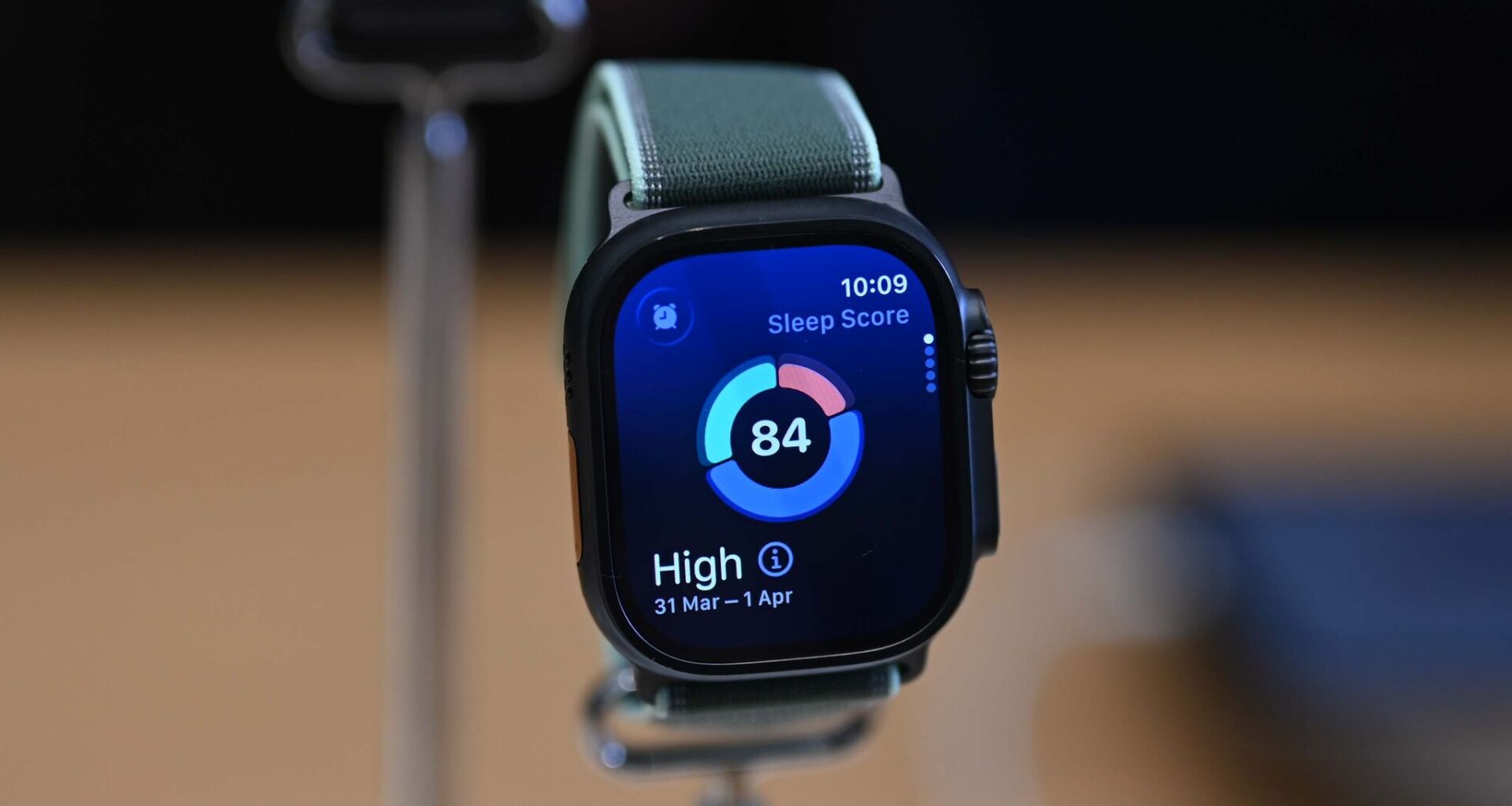
An Apple Watch Series 11 is displayed at an Apple Store in September 2025. Wearables and sleep-tracking devices have grown increasingly popular, but sleep experts say some of the data they collect — including sleep scores and sleep-stage breakdowns — can be misleading.
Anadolu via Getty Images
The use of sleep tracking devices is exploding, with nearly half of U.S. adults saying they’ve used a smartwatch, app or other device to monitor their sleep — up from 35% in 2023, according to the American Academy of Sleep Medicine.
The uptick is part of a growing interest in sleep among researchers and the public, which is helping drive the recent “sleepmaxxing” trend on social media.
Article continues below this ad
The trend is especially visible in the Bay Area, whose tech-heavy, fitness-oriented population fits the national profile of consumers most likely to adopt wearables like the Apple Watch, Garmin watches and Oura ring to track sleep.
But not all of the data these devices collect is meaningful, sleep medicine experts said. And they add that people who use them obsessively — including those who seek optimal sleep, driven by wearables data — may be the least likely to benefit from them.
San Francisco Chronicle Logo
Make us a Preferred Source to get more of our news when you search.
Add Preferred Source
Here’s what the technology is most and least helpful for:
What they’re good at
By tracking heart rate and other metrics, sleep trackers are fairly accurate at distinguishing between when you’re awake and when you’re asleep, and thus at estimating your overall sleep time, said Dr. Katherine Malcolm, a sleep medicine specialist at UCSF.
Article continues below this ad
Some devices also claim to measure how much time you spend in each stage of sleep (light sleep, deep sleep and REM sleep). The technology is reasonably good at telling when you’re in REM sleep because that stage of sleep tends to have more heart rate variability, which sensors pick up on.
What they’re not as good at
But these devices are less reliable at measuring deep versus light sleep.
The only way to tell if someone is in deep sleep — when the brain goes into slow synchronous activity — is when they’re in a lab study and their brain activity is being monitored by an electroencephalogram, or EEG, Malcolm said.
Patients will sometimes use information from their trackers about how much time they’re spending in each stage of sleep, and interpret it incorrectly, she said.
Article continues below this ad
“People are like, ‘I had a bad night, I was in a lot of light sleep,’” she said. “That’s an incorrect way to look at it. You should be spending a lot of time in light sleep. It’s very important for your brain.”
In fact, the majority of the night, up to 55%, can be in light sleep, she said. Different things occur during the different stages of sleep — including memory consolidation, the clearing out of proteins that are associated with Alzheimer’s and hormone secretion — and some functions take place over multiple stages. A person with a normal, healthy brain should have all stages in a good night’s sleep, she said.
Some devices also generate a “sleep score,” and each company has its own “black box” algorithm that comes up with that score, said Stanford sleep medicine specialist Dr. Rafael Pelayo.
A sleep score in and of itself is not objective or meaningful, experts said. They are not standardized the way, say, an oximeter reading is standardized across different brands, Pelayo said.
But it may be a useful tool to track changes over time — the same way your bathroom scale can show changes in your weight over time, but only when compared to your previous weight on the same scale, Pelayo said.
Article continues below this ad
“A hotel scale might be slightly off, but if your own scale went up or down, you trust it more,” he said.
If you’ve had high scores for a while and it suddenly drops, you can look into what may have changed, such as a new mattress or a new medication, he said.
Who should and shouldn’t use them
Wearable sleep devices are more helpful for some than others, and some people should probably avoid them altogether, experts said.
If you drink alcohol some nights and not others, for instance, you may notice differences in sleep patterns that might compel you to drink less alcohol — a known sleep disrupter that can cause fragmented sleep.
Article continues below this ad
“It might cause a behavioral change because you realize alcohol impacts your sleep,” Malcolm said. “That’s a helpful way to use a tracker.”
The people that get the least benefit from sleep trackers, she said, are people with insomnia or orthosomnia — a relatively new term to describe someone with an unhealthy obsession with attaining “perfect” sleep.
“We see (orthosomnia) a lot in our clinic,” she said. “They’re tracking their sleep obsessively and bring me a huge data download and say, ‘I feel fine during the day but I get a sleep score of 50 or 60.’ This obsession with having perfect sleep, based on a wearable that’s an imperfect measure of sleep, is a difficult way to use them.”
Malcolm also recommends people with insomnia not use sleep trackers because it stresses them out even more.
“If someone presents to me with insomnia and brings me their tracking device, I tell them to throw it away,” she said. “You have to stop tracking your sleep. This is not a healthy behavior for you.”
Some devices like the Apple Watch can flag certain medical conditions like sleep apnea and atrial fibrillation with relative accuracy, Pelayo said, but they can’t replace a formal medical diagnosis.
“We’re blurring the line between consumer electronics and medical devices,” he said.