
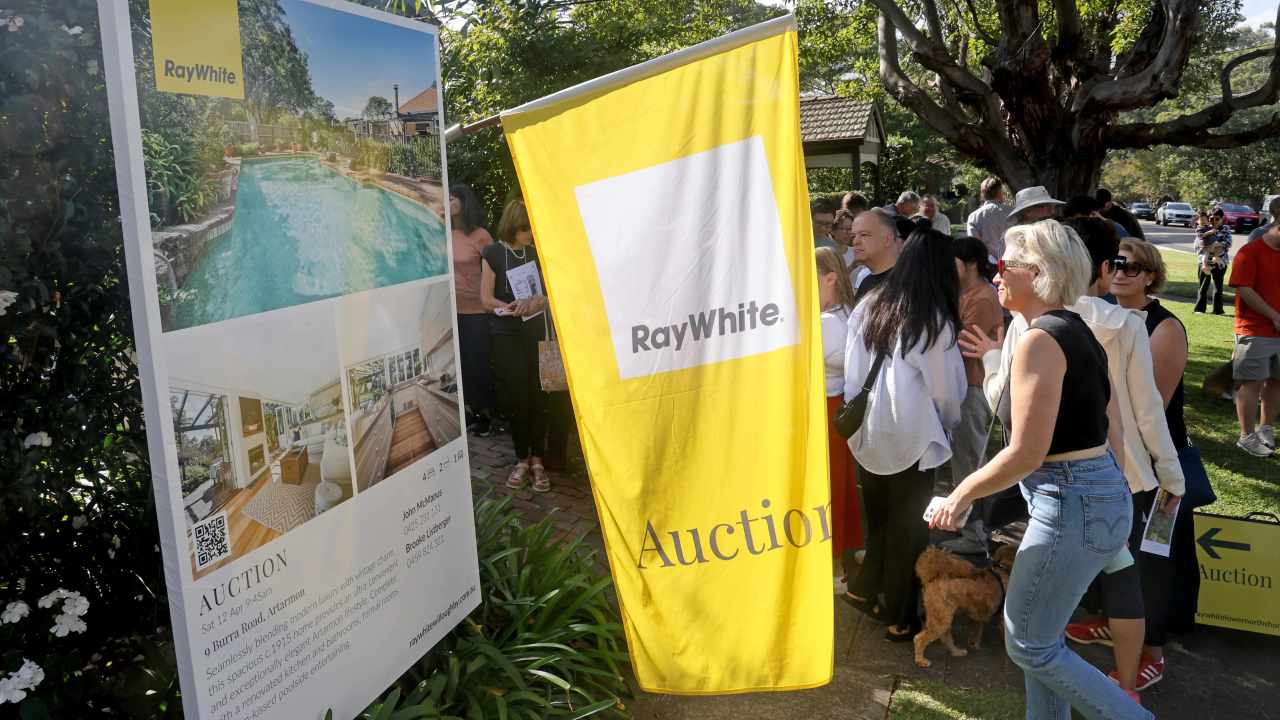
Auction numbers are down one third from their 2025 peak after property tax changes and interest rate hikes rocked the market.
The latest data from property analytics firm Cotality showed vendors are ditching auctions for private sales.
The national share of auctions to new listings dropped from their November 2025 peak of 45 per cent to just above 30 per cent in June 2026.
Cotality’s head of research Gerard Burg said recent market trends reflected major shifts in the housing sector.
“The decline in clearance rates since late last year has captured a lot of headlines,” Mr Burg said.
“Given that the auction market has a strong seasonal trend, typically stronger in the spring and weaker in winter, it is important to look through these factors to see the underlying trends in the market.
“What we have observed over the past few months has been a steady decline in sales volumes as demand-side pressures have built, meaning that there have been fewer buyers in the market. This goes well beyond just the normal seasonal trend.”
Cotality also warned auction activity could tighten further.
The warning comes after Labor moved to limit negative gearing to new builds and properties purchased before budget night.
Investors were also dealt a blow as the capital gains tax discount was scrapped and replaced with an inflation-adjusted model with a minimum 30 per cent rate.
Alongside the Reserve Bank of Australia hiking the cash rate three times since the beginning of 2026, the changes are pushing vendors towards private sales as the risk of public auction failure rises.

The shift is clearest in the Sydney and Melbourne markets where auctions are typically common.
“Auctions are losing their shine as clearance rates have fallen and a greater number are being withdrawn in the face of weaker demand,” Cotality’s report says.
“There could be further to go, with the long-term average being around 28 per cent of new listings.”
The national clearance rate rebounded to a seven week high of 54.8 per cent last week, however, the number of auctions fell 8.7 per cent.
Property values in Sydney declined 3.2 per cent in the June quarter, while Melbourne prices sank 2.6 per cent in the same period.
In cities where private sales are more common there has been an increase in preferencing the method.
Mr Burg said the decline in sellers putting their properties up at auction reflected weaker buyer appetite.
“During times of strong demand, vendors clearly favour auctions as competition between multiple bidders can result in a higher price,” he said.
“However, they have been shying away more recently in this weaker demand environment.
“This has been seen in an increasing tendency to sell ahead of the auction date as well as a rise in withdrawals, pointing to vendors who are increasingly unwilling to test the market at an auction and have the property fail to sell.”
HSBC’s chief economist Paul Bloxham said the downturn would continue as buyers avoid entering a market where property values are sinking.
“This is just the beginning,” Mr Bloxham said in a statement.
“The recent big shifts in tax policy concerning investment properties, as well as the RBA’s earlier three rate hikes, have rapidly sapped investor demand from the market.
“As we see it, first home buyers and other owner-occupiers are unlikely to want to try to ‘catch a falling knife’.”