

Over two decades on from their blockbuster Premier League moves, Harry Kewell and Mark Viduka remain in slots two and three respectively in the list of the biggest transfers ever involving Australian footballers.
Harry Souttar’s move to Leicester sits top of the chart, which is expected to be almost completely rewritten in the coming months and years on the back of exceptional performances from several players from the up and coming generation of Socceroos at the World Cup.
The likes of Nestory Irankunda, Alessandro Circati, Lucas Herrington and Jordan Bos all look to be in line for significant deals in the near future, to name just a few.
TRANSFER CENTRE: Every Aussie move in the current window, A-League and abroad
TRANSFER NEWS LIVE: The latest deals and rumours as they happen
In recent years, the global football transfer market has exploded into an industry worth over US$13 billion (A$18.5 billion), and in turn the figures clubs are dishing out to sign players have increased enormously.
With that in mind, the likes of Kewell and Viduka look set to fall rapidly down the charts in a manner that does not actually align with the value of their transfers in their time.
In order to understand what the value of those deals – and others of the past – were in terms of today’s money, we look at a list of the top 10 moves involving Australians adjusted for inflation.
How we calculated these figures
Comparing transfer fees across different eras isn’t as simple as adjusting for ordinary inflation.
A €10 million transfer in 2003 represented a far greater share of football’s economy than a €10 million transfer today. Since then, television rights, commercial revenue, prize money and transfer spending have grown dramatically, meaning clubs have significantly greater purchasing power.
For that reason, Football360 has adjusted each transfer using football inflation, rather than standard consumer inflation.
Our starting point was Transfermarkt’s reported transfer fee for every Australian player. We then compared the financial size of the English top flight in the season each transfer took place, with the most recently completed season with data available (2024/25), using historical revenue data from Deloitte’s Annual Review of Football Finance.
Rather than comparing total league revenue, we used average revenue per club. This accounts for the fact England’s top division featured 22 clubs until 1994-95 before reducing to 20 clubs from 1995-96 onwards, ensuring early-era transfers aren’t artificially inflated.
Your Next Read

The calculation used throughout this article is: Adjusted transfer value = Original transfer fee × (Average Premier League club revenue in 2024-25 ÷ Average top-flight club revenue in the transfer season)
This approach estimates each transfer’s equivalent buying power within football’s economy, rather than what that player would necessarily be worth on today’s market.
For example, Harry Kewell’s €10 million move from Leeds United to Liverpool in 2003/04 took place when the average English top-flight club generated around £66 million in annual revenue. By 2024-25, that figure had risen to approximately £340 million per club. Applying that growth produces an inflation-adjusted equivalent of just over €51 million.
As with any historical comparison, these figures are estimates rather than exact valuations.
Transfer fees – particularly older ones – can vary slightly between sources and may exclude performance-related add-ons. However, using a consistent fee source (Transfermarkt) and a transparent football-specific inflation model provides a fairer comparison of Australian transfers across more than three decades.
Why not use CPI?
Consumer inflation measures changes in the cost of everyday goods and services. Football transfer fees have risen much faster than the wider economy, so using football revenue growth provides a more meaningful comparison of transfer values across different eras.
10. Stan Lazaridis to Birmingham City – 1999-2000 (€19.82m / A$32.48m)
Unsurprisingly, this list is dominated by older transfers, given the quality and playing level of Australia’s golden generation in comparison to what the nation has produced since.
According to Transfermarkt, Stan Lazaridis’ move to Birmingham City from West Ham United carried a transfer fee of €2.25m at the time.
The fact the move took place way back in the 1999-2000 season, means it carries a multiplier of 8.81x according to our model, meaning that it would rise to a fee of €19.82m or A$32.48m when adjusted for inflation.
9. Ned Zelic to Queens Park Rangers – 1995-96 (€24.41m / A$40m)
Back in the 1990s, Socceroos midfielder Ned Zelic was a hot commodity, having played three seasons in the Bundesliga with German giants Borussia Dortmund.
Queens Park Rangers broke their transfer record to sign him on the back of a season where they had finished 8th in the Premier League.
According to Transfermarkt, the deal was worth €1.40m at the time. Three decades on, the move carries a multiplier of 17.44x, seeing it come in at €24.41m or A$40m when adjusted for inflation.
8. Aurelio Vidmar to Feyenoord – 1995-96 (€31.38m / A$51.41m)
After three fairly prolific seasons in Belgium with Kortrijk and Waregem, Socceroos striker Aurelio Vidmar levelled up by claiming the competition’s Golden Boot in his first season at Standard Liege, scoring an incredible 22 goals.
That caught the attention of Dutch giants Feyenoord, who splashed €1.80m to sign him ahead of the 1994-95 Eredivisie season.
Like Zelic’s transfer, the multiplier applied to that deal would be 17.44x given it occurred in the same year, seeing the adjusted fee sit at €31.38m or A$51.41m.
7. Mark Viduka to Middlesbrough – 2004-05 (€34.46m / A$56.47m)
The first of three entries for Mark Viduka on this list, the V Bomber’s move from Leeds to Middlesbrough came after four straight seasons of reaching double figures for goals in the Premier League.
Boro spent €6.75m to sign him, which was a significant outlay in those days.
Slightly more recent than any other deal listed here, the multiplier for this move from 2004/05 is 5.11x, bringing the adjusted fee in at the €34.46m or A$56.47m mark.
6. Mark Schwarzer to Middlesbrough – 1996-97 (€37.36m / A$61.22m)
It is no surprise to see the most capped foreigner in Premier League history finding his way onto this list; Mark Schwarzer was a fixture in the world’s top competition.
His move from Bradford to Middlesbrough in 1996-97 was worth €2.50m at the time.
Adjusting for inflation, with a multiplier of 14.95x, we arrive at a fee of €37.36m or A$61.22m – and you’d argue Boro got value for money, with Schwarzer making 446 appearances for the club in all competitions.
5. Mark Bresciano to Parma – 2002-03 (€38.08m / A$62.4m)
Mark Bresciano’s move to Parma in 2002-03 is still the eight biggest deal involving an Australian in history, according to Transfermarkt.
However, it moves higher in the list when you account for inflation.
Parma brought Bresciano to Serie A after he netted 10 times for Empoli in Italy’s second tier, paying €7m for his services.
The multiplier on this deal stands at 5.44x, bringing the fee to €38.08m or A$62.4m when adjusted for inflation.
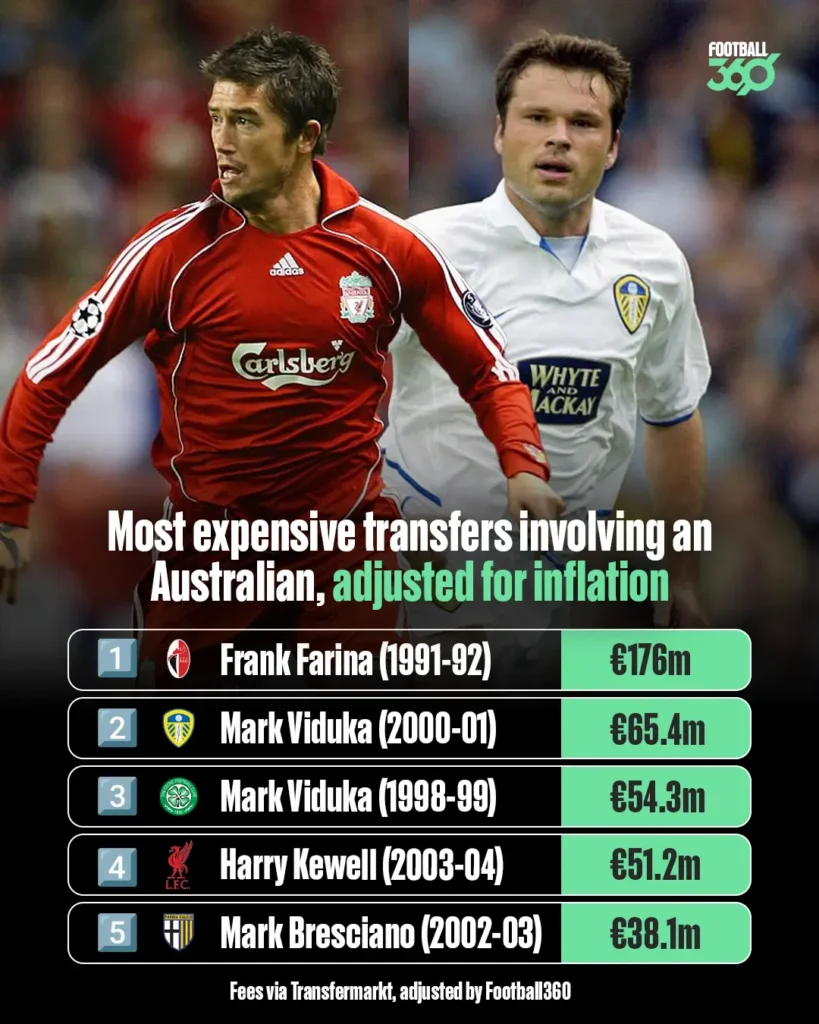
4. Harry Kewell to Liverpool – 2003-04 (€51.24m / A$83.97m)
Harry Kewell’s blockbuster move from Leeds United to Liverpool back in 2003-04 remains the second most expensive deal ever involving an Australia, according to Transfermarkt.
At the time, Kewell was one of the most sought after wingers on the planet, with the Socceroos legend turning down the likes of Barcelona, Arsenal and Chelsea to seal a move to Anfield, where he went on to win the Champions League.
At the time, the deal stood at €10m, adjusting for inflation with a multiplier of 5.12x, it rises to €51.24m or A$83.97m.
3. Mark Viduka to Celtic – 1998-99 (€54.30m / A$88.98m)
It’s Mark Viduka again, this time moving from Dinamo Zagreb to Celtic in 1998-99.
Zagreb had won the Croatian title, with Viduka contributing eight goals at age 22, leading to a move to the Scottish giants for a fee of €5.35m.
Real Madrid, Juventus and Sporting Lisbon all reportedly showed interest, but Zagreb famously won the race after a personal intervention from Croatian president Franjo Tudjman.
Nearly three decades have passed since Viduka made the move to Scotland, where he won a Golden Boot as the league’s top scorer. Adjusting for inflation with a multiplier of 10.15x, his move converts to a fee of €54.30m or A$88.98m.
2. Mark Viduka to Leeds United – 2000-01 (€65.36m / A$107.11m)
Yep, him again. Viduka’s next move was even more valuable, as he departed Celtic to join Leeds for a fee of €9.15m in 2000-01. To this day, it stands as the third most expensive transfer involving an Australian, according to Transfermarkt.
They got value for money, with the Socceroos icon bagging 72 goals in 166 appearances for the Premier League outfit, including a haul of four in a match against Liverpool. His best return in a top-flight season was 20 in 33 matches in 2002-03.
Adjusting for inflation with a multiplier of 7.14x, Viduka’s move to England stands at €65.36m or A$107.11m.
1. Frank Farina to Bari – 1991-92 (€176.00m / A$288.42m)
Topping the list by a distance is Frank Farina’s move from Club Brugge to Serie A side Bari way back in 1991/92.
Transfermarkt places the move at a fee of €4m, which actually still places it 16th on the current all time list an extraordinary 35 years down the track.
Farina had dominated in Belgium, winning the Belgian Golden Boot and Best Foreign Player awards in Club Brugge’s successful 1989-90 season.
At the time, the Serie A was the world’s top football league, and Bari were an ambitious outfit eager to compete with the likes of AC Milan, Juventus, Inter and Lazio, to name a few.
They shelled out big money for Aston Villa’s David Platt and acquired a young Zvonimir Boban on loan from AC Milan, as well as splashing big money on Aussie striker Farina. His move ultimately did not pay off, with Bari relegated the following season as the Socceroo failed to score a goal for his new side.
When you account for inflation, this transfer is easily the biggest ever involving an Australian.
The multiplier from 1991-92 stands at an enormous 44x, taking Farina’s move to an unbelievable €176m or A$288.42m, when adjusted for inflation.
The top 10 as it stands, before inflation
Harry Souttar to Leicester City – €17m
Harry Kewell to Liverpool – €10m
Mark Viduka to Leeds United – €9.15m
Aaron Mooy to Huddersfield Town – €9.10m
Cristian Volpato to Sassuolo – €7.5m
Jordan Bos to Feyenoord – €7m
Mathew Ryan to Valencia – €7m
Mark Bresciano to Parma – €7m
Mark Viduka to Middlesbrough – €6.75m
Mathew Ryan to Brighton – €6m
The top 10 adjusted for inflation, based on above model
Frank Farina to Bari – €176m
Mark Viduka to Leeds United – €65.36m
Mark Viduka to Celtic – €54.3m
Harry Kewell to Liverpool – €51.24m
Mark Bresciano to Parma – €38.08m
Mark Schwarzer to Middlesbrough – €37.36m
Mark Viduka to Middlesbrough – €34.46m
Aurelio Vidmar to Feyenoord – €31.38m
Ned Zelic to QPR – €24.41m
Stan Lazaridis to Birmingham City – €19.82m