
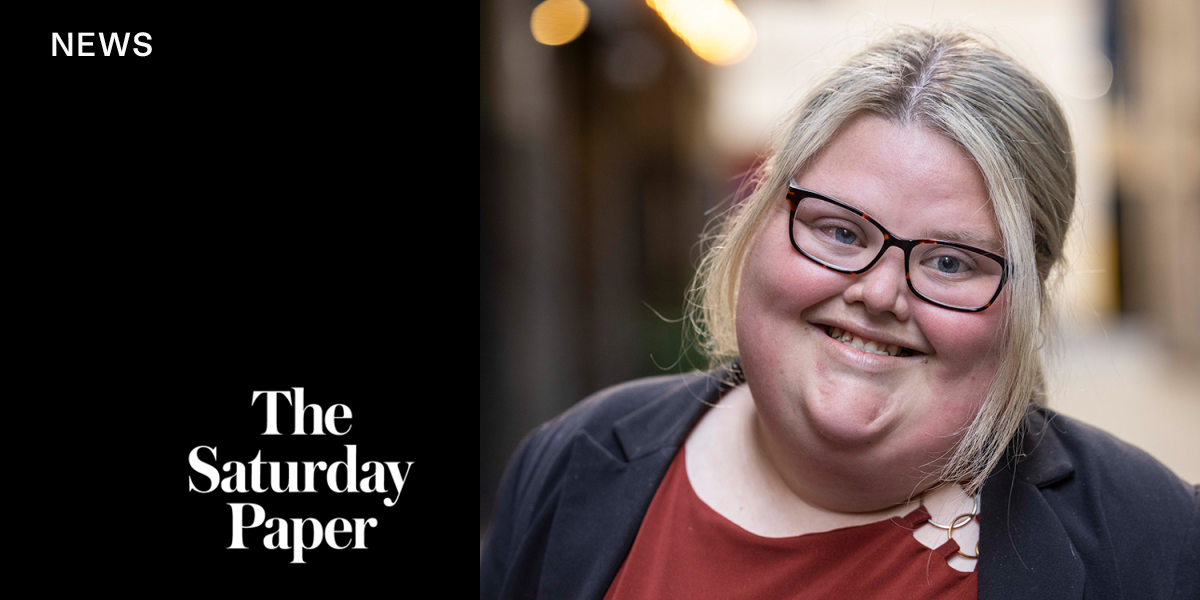
Brooke Canham is no stranger to hard work. For two years, Canham worked in a role that promised her “opportunities” and a better future: she washed cars, packed pamphlets, and filled show bags. For this tiring, monotonous work, Canham was paid just $3 an hour.
“It made me feel so upset,” she tells The Saturday Paper. “It was unfair that people got more money than me for doing the same job. This would get me so mad.”
Canham has an intellectual disability, and it’s her disability that justified her former employer, an Australian Disability Enterprise (ADE), paying her a small fraction of the national minimum wage. Under the Supported Employment Services Award, ADEs pay workers based on their productivity, as determined by a “work assessment” that measures physical and intellectual capabilities. It was Canham’s former employer who valued her work at $3 an hour.
In 2022, Inclusion Australia reported that more than 20,000 people with disability, most with intellectual disabilities, were employed by about 600 Australian ADEs. Within ADEs, disabled staff provide a range of essential services, including food preparation, recycling, laundering and landscaping. Many of these workplaces, like warehouses and factories, are not visible to the public, and are sometimes referred to as “sheltered workshops”.
As well as ADEs, other businesses can apply to employ disabled staff under the Supported Employment Services Award. Ange McArthur, an autistic National Disability Insurance Scheme support coordinator, says third-party NDIS service providers also prey on disabled people and the supported wage system. “New businesses keep popping up to take advantage of us,” she says.
McArthur explains that while NDIS participants often work for supported wages doing dog walking or car washing, third-party providers provide “support”. Providers, who earn many times the disabled person’s hourly wage, bill the participant’s NDIS plan.
“The blatant breach of basic human rights and the way the system operates has almost killed my drive to help people,” McArthur says.
Although the government states that “most” supported employees also receive the Disability Support Pension, which has a current maximum fortnightly payment of $1200.90, for many the DSP does not cover basic living costs, let alone the cost of disability.
As Brooke Canham explains, being disabled is expensive. Canham says she spends much of her income on medication, specialist appointments and, because she can’t drive, transport. A 2020 study quantified these disability costs in Australia, finding that disabled people need 50 per cent more disposable income to achieve the same standard of living as those without a disability.
“It made me feel so upset. It was unfair that people got more money than me for doing the same job. This would get me so mad.”
At the same time, the employment rate for disabled people is declining, and the disability wage gap is increasing. National figures from 2022 show the median weekly income for a disabled person was $575, compared with $1055 for people without disability. This weekly income gap of $480 is up from $370 in 2015.
A key problem with disability-segregated employment is therefore obvious: being paid less than everyone else while enduring additional expenses results in significant financial stress.
As of July 1, the national minimum wage is $26.44 an hour. The minimum supported wage is still only $8.32 an hour.
Research shows being underpaid damages the health and wellbeing of disabled people. The disability royal commission heard evidence that disability-segregated employment can also “heighten the risk of exposure to violence, abuse, neglect and exploitation”.
Professor Linda Steele, a socio-legal researcher at the University of Technology Sydney, says disability-segregated employment can also be seen as a form of labour exploitation under modern slavery law. The United Nations recognises that disabled people are disproportionately subjected to abuse, neglect and financial exploitation, including modern slavery.
Steele explains that modern slavery includes “situations in which people are working but have limited control over the conditions of their work, such as where they work, what kind of work they do, and how much they earn”.
For disabled people like Brooke Canham, particularly those in regional and rural areas, there are often few options for employment outside ADEs. “I feel like I had to do the job in the ADE because I wanted the independence to earn and spend my own money,” Canham says.
Steele says low wages for disabled workers in ADEs, such as those paid to Canham, are “primarily justified by the ableist assumption that disabled people are less productive”, with “unjust” productivity tests used to quantify this difference. “I can’t think of any other situation where productivity tests determine someone’s wage.”
The paradox, Steele says, is that although the supported wage system is based on the idea that disabled people’s work is worth less, businesses profit because of their workers’ disabilities.
“There is a significant source of financial benefit associated with employing disabled people, on top of the financial benefit derived from the goods and services produced through their low-cost labour,” she says.
While businesses pay disabled people significantly reduced wages, they simultaneously market disabled people’s work as contributing to disability empowerment and inclusion. In this “perverse form of ‘inclusion washing’ ”, Steele explains, ADE cafes, for example, profit from disabled baristas because of the “sentimental narrative of buying a coffee to make a difference”.
Still, the government maintains that ADEs “have the same working conditions as other employers” and “empower people living with disability to contribute to their communities”.
Brooke Canham’s former employer told her a similar story. “When I said something about it being unfair that I get paid less than other people, they said it wasn’t about the money and that I was there to build skills and make friends,” she says.
Eventually, Canham managed to find her way out of the supported wage system, finding open employment as a policy officer with Inclusion Australia.
For others, this transition proves impossible. As one man, Jamie, who lives with an acquired brain injury and vision impairment, told the disability royal commission, experience working at an ADE does not guarantee future open employment. Despite having an undergraduate degree, two master’s degrees and more than 20 years of volunteering experience, Jamie could not secure open employment and was forced to work for an ADE, earning $3.51 an hour.
“A lifetime of unemployment and underemployment has ruined my life and left me welfare dependent,” he told the commissioners.
In response to testimony such as Jamie’s, the royal commission recommended phasing out segregated employment by 2034. Groups including the Centre for Inclusive Employment, Inclusion Australia, People with Disability Australia, and Women With Disabilities Australia have urged the government to transition all supported wage workers to full wages. Despite this, the government remains invested in the supported wage system.
In May, Minister for Social Services Tanya Plibersek announced the development of a “road map” for the future of supported employment. Consultations are expected to conclude by the end of this year.
“For some people, open employment with the right supports will be the right answer,” Plibersek said at the time. “For others, supported employment needs to remain in place, in some form, and as minister I want to ensure it does.”
The Australian Human Rights Commission, meanwhile, states that “segregated employment, sub-minimum wages and productivity-based assessments are inconsistent with Australia’s human rights obligations”, specifically Article 27 of the United Nations Convention of the Rights of People with Disability (CRPD).
When The Saturday Paper contacted Minister for Employment and Workplace Relations Amanda Rishworth for comment, a spokesperson said the “responsibility for setting award wages sits with the independent Fair Work Commission”.
For Brooke Canham, her successful move to open employment and full wages means she can afford to socialise and have hobbies.
“I like going out with family and friends for dinner, and also spend my money on dance costumes,” she says.
Aware of the barriers people must overcome to secure open employment, Canham remains hopeful for other people with disability.
“There are many ways you can work in open employment and have a good job,” she says. “Ask the people you trust to support you. People need to respect you and let you be the person you are. Everyone should be paid the same. I am not a charity worker.”
The minister for the National Disability Insurance Scheme, Jenny McAllister, was contacted for comment but did not respond before deadline.