
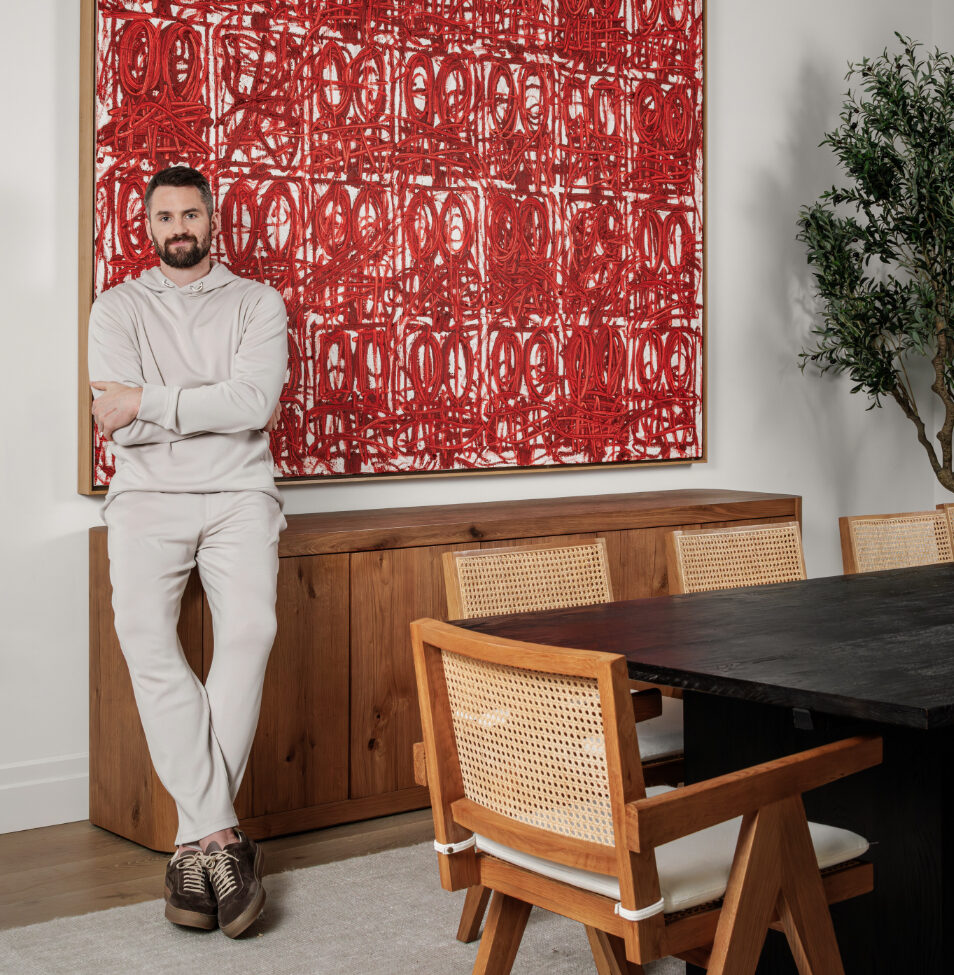
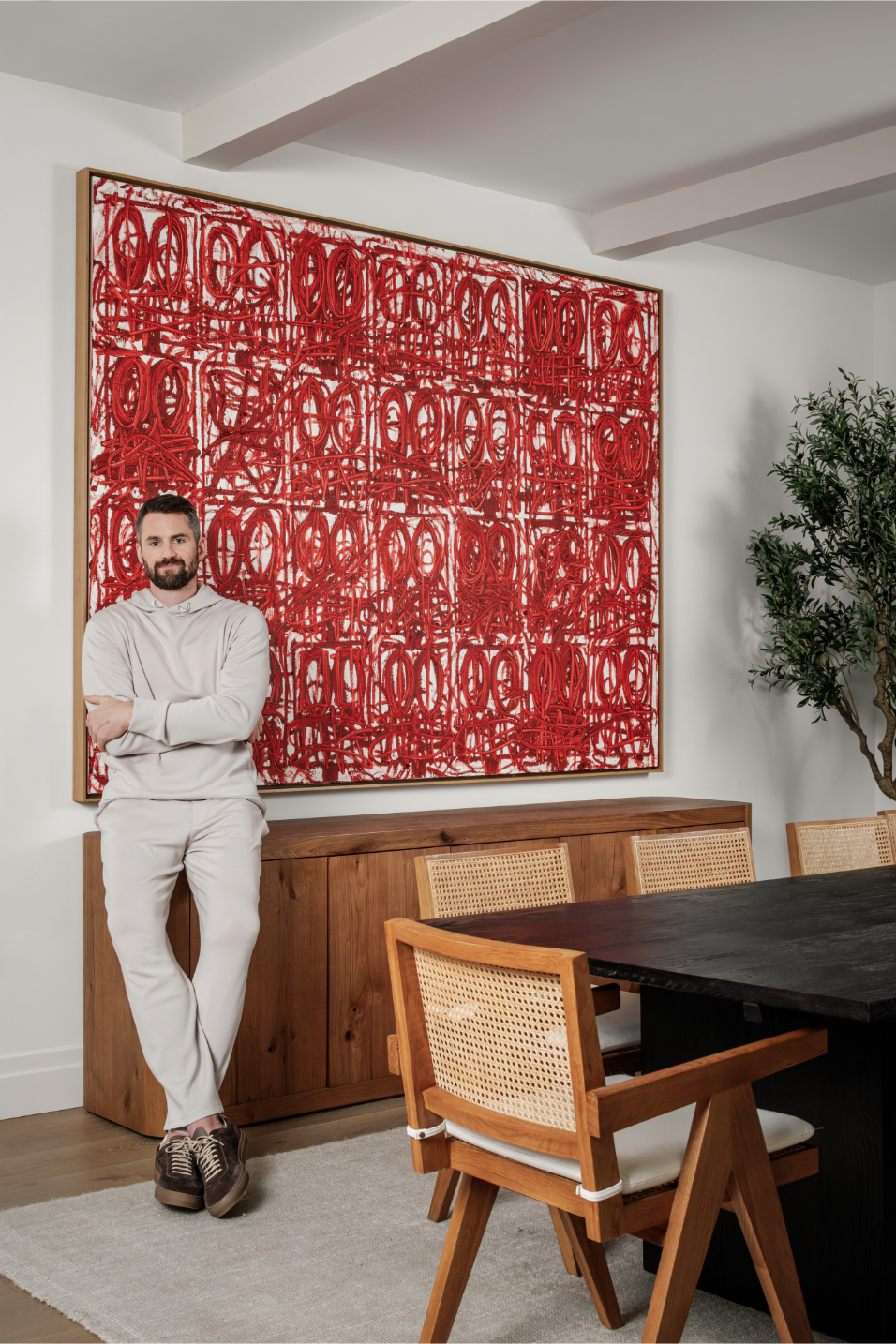
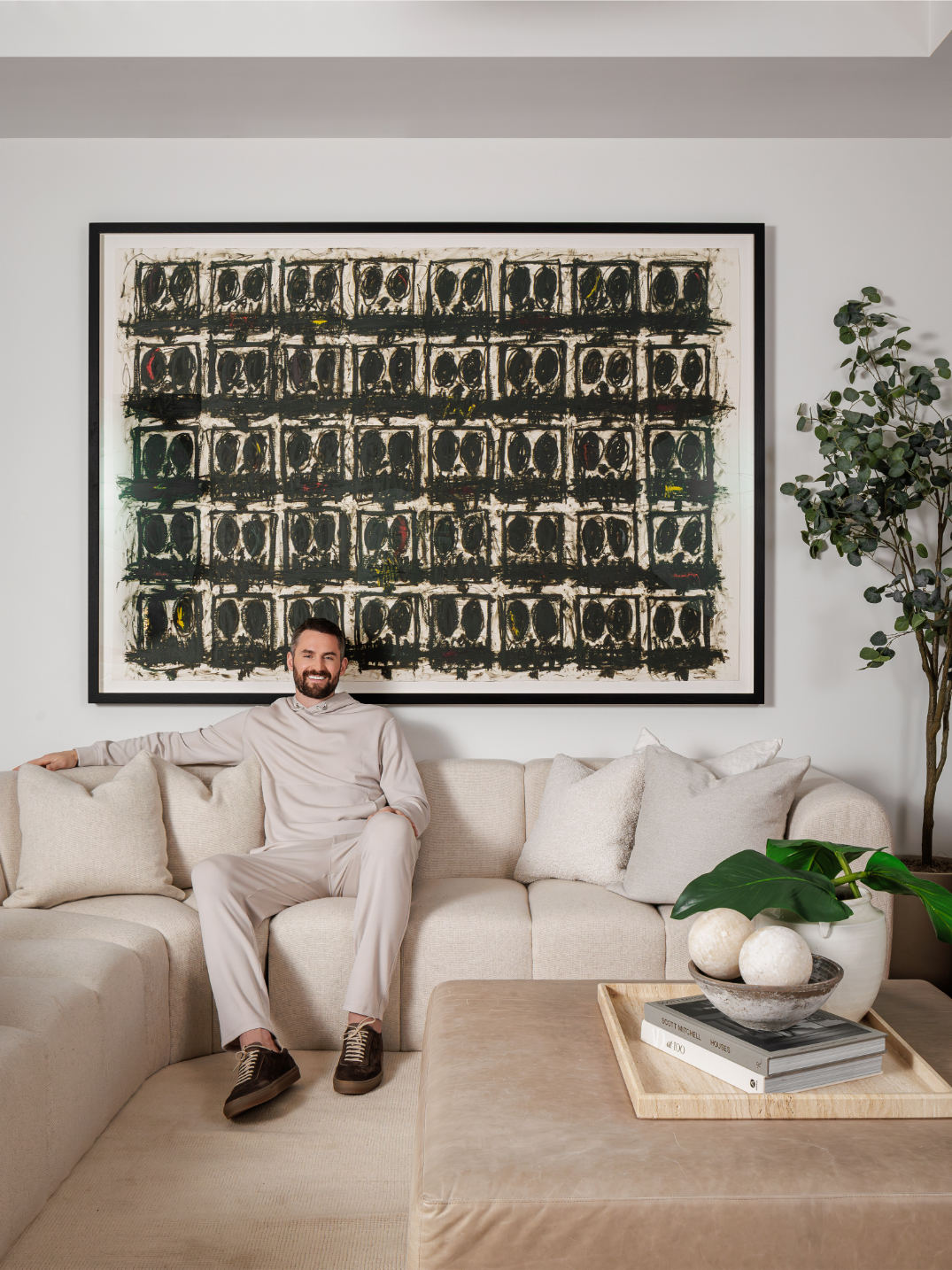
 Kevin Love with Rashid Johnson’s Untitled Anxious Red, 2020. All photography by Kris Tamburello and courtesy of the collector.
Between Olympic medals and offensive rebounds, Utah Jazz power forward Kevin Love has found time for a lesser-known pursuit: amassing an enviable art collection. The trove features a roster of all-star artists of the last century, from Ed Ruscha and George Condo to Rashid Johnson. Discovering that fellow NBA stars Carmelo Anthony and LeBron James were also in the game may have set Love on the path, but advisor Jane Suitor and dealer Vito Schnabel have helped him carve out a niche all his own.
It’s an off-court passion much like the player’s Kevin Love Fund, begun after a panic attack during a 2017 game, developed to raise awareness and encourage others to pursue the activities that bolster their emotional well-being. For Love, it’s puzzling through his own anxieties through the work of another. Here, he discusses the origins of this practice, the Cindy Sherman that got away, and how building an art portfolio can require just as much maneuvering as a full-court press.
Where does the story of your personal collection begin?
It probably began before I knew I was collecting. I grew up around music, film, and a very specific kind of West Coast/Pacific Northwest visual language. I was always drawn to mood, atmosphere, and storytelling. But in terms of collecting seriously, I would say it started in my late 20s, when I realized art could be more than something I admired from a distance. It could become part of my daily life and a way to understand myself better.
The first contemporary piece I bought was Ed Ruscha’s The End. That felt like an entry point that made sense to me. There was text, film, humor, ambiguity, and a kind of American mythology all wrapped into one. From there, I started educating myself, asking questions, going to galleries and fairs, visiting studios, and I realized how much I didn’t know.
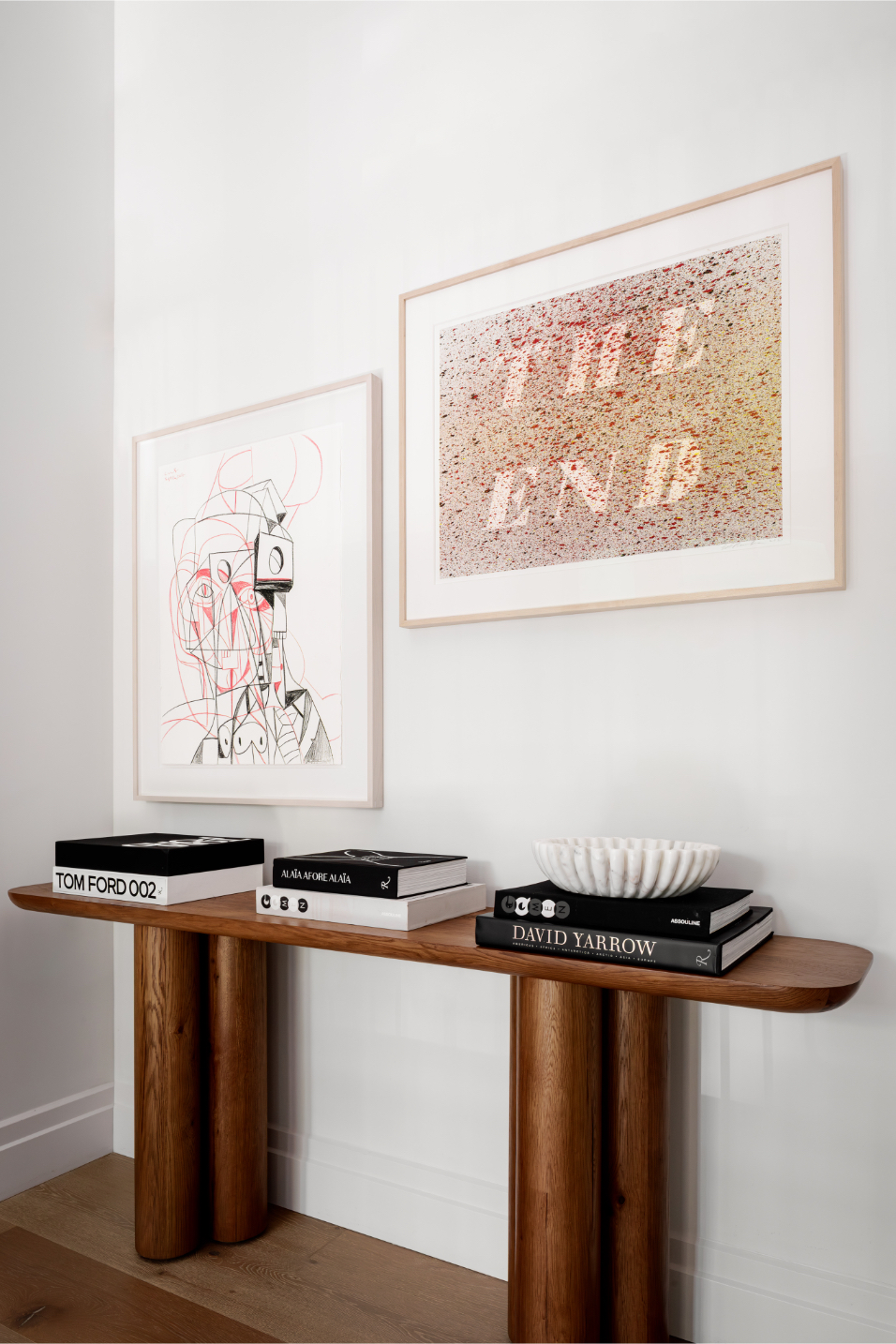 From left to right: George Condo, Untitled, 2017; Ed Ruscha, The End, 2021.
How would you characterize your collection today? What themes or qualities tend to pull you in?
It’s personal, and probably more autobiographical than I realized at first. I’m drawn to artists who can hold tension—beauty and discomfort, humor and sadness, control and chaos. There’s a lot of language in the collection, a lot of works that reference film, the body, memory, anxiety, and American identity. I like when a work has an immediate visual pull, but then keeps revealing itself over time. Ruscha does that for me. Rashid Johnson does that. Gordon Parks, Nan Goldin, and Tracey Emin. Those are artists who make you feel the human story behind the image. I’m interested in work that has presence, but also vulnerability.
Which work in your home sparks the most conversation when teammates, friends, or family come over?
Doug Aitken’s EXIT always gets people talking. It’s bold, it’s reflective, it has this cinematic quality, and the word itself is loaded. People see it and immediately bring their own interpretation to it. Is it funny? Is it ominous? Is it about leaving, starting over, escaping, ending something? That’s what I love about it.
The Tracey Emin neon also stops people in their tracks. It says “An Insane Desire For You.” There’s something very direct and emotional about it. It’s intimate, but because it’s in neon, it also has this public-facing quality, almost like a confession in lights.
Mental health advocacy has become such an important part of your public life. Has that perspective influenced the kinds of artists or stories you’re drawn to collecting?
I don’t think I can separate the two. Once I became more open about my own mental health, I started recognizing certain emotional frequencies in art more clearly. I’m drawn to artists who are willing to sit with anxiety, vulnerability, identity, pain, or contradiction without trying to clean it up too much. Rashid Johnson’s work has been especially important to me in that way. There’s an intensity and unease in some of his pieces that feels very honest. George Condo, too. There’s beauty, but also distortion and psychological complexity. Art can give form to things we don’t always have language for. That’s also what I try to do through my mental health work: create space for people to name what they’re feeling.
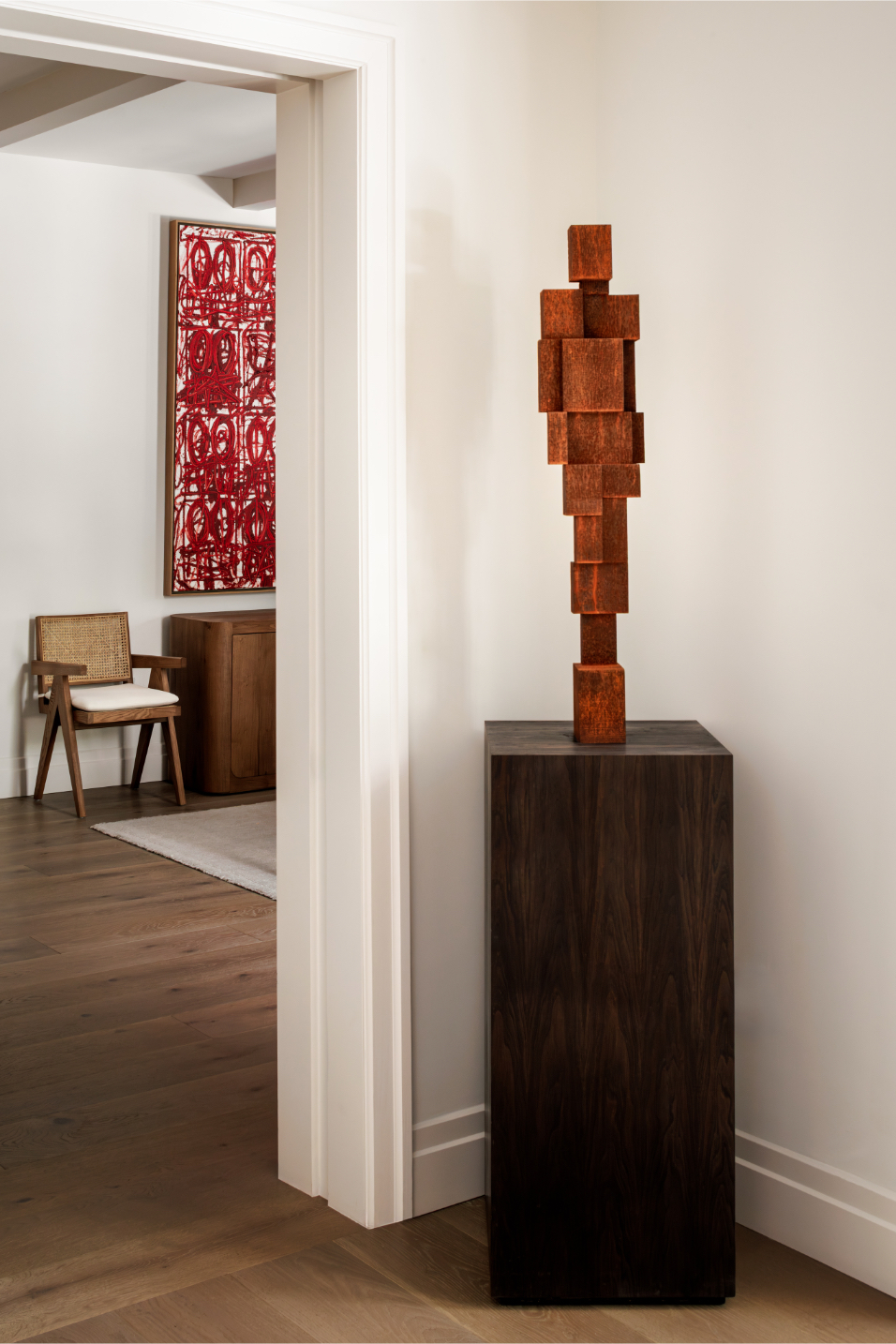 Antony Gormley, SMALL LOOK V, 2015.
What work in your home have you spent the most time staring at?
Probably one of the Ruscha “The End” works. I never get tired of the ambiguity. In sports, endings are always present. End of a game, end of a season, end of a chapter, end of a version of yourself. But “the end” can also be funny, cinematic, or even freeing. I’ve also spent a lot of time with the Antony Gormley sculpture. As an athlete, I’m always thinking about the body—how it moves, how it breaks down, how it carries pressure. Gormley’s work has this quiet force. It feels physical and psychological at the same time.
Is there one piece that got away, or that you still think about?
One that comes to mind is Cindy Sherman’s Untitled Film Still #21. I remember seeing it and immediately thinking about Hitchcock, suspense, New York, identity, performance—all these things I’m already drawn to. It had that cinematic quality I love, but also this deeper question about who we become when we’re being looked at. Sometimes the ones that get away are important because they sharpen your eye. They teach you what you really respond to.
You’ve developed relationships across sports, fashion, entertainment, and art. What’s the most unexpected introduction that’s led to a meaningful acquisition?
Some of the most meaningful art conversations started in basketball spaces. Talking with Melo [Carmelo Anthony] during the 2012 Olympics, talking with LeBron, realizing that guys I knew through the game were also thinking seriously about art… that opened a door for me. Then, through people like my art advisor Jane Suitor and Vito Schnabel, those conversations became more focused and educational. I’ve been lucky to have people around me who pushed me to look more closely, ask better questions, and not just chase names. The unexpected part is that the path into art wasn’t linear. It came through locker rooms, dinners, friendships, studio visits, and a lot of curiosity.
 Rashid Johnson, Untitled Anxious, 2018.
When you’re considering a new acquisition, what ultimately tips you from admiration into commitment?
It’s usually a combination of instinct and time. I have to feel something immediately, but I also want to know that the feeling isn’t temporary. If I keep thinking about the work after I’ve left the room, that’s usually a sign. Then I want to understand the context: the artist’s practice, where the piece sits within their work, why it matters, and whether it adds something meaningful to the collection. I don’t want to acquire something just because it’s available. It has to feel like it belongs in the conversation I’m building.
Does collecting feel similar to building a team, or is it a completely different instinct?
There are similarities. You’re thinking about chemistry, balance, and how one piece changes the energy of the whole room. A collection can’t just be all “stars.” Sometimes a quieter work is what gives the bigger pieces space to breathe. But collecting is also very different because it’s more internal. Basketball is about performance and outcome. Collecting is more about attention. It’s about slowing down, listening to your instincts, and letting the collection evolve as you evolve.
What’s a rookie collector mistake you made early on that you’d never make today?
Trying to know everything too quickly. Early on, you can feel pressure to have an opinion or to understand the market, the history, the language. But the best thing you can do is admit what you don’t know. I’ve learned to be patient. See the work in person when possible. Ask questions. Read. Listen to people who know more than you. And don’t buy something just because you feel like you’re supposed to like it. Your eye has to be educated, but it also has to be honest.
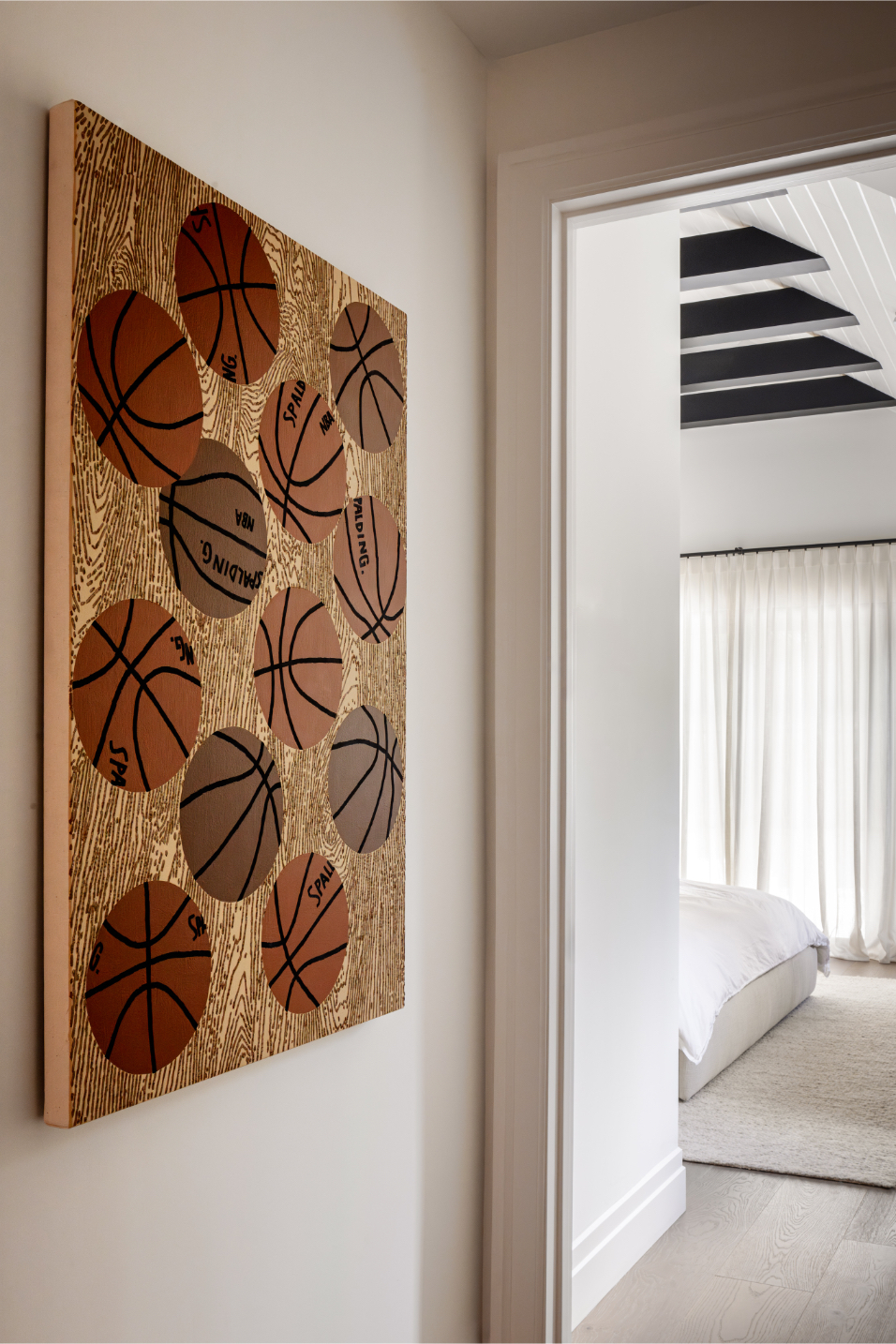 Jonas Wood, Floating Balls on Wood Grain, 2021.
Which artist are you currently most excited about, and what makes their work resonate with you right now?
I return to Ed Ruscha’s work time and time again and was lucky enough to acquire a beautiful work on paper, Woman on Fire. I try to follow what the emerging artists are up to but my interest seems to be drawn to more established artists like Gormley and his work—artists who are already part of the canon of art history. Not only has contemporary art enhanced my living environment but the narrative has added a greater dimension to my life.
What book changed the way you think about art?
Early in my collecting journey, Jane Suitor gave me a copy of Why Your Five Year Old Could Not Have Done That: Modern Art Explained. It helped me realize that contemporary art isn’t about having all the answers, it’s about curiosity. That mindset has stayed with me. The more I’ve learned about art, the more comfortable I’ve become asking questions and sitting with ambiguity.
Do you have an art-fair or museum-going uniform?
Usually a good jacket, relaxed trousers, something simple underneath, and shoes I can put miles on. I like clothes with some texture or history to them—vintage, workwear, tailoring, pieces that feel lived-in. I don’t want to look overthought, but I do want it to feel intentional. In a way, it’s similar to collecting. I’m drawn to things that have character, but don’t have to announce themselves too loudly.
More of our favorite stories from CULTURED
Bowties in Public, Rubber Curtains at Home: Inside the NYC Loft of a Revered Modernist Starchitect
Introducing CULTURED’s 2026 Young Collectors List
12 Burgers, 10 Snapper Crudos, 1 Rabbit: These Are the Rarest Dishes in New York
Here Are the Books Young Writers Can’t Stop Turning to for Inspiration
Sign up for our newsletter here to get these stories direct to your inbox.