
 Save
Save
You have reached your maximum number of saved items.
Remove items from your saved list to add more.
AAA
Sydney’s first high-rise residential block, Blues Point Tower by architect Harry Seidler, turns 64 next week.
With its exterior influenced by Bauhaus artist Josef Albers, the 83-metre-high, 23-storey block completed in 1962 was thought to be a symbol of modernism.
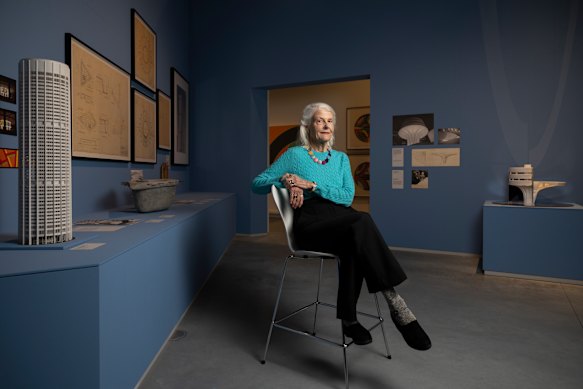 Penelope Seidler at the exhibition Migrating Modernism: the architecture of Harry Seidler, at the Chau Chak Wing Museum in Sydney. Janie Barrett
Long before today’s transport oriented development, Seidler argued against urban sprawl, proposing that cities needed more density and homes near public transport and open spaces.
Seidler’s collaborations with artists and designers like Albers; his former architectural mentor, Marcel Breuer; and Italian architect and engineer Pier Luigi Nervi, are celebrated in a new exhibition opening on Saturday at the Chau Chak Wing museum at the University of Sydney.
“In his hands architecture rarely arrived alone,” said architect and historian Kenneth Frampton.
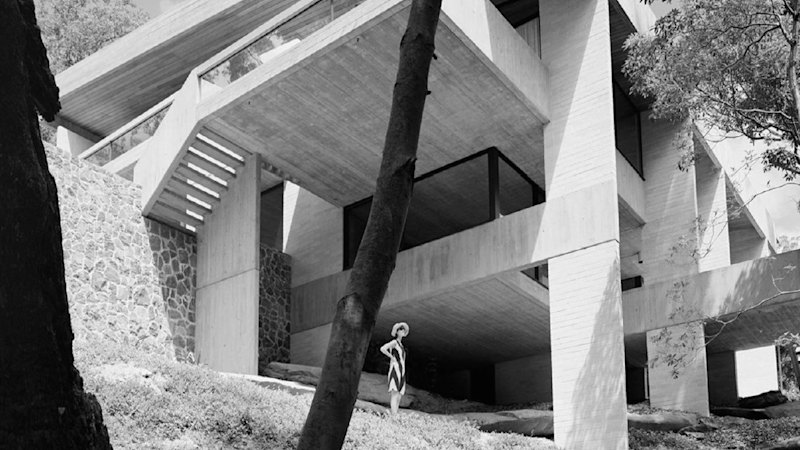
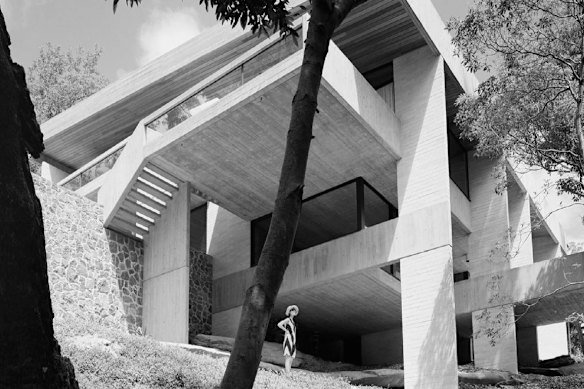 Penelope Seidler at Harry and Penelope Seidler House in 1967. Photo by Max Dupain, copyright Penelope Seidler
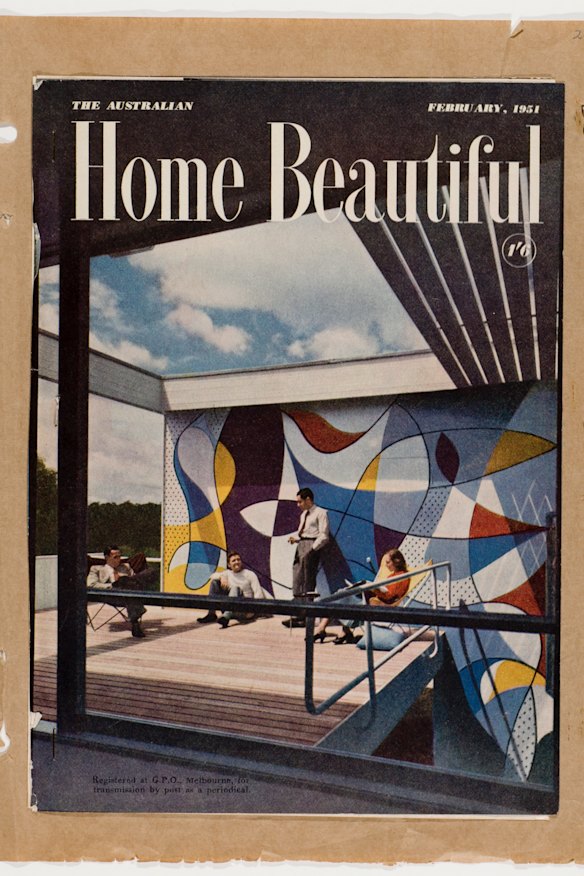 The Australian Home Beautiful with Rose Seidler House mural by Harry Seidler. Melbourne, February 1951, collection State Library of NSW, reproduction of cover.Copyright Penelope Seidler
Every Seidler project – no matter the type or scale – came with art he’d selected. Home owners recalled how he selected paintings. At his mother’s home, Rose Seidler House in Wahroonga, he painted a bright-coloured mural himself, similar to those he’d seen in Brazil.
At Australia Square he commissioned sculptor Alexander Calder to design Crossed Blades. Its curved walls were hung with tapestries by Le Corbusier and Victor Vasarely, which were later replaced by Sol LeWitt’s Bars of Colour.
Art historian Dr Ann Stephen argues Seidler was a global exemplar of modernism, ahead of his time. “You had to be a visionary to realise what he did. You can’t imagine how conservative Australia was in the late 1940s when Seidler arrived,” she said.
Stephen and Dr Paolo Stracchi, a senior lecturer in architecture, co-curated the exhibition Migrating Modernism. The architecture of Harry Seidler.
Seidler was born in 1923 to a Viennese-Jewish family. After the Nazi annexation of Austria in September 1938, he was 15 when his family sent him to England.
His wife, architect Penelope Seidler, said Seidler’s architecture career began in England when he completed a course in carpentry, metalwork and bricklaying at Cambridgeshire Technical School.
He also learnt English. Seidler later told a historian that when he arrived in London, the only thing he could read (and understand) was “one way street”.
Although he was a refugee fleeing the Nazis, he was later interned as an enemy alien in England.
Related Article
He was then deported to Canada, where he wrote that Nazi soldiers were housed alongside European Jews in an internment camp. In 1941, then aged 18, he was given conditional release to study architecture, and by 21 had graduated.
The exhibition includes Seidler’s extensive diaries and scrapbooks, including cross-stitching by Penelope Seidler, including of Blues Point Tower, and the shirt Seidler wore at the internment camp.
There are also artworks from the artists he commissioned, photos, architectural models and drawings, and rare video footage.
Arriving in Australia aged 24 after studying in the United States, Seidler introduced “a distinctly cosmopolitan culture to Australian cities – not only through his buildings, but also through the art he commissioned to open up major public spaces,” Stephen said.
He had a technical mastery of his profession and building, and the ability to realise his vision, she said.
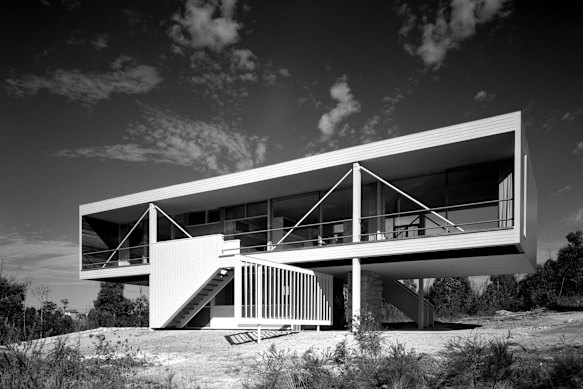 Julian Rose House, Wahroonga, Sydney 1950-54. Architect, Harry Seidler. Photo by Max Dupain 1954. Copyright Penelope Seidler.
At a time when most Australians lived in low-rise flats or detached homes, she said Blues Point Tower showed the “joys of being able to live in an apartment right in the centre of the city.”
Long before public opinion turned on Blues Point Towers with critics saying it was a blight on the harbour, the tower was described as “millionaire homes for the many”. It was glamorous living, reports said, an ideal solution for renters, a model for the towers of the future and “everybody’s idea of home units”.
A double page spread by The New York Times reported Seidler had positioned the skyscraper diagonally on the block to maximise residents’ views.
Residents said they had more free time. No more mowing lawns.
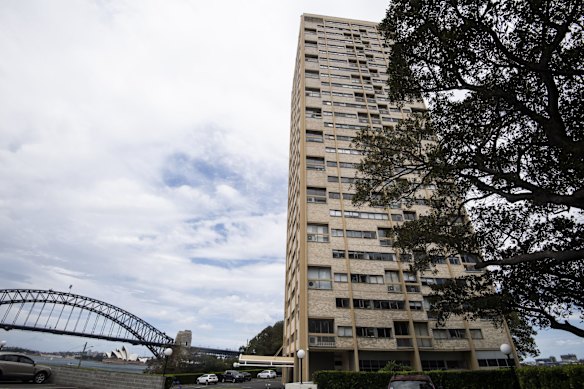 Blues Point Tower, November 2020.Louise Kennerley
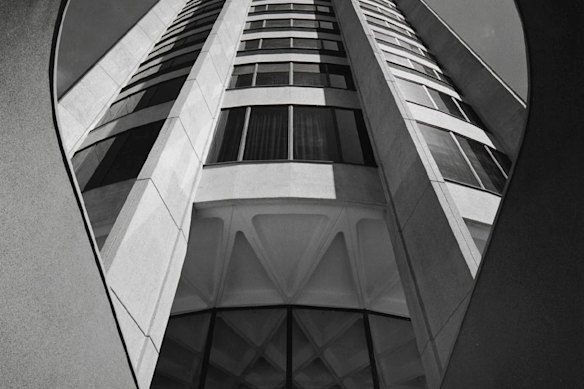 Australia Square, 1967. Photo by Max Dupain, copyright Penelope Seidler
If Blues Point was to transform how Australians lived and worked, it also changed the life of 18-year-old Penelope Seidler, then Evatt.
She met Seidler in North Sydney in 1957 when architects and others were lobbying against the area’s rezoning for industrial use.
Seidler was nothing like the young men Penelope knew. “That was the point,” she said on Thursday, visiting the exhibition. “He was driven, that’s for sure. He was obviously the most interesting person I’ve ever met.”
They were soon engaged, and married on her 20th birthday in 1958. They worked and practised together until his stroke in 2005.
He died in 2006. After Seidler’s death, Australian architect Glenn Murcutt said he had brought art to architecture. “Whilst he wasn’t everyone’s cup of tea … he actually brought a level of architecture that few architects have seen in this country.”
Start the day with a summary of the day’s most important and interesting stories, analysis and insights. Sign up for our Morning Edition newsletter.
Save
You have reached your maximum number of saved items.
Remove items from your saved list to add more.
 Julie Power is a senior reporter at The Sydney Morning Herald.Connect via X or email.From our partners