
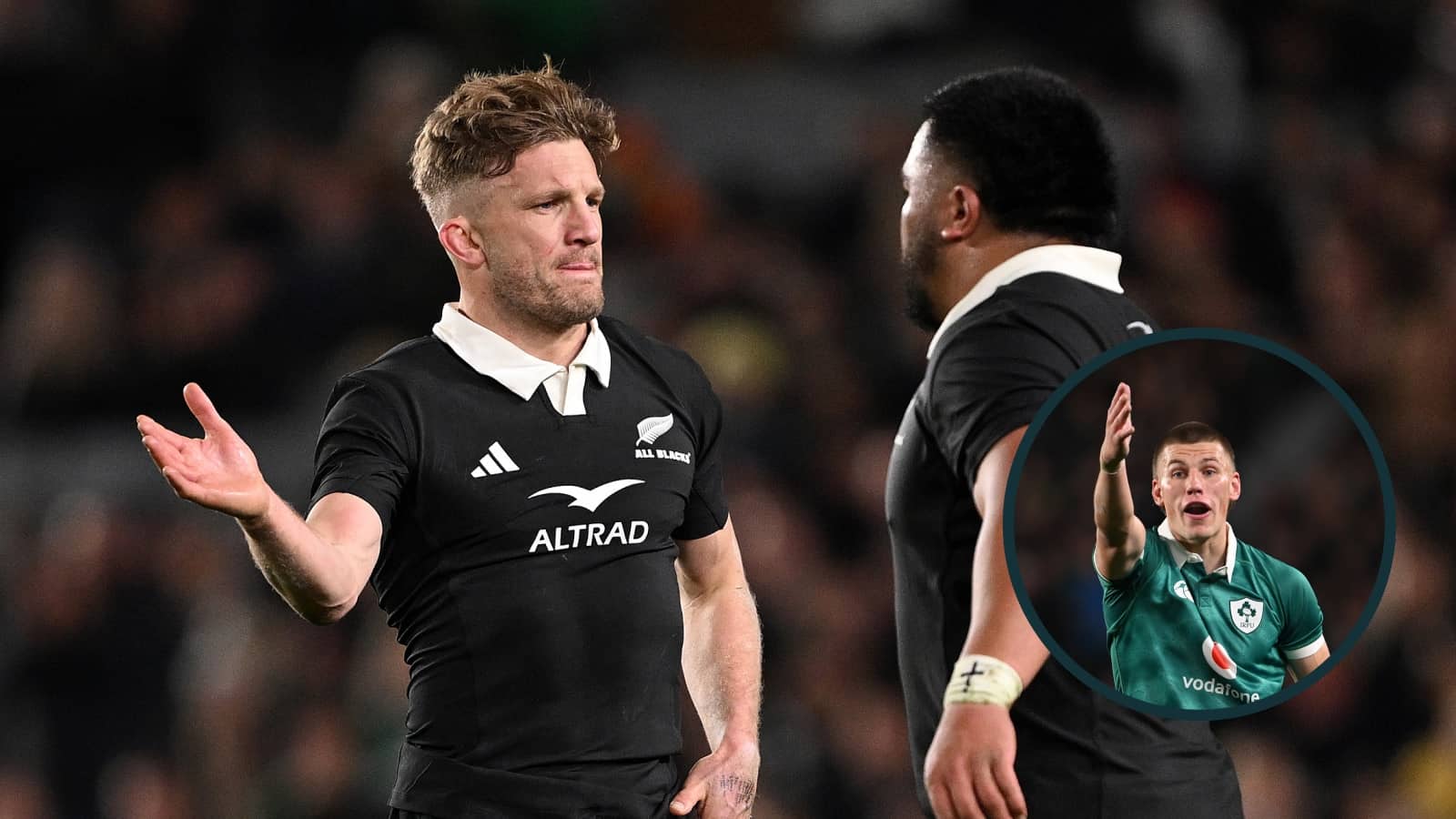
The All Blacks extended their 32-year unbeaten record at Eden Park to 53 Tests with a 40-21 Nations Championship victory over Ireland, running in six tries to complete a perfect July and throw down the gauntlet to South Africa.
The Top Line
The world’s second-ranked side met the third, and the one-place gap in the rankings failed utterly to describe what unfolded at Eden Park as the All Blacks delivered their best performance of the year.
New Zealand beat Ireland with speed and precision at the most contested square metre in rugby, the ruck, and from that single square metre flowed everything else: 62 per cent of possession, 59 per cent of territory, seven line breaks to three and six tries through Patrick Tuipulotu, Ardie Savea, Will Jordan, Asafo Aumua, Damian McKenzie and Anton Lienert-Brown.
Ireland’s replies came from Jack Conan, Joe McCarthy and Hugo Keenan, all three hewn from close-range labour, and whilst the visitors won the second half 14-12, the contest itself had been settled by an opening 40 minutes of total systemic superiority.
Dave Rennie’s first month in charge ends with three wins from three, a maximum 15 championship points, and a fortress record stretched to lengths no touring side has dented since 1994.
All Blacks extend Eden Park record in statement victory over Ireland
Won at the most contested square metre in rugby
The anatomy of the opening try told the whole story in miniature. A break out wide, then four rucks hammered straight down the middle at extreme pace, simple pop passes, and Tuipulotu arriving through a gap off Josh Lord’s tip to score on 15 minutes. Nothing elaborate was required all evening because the fundamentals were immaculate: pass retention superb, cleaners arriving to tidy pictures, and Quinn Tupaea winning the gain line by two and three metres on first phase; his match-high 16 carries were the platform on which the tempo was built.
The subtler brilliance lay in what New Zealand declined to do. When Ireland attempted to inject pace by committing three men to every clean-out, the All Blacks simply refused the contest, keeping upwards of 13 defenders on their feet whilst Ireland buried bodies securing ball nobody was fighting for. The consequence was arithmetic as much as athletic: Ireland attacked phase after phase with 11 or 12 against a full defensive line, funding the very line speed, led by Tupaea’s push from 13 and a hard-hitting inside wall, that was suffocating them.
The one stain on the discipline ledger was Luke Jacobson’s clean-out on Josh van der Flier, shoulder-led and without a wrap to the naked eye. The on-field yellow was referred to the bunker, the review found mitigation, and the card stayed yellow. If there was a scintilla of mitigation, we’ve yet to see it.
Ireland beaten at their own religion
The defining virtue of Farrell’s Ireland across two World Cup cycles has been precision under pressure, the catch-pass-decision machine that made them the world’s best side. At Eden Park they were beaten at their own religion, and the number that quantifies it is 15 turnovers lost to New Zealand’s seven. With turnovers won level at four apiece, those 15 were overwhelmingly unforced; Stuart McCloskey passing directly into Jordan’s hands for the wing’s 51st Test try, Robert Baloucoune dropping in open field for McKenzie to punish with a 50/22 that yielded Aumua’s maul try through McCarthy’s channel, and exits run from deep when the ball should have gone to the sky. One side was as accurate as a Rolex; the other fell apart under pressure it largely manufactured itself.
The balance must be stated honestly for the tourists. This was Test 12 of a ten-month, post-Lions season against opponents three matches into a fresh campaign, and the second half offered evidence of a living team rather than a broken one: the corner-fold failures of the first 40 were repaired at the interval, the scramble sharpened, and a 33-phase New Zealand siege was repelled without a point conceded.
McCarthy was magnificent throughout, topping the match with 18 tackles and adding 14 carries whilst featuring in the build-up to all three Irish tries, with Tadhg Furlong’s 17 tackles and Conan’s 16 in close support. Yet fatigue explains slow; it does not explain a scrum defence misaligned for Savea’s try under the posts, with the fly-half stationed on the wrong side of the most predictable picture in rugby. If November brings more of the same from fresh legs, the transitional alibi expires and a harder word beckons.
The experiment at six that answered two questions
Tupou Vaa’i was the third man to wear the No.6 jersey in as many Tests, and the experiment is over: it worked. The 120kg lock gave New Zealand power and rebalance on the blindside, 12 carries with a clean break, a physical edge in the maul and lineout exchanges, and the mass that drove Ireland backwards in the tight.
The orthodox objection to two heavyweight blindsides, the absence of a genuine openside, dissolves on inspection because Savea does the seven’s open-play job from No.8, first to the breakdown threat and the game’s top jackal with two turnovers won. Rennie has relocated the back row’s balance rather than abandoned it, and with Jacobson at 6ft 3in and 112kg the smallest of the trio, the tonnage argument makes itself.
Four Tests against South Africa loom, and the configuration built to meet the Springbok pack has just passed its audition against the best forward unit the north sent south this year.
The quiet men won the loudest arguments
Nobody in black produced a highlight-reel individual performance, which is precisely the point. Ruben Love, seven caps and facing Ireland for the first time, answered every pre-match question about his readiness for a pressure side with an evening of error-free orchestration: changing the point of attack, raiding the short side off accurate counts, beating three defenders, and striking a 50/22 to match McKenzie’s earlier effort.
Cam Roigard’s speed to the base set the ruck tempo that broke Ireland’s fold, whilst McKenzie beat a match-high eight defenders and turned every loose Irish ball into territory. In the arm wrestle Ireland finally imposed after the hour, New Zealand’s answer was to accept the terms and win those too, hammering the 10 channel where Irish back-rowers lay buried in rucks until McKenzie crossed on 57 minutes.
The contrast at fly-half was merciless. Sam Prendergast received standing still, shuffled or turned before releasing, and the quarter-second tax on every recycle compounded across phases into murdered momentum, with three passes thrown directly into touch and the misalignment for Savea’s try completing a chastening examination. And for Jamison Gibson-Park, back in Auckland 12 years after his Blues debut with family in from Great Barrier Island, the homecoming curdled into a lament: the world’s premier facilitator starved of front-foot ball behind a beaten pack, watching two kids do his job better on his old ground.
Fortress 53
Eden Park has now gone 53 Tests unbeaten across 32 years, and Ireland’s fifth visit ended like the previous four, this one a fourth defeat by 19 points or more in Auckland. The margin sits alongside the 42-19 of 2022 and the 2012 hammering in the same grim lineage, and Ireland were fortunate the gap was only 21: their opening try came with Jacobson in the bin, and New Zealand left further scores out there, Love held up over the line among them.
The honest caveat attaches to the champions-elect too. For the second consecutive week the All Blacks faded after the hour, conceding 14 second-half points and going 33 phases without breaking a reorganised defence, the same looseness Rennie called out after Italy.
It is the one flaw a perfect July has not buried, and South Africa’s analysts will have it circled. New Zealand top the Southern Hemisphere pool with 15 points from 15, the try bonus secured before half-time in all three outings, and the Springboks, who face Wales in Durban this afternoon, are the next side invited to answer.
READ MORE: All Blacks 40-21 Ireland: Check out the stats, facts and more from the Nations Championship clash