
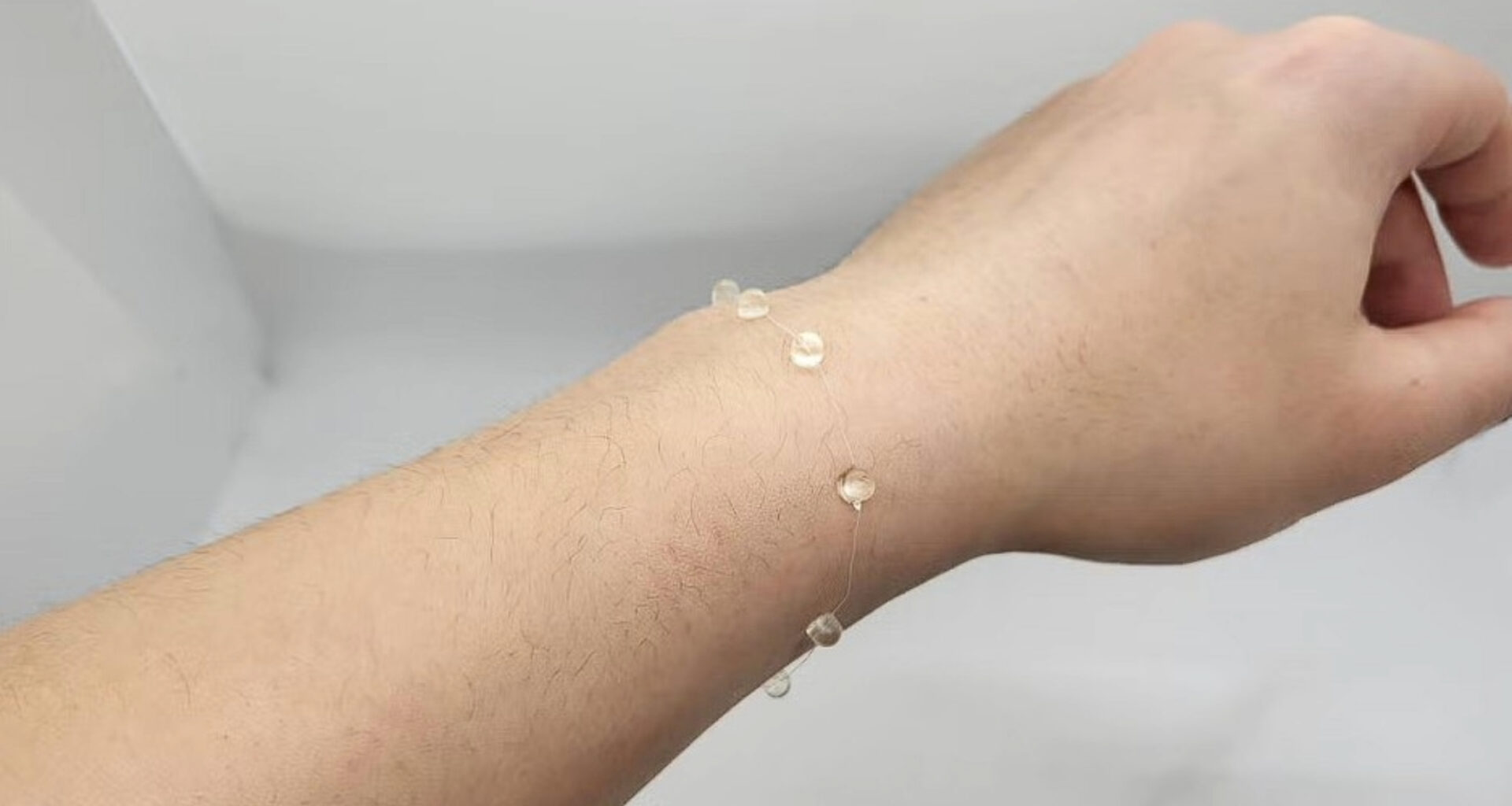
Electronics that bend, stretch, and move like ordinary thread could soon make wearable health monitors almost disappear into clothing.
Engineers have created flexible integrated circuits built directly onto thread, allowing complex electronics to coil, bend, and conform naturally to the human body.

The technology could eventually lead to clothing that continuously tracks health and sensors that monitor breathing without bulky equipment. It could even lead to electronic sutures that track healing inside the body.
Led by Sameer Sonkusale, an engineering professor at Tufts University, the team built the circuits using soft materials and a manufacturing process that requires no expensive cleanroom.
The result is a new kind of electronics that behaves less like traditional hardware and more like the fabric we already wear.
Putting entire circuits onto thread
To pull this off, Sonkusale and his team built every component of a complex integrated circuit in thread form.
That included transistors, sensors, and everything in between, rather than using a traditional flat surface.
That’s a significant departure from how electronics have traditionally been manufactured, and it opens the door to devices that behave more like fabric than hardware.
“By moving electronics from planar patches to free-form threads, we have opened a path toward wearable bioelectronics that are more like fibers than hardware,” Sonkusale said.
“They will be soft, stretchable, and able to follow the body’s shape rather than forcing the body to accommodate the device. They could even potentially be used like sutures to monitor processes inside the body.”
Health monitors you barely notice
Wearable devices are already everywhere. More than a third of U.S. adults use smartwatches or smart rings, many of which offer some form of health tracking.
Thread-based integrated circuits could push that trend even further. Health monitors could be woven directly into clothing, soft interfaces, or skin-contacting threads.
These devices could move naturally with the body instead of sitting rigidly on top of it. The potential health applications extend well beyond fitness tracking.
Researchers point to possibilities like sutures that can directly monitor wound healing.
Thread-based sensors could also track movement patterns tied to cognitive decline or fall risk in older patients. They could even detect breathing irregularities in infants.
In such applications a soft, unobtrusive sensor could matter far more than a conventional rigid device.
Electronic threads prove their potential
As an early proof of concept, the researchers demonstrated circuits capable of amplifying signals from sensitive sensors.
They built one device designed to sit on the temple and detect blinking. Another was positioned near the diaphragm to track changes in breathing patterns and rate.
Both demonstrations point toward a future of soft, thread-based wearable systems. These devices could monitor health indicators like stress or respiratory function while barely registering to the person wearing them.
“The technology platform is still in early stages,” said lead author Wenxin Zeng, a PhD candidate in electrical engineering at Tufts.
“But we expect to improve the speed and precision of fabrication, and the ability of the thread-based integrated circuits to carry out more complex functions.”
The technology behind the thread
At the core of each electronic device runs a thin thread coated in gold. Tiny, fully flexible transistors attach to this thread.
These transistors are the fundamental building blocks of any digital device. A conducting, plastic-like material connects them to the gold thread on either side.
Electron flow through the transistor gets switched on and off much like a spigot. A second current acts as a gate, functioning essentially like a valve.
The real innovation enabling all of this is a material called a eutectogel.
This gel creates a gap less than a millimeter wide between two ends of the electronic thread. In this gap, the flow of electrons can be precisely controlled inside a thread-based resistor, capacitor, sensor, or other component.
Previous attempts by other researchers relied on hydrogels for similar connections, but those tend to dry out over time.
The eutectogel avoids that problem entirely, remaining stable, soft, and safe for extended contact on or inside the body.
Circuits that can heal themselves
The eutectogel brings an unexpected bonus: it gives the transistor a genuine self-repair capability.
If the gel breaks, researchers found that simply bringing the broken pieces back together and applying gentle heat restores both its mechanical structure and its electrical function.
The electronic thread itself can’t be repaired if it’s actually cut. However, the gel components at the heart of each transistor can be rejoined.
This ability could extend the practical lifespan of these devices in ways rigid electronics simply can’t match.
Cutting costs of flexible electronics
Unlike traditional integrated circuits, these electronic thread-based circuits need no cleanroom at all during fabrication.
Traditional circuits typically require photolithography, which precisely deposits patterned material layers onto a surface, or other high-temperature processing methods.
That makes the entire approach far more compatible with soft polymers and textile-like materials.
Most importantly, it opens the door to genuinely low-cost manufacturing, a detail that could matter enormously if this technology is ever going to scale beyond the lab and into everyday clothing.
The study is published in the journal ACS Applied Materials and Interfaces.
Image Credit: Wenxin Zeng
—-
Like what you read? Subscribe to our newsletter for engaging articles, exclusive content, and the latest updates.
Check us out on EarthSnap, a free app brought to you by Eric Ralls and Earth.com.
—-