
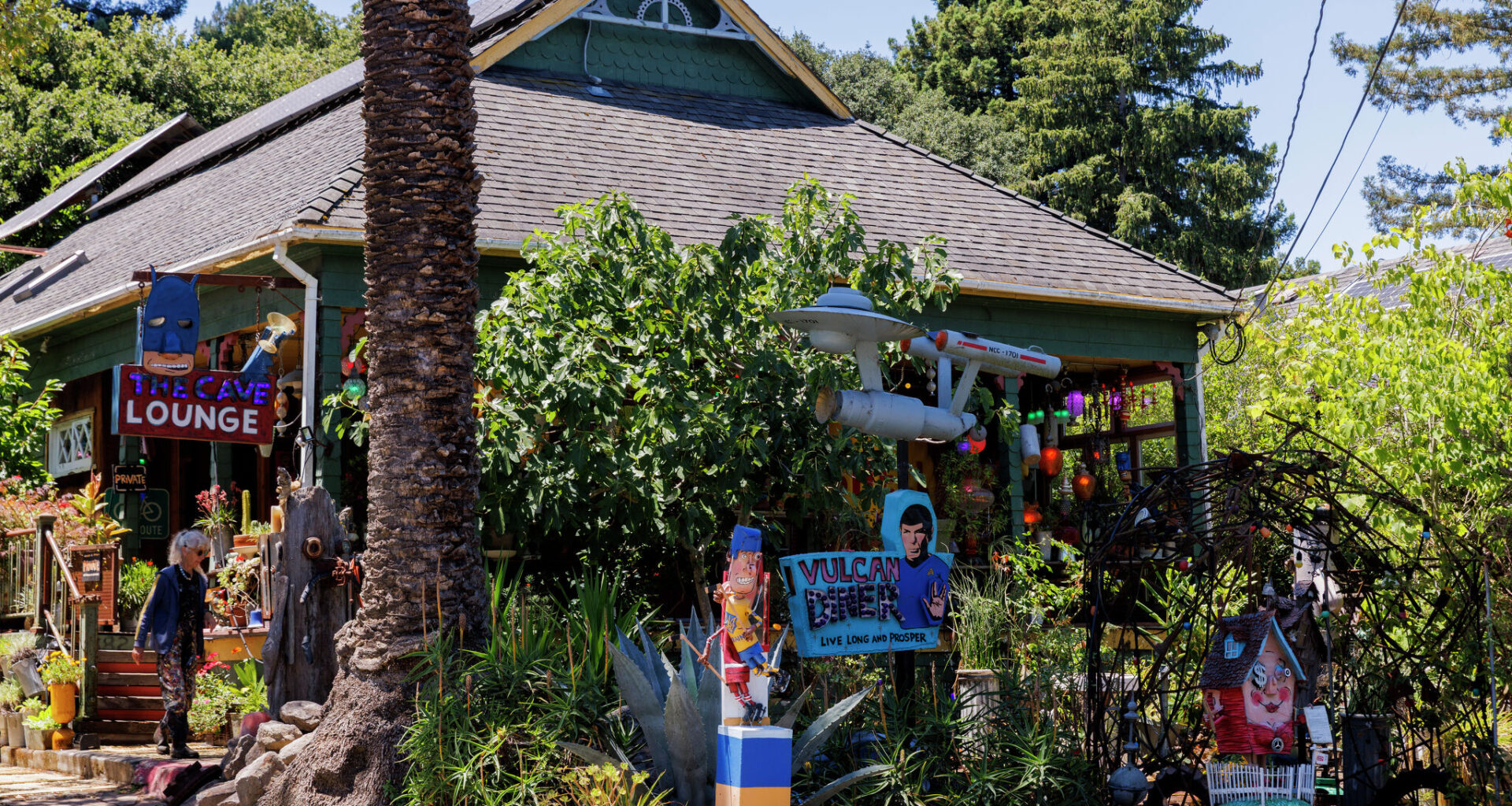
The home of Patrick Amiot and Brigitte Laurent in Sebastopol. Amiot makes junk art out of repurposed materials and his spouse Laurent paints them.
Santiago Mejia/S.F. Chronicle
Patrick Amiot in his backyard on Florence Avenue in Sebastopol. The sculptor has given pieces to many neighbors, turning his street into a destination.
Santiago Mejia/S.F. Chronicle
A Godzilla sculpture by artist Patrick Amiot stands in the front yard of a home on Florence Avenue in Sebastopol.
Peter Hartlaub/S.F. Chronicle
Amiot and Laurent’s backyard is filled with their junk art sculptures.
Santiago Mejia/S.F. Chronicle
Patrick Amiot’s first sculpture on Florence Avenue in Sebastopol, a 14-foot fisherman made of recycled parts, was installed in June 2001. It was meant as a goodbye.
He was broke, his career was at a crossroads, and the artist planned to pack up his young family and open a pizzeria in Costa Rica. The looming, joyful artwork erected at his home was a thank you to his adopted town.
“I was expecting a city ordinance to tell me to get my s— off the front yard,” Amiot remembers. Instead, it drew the interest of a local newspaper. “They asked the neighbors, ‘What do you think about this? ’ And the neighbors said, ‘It would be nice if he did something else.’”
Article continues below this ad
Amiot and Laurent’s Sebastopol home is filled with surprise art pieces, furniture made from recycled materials and work from fellow artists.
Santiago Mejia/S.F. Chronicle
The end became the beginning for Amiot, ringmaster of one of the most charming traditions in Bay Area art and community. The sculptor and his wife Brigitte Laurent have since collaborated on more than 30 works of whimsy on their street — including baseball players, batmen, a wicked witch, a rampaging Godzilla and houses strutting on chicken feet — which adorn almost every Florence Avenue home for a three-block stretch.
An otherwise unremarkable residential street has transformed into a Halloween attraction and guidebook destination with a 4.8-out-of-5 rating on TripAdvisor. Amiot’s art-ensconced house is the centerpiece.
San Francisco Chronicle Logo
Make us a Preferred Source to get more of our news when you search.
Add Preferred Source
“I always tell people, I think it’s a combination between Willy Wonka’s factory and Pee-wee Herman’s house,” said Katlyn Dycus, who lives in a cute cottage fronted by an Amiot sculpture.
Article continues below this ad
Her shaggy brown dog with a chef’s hat, apron and wide eyes that look like they were made from shower drains is dad-coded, holding a (local) Crooked Goat beer while turning hot dogs.
“You’ve never seen anything like it before.”
Amiot landed on the Chronicle’s radar when his block showed up in a Google review dataset as the second-highest-rated museum in the Bay Area. Amiot laughs at the mistake. He has never courted art museums or galleries, preferring to drop his often monolith-sized sculptures in shared community spaces.
Laurent paints an Amiot junk art sculpture that the couple is creating on commission for a local auto repair shop.
Santiago Mejia/S.F. Chronicle
And the community has embraced him back. Amiot and Laurent, who curate color schemes and paint the sculptures, landed in Sebastopol by accident. The artists, who still carry French accents, left Quebec in 1997 with their 4- and 6-year-old daughters. After Mendocino (too cold) and Los Angeles (too Los Angeles) didn’t feel right, the family lucked into Sebastopol.
Article continues below this ad
“We ran out of gas here,” Amiot said.
The family connected to the agricultural city’s Americana spirit and progressive leanings from the start. But they missed the way Quebec neighbors socialized during hot summers, blending without boundary in each other’s front yards. Amiot and Laurent improvised a pizzeria in their front driveway and asked neighbors to join.
After the newspaper article about his giant fisherman, Amiot made a large Statue of Liberty using a metal trash can and other found materials. It was erected on Sept. 10, 2001. When the world changed the next day, the artist planned to take it down in the name of good taste, but locals had already started a shrine of flowers and notes.
A firefighter neighbor was the first to ask for his own sculpture. Amiot made a cowboy for another neighbor shortly after, inspired by a “Report All Poachers” bumper sticker. He knocked on doors, started conversations and remained curious toward newcomers, his next work always in mind.
“Basically that’s how it started,” Amiot said. “I got to know all my neighbors through the artwork.”
Article continues below this ad
Amiot and Laurent’s home studio in Sebastopol. The sculptor has added a second studio where he welds his pieces.
Santiago Mejia/S.F. Chronicle
Amiot’s art career was founded on making bright and detailed ceramic figures; the Montreal Canadiens hockey team was an early muse. The much larger junk art sculptures (Amiot embraces that term) flourished after the Sebastopol move.
A quarter century after his first Florence Avenue piece, nearly every home on the street of inviting bungalows and neat yards has an Amiot sculpture outside: a Godzilla with spark plugs for teeth; a punk rock guitarist with a metal cauldron head and (real) spiky grass for hair; animals with eyes made from clocks and pressure gauges; superheroes with sprinkler parts on their utility belts.
Some are chosen by neighbors from the sculpture garden surrounding Amiot and Laurent’s otherworldly home — a colorful mix of neon signs, themed family photos, surprise artwork on pull-blinds, furniture made from car parts and sculpture installations bartered from other artists.
Others are custom-made. Multiple neighbors explain that the “Crow Bar,” a murder of crows drinking Coronas, with one bird passed out on the bar, was made for the resident, a former bartender at Marty’s Top of the Hill, an iconic Sebastopol country-western bar that closed in the 1990s.
Amiot’s work now helps define Sebastopol, appearing around unexpected corners of the charming downtown along Highway 12. There’s a 10-foot chicken in front of the community art center; a Jerry Garcia sculpture greets you at the computer repair shop. When the Chronicle shows up for an interview, Amiot and Laurent are finishing a cartoonish car piece — a bearded mechanic pops from the hood of a salvaged 1950s aquamarine truck — that will welcome customers into a local auto repair shop.
Article continues below this ad
“His mind is always bubbling and he always has crazy projects,” Laurent says, as she adds a little rouge to the auto mechanic’s cheeks.
The artist now has a steady stream of paid jobs. He added a studio along Highway 116 where the welding happens and has shipped finished pieces as far away as Norway and Japan. His commissions include the Pride of Canada carousel, which opened in Markham, Ontario, in 2016 with 44 rideable Amiot sculptures.
As we pass by on Florence Avenue, Sebastopol’s former mayor, Guy Wilson, is tending tomatoes in his yard, which features two Amiot sculptures: a Babe Ruth and a San Francisco Giants pitcher who appears to have a frying pan and hubcap for ears.
Junk art made by artist couple Patrick Amiot and Brigitte Laurent fills their neighborhood in Sebastopol. The section of Florence Avenue around their home has become a highly rated destination on TripAdvisor and Google.
Santiago Mejia/S.F. Chronicle
“I think one of the great things about Sebastopol is the level of engagement by the people who live here. The community spirit. The community involvement,” Wilson says, calling it a microcosm of Berkeley. “People can get worked up about local issues, but they all come together in the end.”
There are drawbacks to living on a street with 140 Google reviews. Halloween on Florence Avenue has become a madhouse, with thousands of visitors. Amiot seems to have mixed feelings about the junk that keeps showing up on his property, which has become a dumping ground for people with things that aren’t valuable enough to sell, but have too much emotional attachment to trash.
One of Amiot and Laurent’s junk art sculptures in Sebastopol.
Santiago Mejia/S.F. Chronicle
“People drop s— in my driveway all the time,” he says. “Everything from barbecues to your grandmother’s clock that didn’t work (to) the hubcaps from their old MG they owned in Europe.”
And drivers often slow to a maddening crawl, blocking residents who need to run errands or get to work. (Florence Avenue pro tip: Get out and walk if you can. The sculpture details are better close-up anyway.)
But the benefits outweigh the frustrations. Wilson seems to finish Amiot’s summers-in-Quebec thought, noting that he now loves spending time in his front yard, which has become a receiving line of friendly neighbors and curious strangers.
“Living on Florence Avenue is great,” he says, “in part because of the serendipitous conversations.”
Amiot, in his 60s now, doesn’t seem to be slowing down. With his business on solid ground, he changed his agreement on the neighbors’ sculptures from loans to gifts. Only one very early neighbor has paid for Amiot’s work.
But his legacy isn’t an installation, a particular style or even the way his art makes people feel. It’s the bond that’s been created on a small street in a random town that one very creative family landed in by accident.
“I feel that people have sort of appropriated the whole street as being theirs,” he says. “In a time when people fight over the color of a fence, I feel lucky to land in a town that is so progressive, where people are willing to give others a chance.”