
Italy had to wait 73 years for its next Belgian Grand Prix winner.
Alberto Ascari was the last to do it, winning the famous race in 1953. It was a key part of his title-winning season, the last time an Italian won the world championship.
Andrea Kimi Antonelli’s victory at Spa-Francorchamps at the weekend broke one of those droughts, and by extending his championship lead to 45 points over Lewis Hamilton and 50 points over hapless teammate George Russell, he’s on the way to breaking the other too.

Fox Sports, available on Kayo Sports, is the only place to watch every practice, qualifying session and race in the 2026 FIA Formula One World Championship™ LIVE in 4K. New to Kayo? Join now and get your first month for just $1.
But the fact victory for the teenager felt inevitable for practically the entire weekend was perhaps the more important part of this result.
Antonelli had been shipping points to Hamilton and Russell for three grands prix, his lead slashed from a season-high 66 points down to just 25 points ahead of Belgium.
Circumstances had played a dominant role in that fallow spell, with unreliability twice rendering him scoreless.
Still, with teammate Russell winning one of those races and with the surging Ferrari claiming the balance, there was a risk that momentum was swinging against the young gun.
He shut down that theory with the sort of ruthlessness becoming of a title-winner.
“The momentum has always been there despite what happened in the previous races,” he said.
“I just need to maximise the performance every time and try to do my best whenever I get in the car, then you see what the balance is at the end of the year.
Instead, the preceding run of low-scoring races had put his campaign into a new perspective.
“I just need to take it one weekend at a time, because you never know what can happen.
“With these new cars and new regulations, there’s so much going on and so many unpredictable things that can happen.
“That’s why I just need to focus race by race, and then you’ll see at the end of the year.”
But then it’s easy to take things week by week when the pace comes easily.
For Russell, who finds himself third in the standings for the third time in five rounds, every new week brings a new level of pain and disappointment.
‘UNACCEPTABLE. UN-F**KING ACCEPTABLE.’
Russell thought he could fight for the lead as he exited La Source with a bit of overlap on second-placed Verstappen.
That brief moment of positivity was as good as things got.
It was when he put his foot down to power down to Eau Rouge that he knew he had problems.
“For whatever reason, the battery decided not to recharge at turn 1, so … I exited the first corner 35 per cent down [on battery charge],” he said, per ESPN.
“Because it didn’t charge and I also had a boost problem, the turbo didn’t sort itself out, so I had no power. I got to the top of Eau Rouge with 0 per cent on the battery.
“Quite frankly it was dangerous, and I got swamped by three cars.”
One of those cars was Hamilton, who cruised down his inside into Les Combes only to find himself stuck behind Verstappen at the apex.
Russell spied his chance to begin his recovery immediately and swooped around Hamilton’s outside.
Hamilton, though, began to understeer, his car lacking downforce in Verstappen’s wake. They collided in the middle of the road.
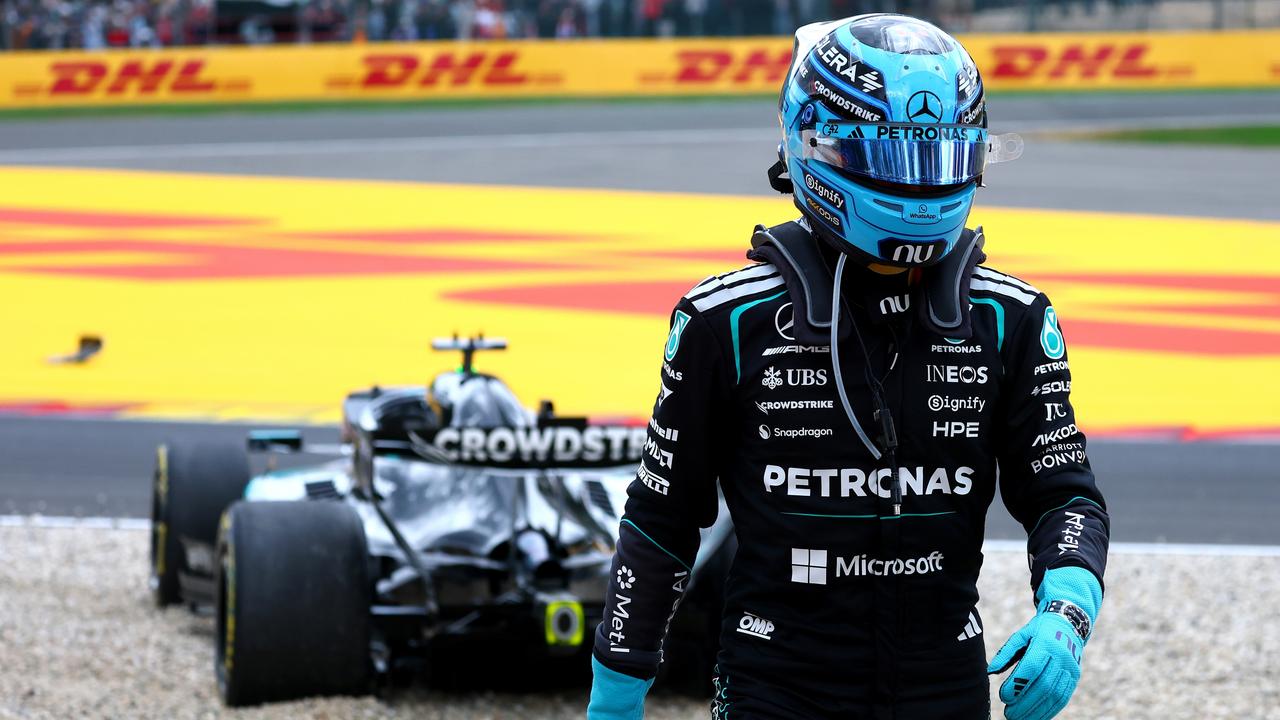
Russell’s Mercedes was bounced into the gravel, where it became beached.
Russell was out of the race, and he was furious.
“What the f**k happened with the [state of charge] down the straight?” he shouted into his radio. “I had no f**king battery down the straight.
“Guys, unacceptable. Un-f**king acceptable.”
He made clear afterwards — if there was any doubt — that his rage was all about his engine problem, not the crash.
“I shouldn’t have been in that position in the first place, that’s why I’m most angry,” he said. “With Lewis, honestly, I think was a racing incident.”
Russell has been complaining about what he’s believed has been an engine problem for the last two weekends, though his complaints had been focused largely on top speed — more on that below.
His issue on the first lap, though, appeared to be different, with an inexplicable and significant lack of battery charge at the start of the race.
He wasn’t alone. Mercedes revealed later that every driver with one of its engines suffered an unexpected lack of power out of the first corner.
Antonelli, for example, lost the lead to Verstappen almost immediately out of the first corner.
“I was so confused about what was happening, because Max came flying past me before Eau Rouge,” Antonelli said.
“I passed him back, but then I saw Charles [Leclerc] almost come alongside me, and I was like, ‘What the heck is happening?’
“I had no clue. I was just trying to hold the position on track, and I was looking in my mirror the whole time because I just saw so many cars coming.
“It was a crazy start. Luckily we got away cleanly.”
For Russell, though, it’s more personal, and not just because it cost him big points.
Though it mightn’t have been the same problem he’s been arguing over for the last few weeks, another clear Mercedes engine issue appears to have opened the door to the team finally accepting that his car is carrying a problem that’s hurting his championship hopes.
RUSSELL’S FRUSTRATION IS BUILDING
The context of Russell’s incident is bigger than the points swing against him.
For the last two weekends the Briton has felt he hasn’t had access to the same engine power as Antonelli.
It’s not an accusation of bias but effectively of substandard workmanship that he says is tainting his title campaign.
As explained after qualifying, the factors that influence straight-line speed are extremely complex with these hybrid engines.
A driver’s speed and inputs through the corners, for example, can have disproportionately massive effects on the battery’s state of charge, either by putting more power into the battery or taking more than expected out of it.
Part of Russell’s deficit to Antonelli in the UK and in Belgium was that his lack of confidence in some corners was leading to him using too much battery power or not recharging the battery enough. It meant Antonelli would have more electrical power down the straights, creating the speed deficit.
In Silverstone the team largely denied that there was a significant issue. Russell was even shut down by team boss Toto Wolff on the cool-down lap when he suggested he was carrying an inherent straight-line speed problem in the race.
In Spa-Francorchamps, however, Russell felt that he was driving in a virtually identical manner to Antonelli, yet by the end of the lap he was still down on top speed.
This time the team has been largely won over.
“With George, over the weekend there was definitely something on the engine that we have identified that meant he only had less energy to deploy [on the back straight],” Wolff said, per the BBC. “That was the most visible.
“It’s good that we spotted it here because, in Budapest [next weekend], which is not energy starved, it would have been more difficult to identify.”
Though Wolff said Russell being in a position to crash with Hamilton was “100 per cent” on the team and its engine, he insisted, however, that the Briton’s weekend-long deficit to Antonelli wasn’t down to the engine alone.
“That probably accounted for half the gap or a little bit more that he had to Kimi,” he said.
The gap between them was 0.508 seconds in qualifying, meaning Russell owns roughly 0.25 seconds of the deficit. That would have been small enough, though, to put him alongside Antonelli on the front row.
The risk of a first-lap incident increases the further down the grid a driver starts, so that could have been the difference in Russell making it out of Les Combes and minimising his points loss to his teammate.
It’s all the more frustrating after having recognised in Silverstone that his bad luck had effectively been levelled out by Antonelli’s bout of misfortune, and he admitted the 25-point gap between them was reflective of driver performance.
Now, though, that gap has doubled, and he’s again counting the cost of incidents not entirely within his control influencing his odds of claiming the title.
“I’m numb to the disappointment now,” he said. “When it happens so often, you just get used to it.”
THIS IS THE RESULT FERRARI NEEDED (YES, REALLY)
Neither Ferrari driver could beat Antonelli to victory, though Leclerc gave it a good crack.
Ferrari played its cards perfectly by capitalising on a virtual safety car to jump Antonelli in the stops. The Italian inevitably closed the gap and took the lead, but Leclerc was able to stick with him, losing the race by only 1.95 seconds.
It might be tempting to paint a late narrow defeat as a disappointment, but Ferrari got everything it needed to out of this grand prix.
It achieved a minor points swing against Mercedes thanks to Russell’s retirement and it proved that its car was still competitive even at one of its least favourable circuits — and even after looking relatively distant after qualifying.
“On Thursday I think we kind of expected to be very far back, maybe to the extent of 0.4 or 0.5 seconds,” Leclerc said. “In qualifying that was true, but in the race we were a bit closer than we thought.
“It’s been positive. I think on two tracks which on paper were quite bad for us, we won [in Silverstone] and we finished second [in Spa-Francorchamps] — with a little bit of luck, but still.
“I think it was a good effort from the team. On two tracks that didn’t fit our car particularly well, we’ve scored good points.”
They say championships are won on your bad days. Silverstone and Spa-Francorchamps should have been among Ferrari’s worst days, and it walked away from both as the highest-scoring team.
Hamilton suggested things could have been even better had he not crashed out of FP3. The team rebuilt the car rapidly, but he said some suspensions setting had been locked in incorrectly, leaving him “a good couple of tenths, maybe 0.3 seconds slower” in qualifying.
That means he would have been in contention for the front row, from where he would have had a totally different race.
Instead he tangled with Russell and copped a penalty — contentious though that penalty was — and then the team blundered in pit lane with what appeared to be a late instruction to the mechanic who was supposed to adjust Hamilton’s front wing.
Not only was the wing adjustment not made, but Hamilton was released from his grid box just as the mechanic was stepping towards the front of the car, and he knocked the man to the ground. Fortunately he escaped injury.
Ferrari — and both its drivers — will need to be perfect to close the 73-point gap the Mercedes for the constructors championship.
It can’t afford those same mistakes this weekend in Hungary, where it’s being widely tipped as the victory favourite.
PIASTRI UNLUCKY, BUT McLAREN UPGRADES ARE COMING
At 163 points down on Mercedes, the odds of McLaren defending its constructors championship are extremely long.
Ironically Mercedes problems are part of the reason it’s so far adrift, with Lando Norris demoted from third to 13th on the grid owing to an engine penalty linked to a Mercedes engine failure earlier in the year.
Oscar Piastri might have backed him up near the front of the grid, but the Australian was slowed in Q3 by what looks like the same electrical problems that have been hampering Russell.
A good launch from sixth had him fighting for the podium early, but then he was hit by Leclerc and picked up serious floor damage the team said cost him as much as 0.3 seconds per lap and commensurate high tyre wear for the rest of the race.
Just as it had been surprising to see Hamilton penalised, it was equally surprising that Leclerc wasn’t — especially given similar incidents have been pinged in the past.
“I don’t know where I was supposed to go, so I was surprised that nothing came of it,” Piastri said. “Obviously it’s small contact that had big consequences for me … from then on the race was definitely more difficult.”
Fifth and seventh was all the race had for Piastri and Norris. Both were closer to the front than in Silverstone, but race pace analysis suggests McLaren was still the slowest frontrunning car on track.
All hope for a strong finish now rests on the big upgrade due at this weekend’s Hungarian Grand Prix.