
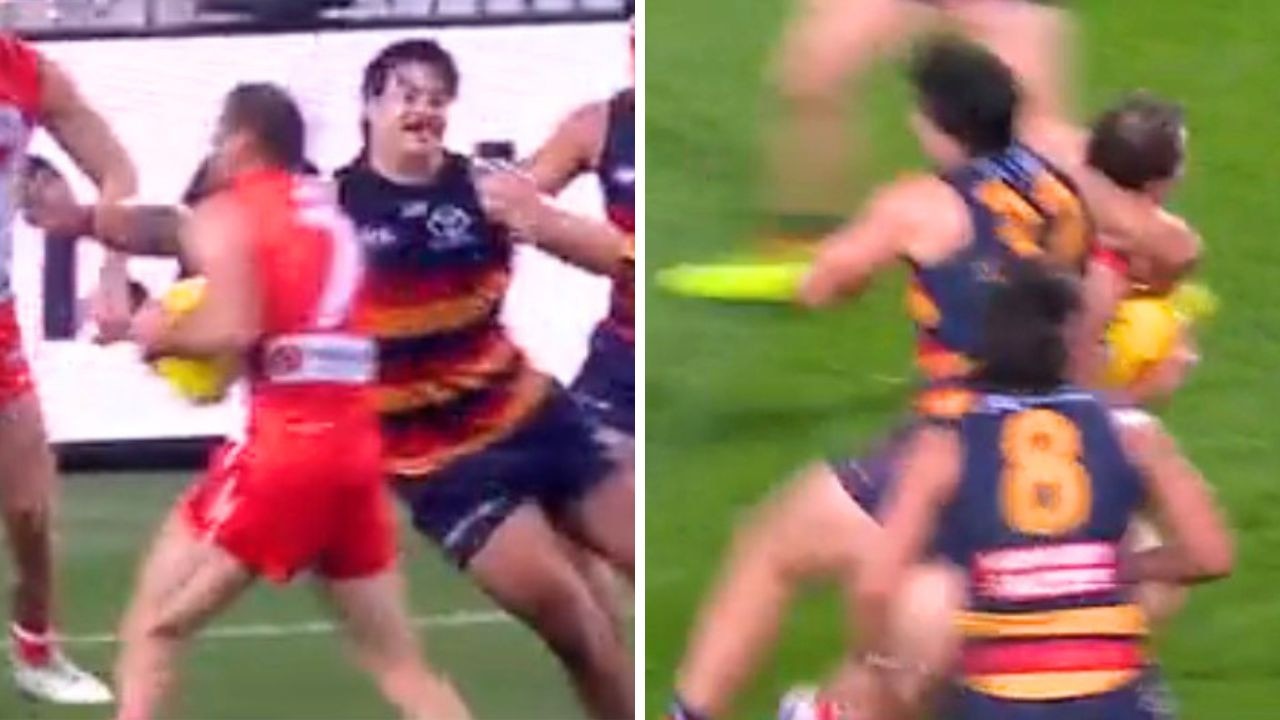
Adelaide’s Darcy Fogarty will miss the next three games after failing to escape his striking ban at the AFL Tribunal.
The Crows spearhead argued he was laying a tackle when he concussed Sydney’s Harry Cunningham, and that it wasn’t a strike at all, but also didn’t equate to rough conduct.
Watch every match of every round of the AFL Premiership Season LIVE and ad-break free during play on FOX FOOTY, available on Kayo Sports | New to Kayo? Join now and get your first month for just $1.

The Tribunal found Fogarty did indeed strike Cunningham, and had the time to consider a more reasonable way of tackling, instead of “swinging his right arm forcibly in the direction of Cunningham’s upper body and head”.
Adelaide coach Matthew Nicks said he was “disappointed” in the verdict.
“We thought it was just a tackle, like the rest of the oval,” he told Fox Footy’s AFL 360.
Fogarty will miss games against Collingwood, Essendon and Richmond.
The incident was graded as careless with severe impact (due to the concussion) and high contact.
“I was just trying to wrap him up and execute the tackle,” Fogarty said during the hearing.
“I adjusted as much as I could to try and get low whilst he went low.”
Fogarty’s lawyer argued the tackle “changed dramatically” as Cunningham landed from his jump and then lowered his body.
“It’s merely a high tackle against the rules and not the kind of tackle that rises to the level of a dangerous tackle,” they said, “and the observable force sits somewhere between medium impact and severe”.
The AFL said Fogarty swung his arm “roundhouse style” and “he should’ve known swinging an arm in that manner was going to lead to a forceful high strike”. They said he could’ve led with his hands or wrapped his arms around Cunningham.
Darcy Fogarty has been hit with a three-game ban for a high tackleSource: Channel 7
The league was also willing to make the alternate case this was rough conduct, but with the same gradings.
The Tribunal took just 20 minutes to fully uphold the charge.
Tribunal statement
“We are comfortably satisfied that Darcy Fogarty committed the act of striking.
“He saw Harry Cunningham jump and reach for a loose ball. He had time to assess the situation and knew that by the time he made contact with Cunningham, the player would have descended from his jump to a level or height that Fogarty could, of course, not precisely determined.
“Fogarty had time to consider how he would tackle Cunningham in those circumstances. He chose to do so by swinging his right arm forcibly in the direction of Cunningham’s upper body and head. While Cunningham may have been in a slightly lower position at the moment of impact than Fogarty hoped, he did not move in an unnatural or unexpected manner.
“Fogarty’s technique of forcefully swinging his arm in the likely direction of his opponent’s head and neck was, in those circumstances, careless. Fogarty’s evidence was he intended to do no more than wrap Cunningham up in a tackle. He could have done so without the unreasonable forceful swing of the right arm.
“The impact was severe. The force of the blow was considerable and Cunningham was concussed and took no further part in the match. He will miss at least one further match. The examples we were shown differed from the present matter in the extent of force and/or the nature of the extended injury suffered.
“The three-match suspension is appropriate.”