
Every movement you make begins with the same tiny molecular interaction. A protein called myosin grabs onto another protein, actin, and pulls. That pull is what makes muscles contract.
Scientists first worked out this mechanism in mammals about a century ago.

Ever since, researchers have largely assumed that all vertebrates, from birds and reptiles to amphibians and fish, rely on the same molecular machinery.
One main assumption
A new analysis suggests that assumption was incorrect. Myosin and actin always work together to contract a muscle.
However, small differences in how they interact change the speed, the rhythm, and the energy cost of every contraction.
Those differences add up in the body. They help set what a given animal’s muscles can actually do.
The work comes from a team led by James Pease at The Ohio State University (OSU). They were first studying a different muscle protein in birds that perform fast overhead wing snaps.
When they lined up the mammal myosin gene layout against the chicken genome, the numbers did not match.
The chicken carried a very different number of genes in the region associated with muscle movement.
A complex story
“Everything we’ve assumed for how a mammal’s muscles work, we’ve applied outside of mammals to these other groups,” said Dr. Christina Harvey at High Point University (HPU).
“But when we pulled in more and more genes over time, we found that the story was more complex than that.”
To test how far the pattern reached, the team pulled from public genomic databases. They modeled 500 million years of history across 1,201 myosins from 119 species.
The result overturned the old expectation. Each major group of vertebrates carries its own distinct set of core skeletal muscle myosins, built up separately over deep time.
“With the advent of molecular biology and being able to explore things at the protein and gene level, we’ve untangled that while the traits that we see on the surface seem very similar, the routes that they’ve taken to get there through molecular processes have been very distinct and very different.”
Fifty new subfamilies
All that separate history left many genes without proper names. The team proposed at least 50 new subfamilies of myosin genes, on top of the 15 already recognized.
“There are many, many more genes that have yet to be identified individually. I like to think that these 50 new subfamilies represent diversity across vertebrates that was previously unrecognized.”
The engine behind this diversity is a slow shuffle. Genes get copied and lost again and again, so each lineage ends up holding its own hand of cards from a shared deck.
Fast and slow stop fitting
In mammals, muscle myosins get sorted into two familiar bins. Slow-twitch fibers hold a posture for hours, like the ones keeping a head upright all day, while fast-twitch fibers handle quick bursts.
That neat split does not carry across the tree of life. Birds, lizards, fish, and mammals use different molecular machinery to build fast and slow muscles.
“The new subtypes are a window into a new paradigm: The molecular basis of what makes a fast-twitch or slow-twitch muscle in mammals doesn’t translate to birds or to lizards or to fish. It’s a different molecular basis,” said Pease.
A special rattlesnake tail
Some of the sharpest examples sit inside a single animal. In the western diamondback rattlesnake, different myosins run the muscles of the head, the midsection, and the tail.
Pease pointed to the muscle wrapped around the rattle, which leans almost entirely on a myosin never documented before.
In that tail segment, one myosin accounts for up to 91% of the muscle’s gene expression.
The pattern shows up again in muscles built for sheer speed. Superfast muscles power echolocation clicks, courtship wing-snaps, and the buzz of a rattle.
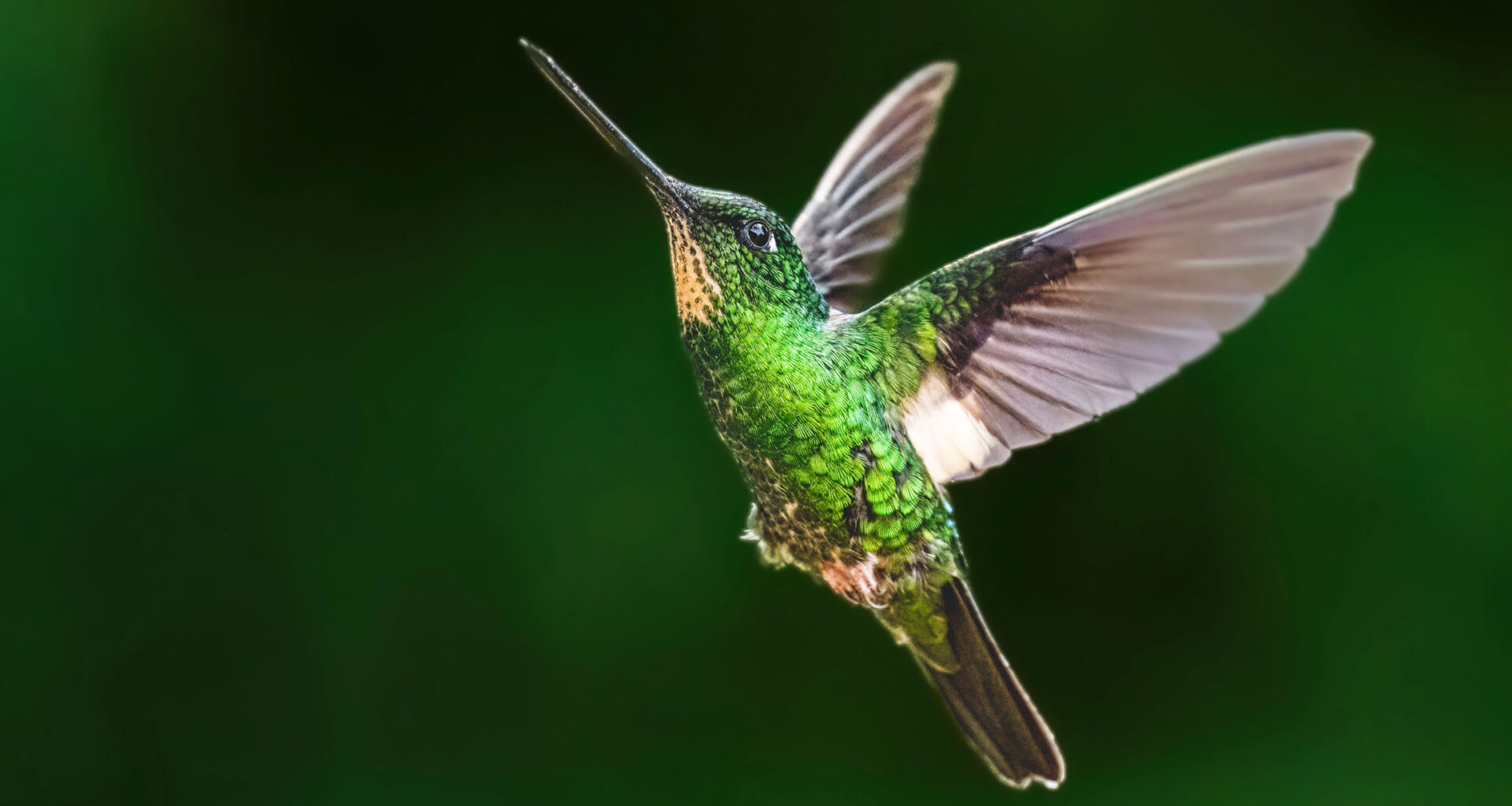
No single “extreme” myosin runs them all. A hummingbird’s flight muscle leans heavily on one myosin, while a bat’s echolocation muscles lean on another entirely.
That points to speed being reinvented many times over. Each lineage reached a similar result through different molecular parts.
Two loops matter most
Most of a myosin protein barely shifts from one species to the next. The real action sits in two small surface loops, and those loops vary a great deal.
One loop helps determine how quickly the protein processes its chemical fuel. The other sits where myosin grips actin, so its shape tunes how tightly the two proteins lock together.
Different animals build fast muscles using different loop designs, with no single winning shape. Each lineage seems to have solved the same puzzle in its own way.
What drives change
The team is careful about claiming to know why all this happened. Adaptation is hard to prove, and the genetic record can only carry an inference so far.
“What we would say in a conservative way is that if this diversity of all of these molecular subtypes weren’t important, there would probably be only one type of myosin,” said Pease.
“These different molecules that are new had specific roles, and this process is overturning and changing, but these molecules are not identical copies. They’re diversifying. And that’s really unlikely to happen over and over and over again if these aren’t being driven by some kind of selective or adaptive process.”
The larger point is that evolution can preserve a vital function while changing the molecular parts that make it possible.
The study is published in the journal Proceedings of the Royal Society B.
—–
Like what you read? Subscribe to our newsletter for engaging articles, exclusive content, and the latest updates.
Check us out on EarthSnap, a free app brought to you by Eric Ralls and Earth.com.
—–