
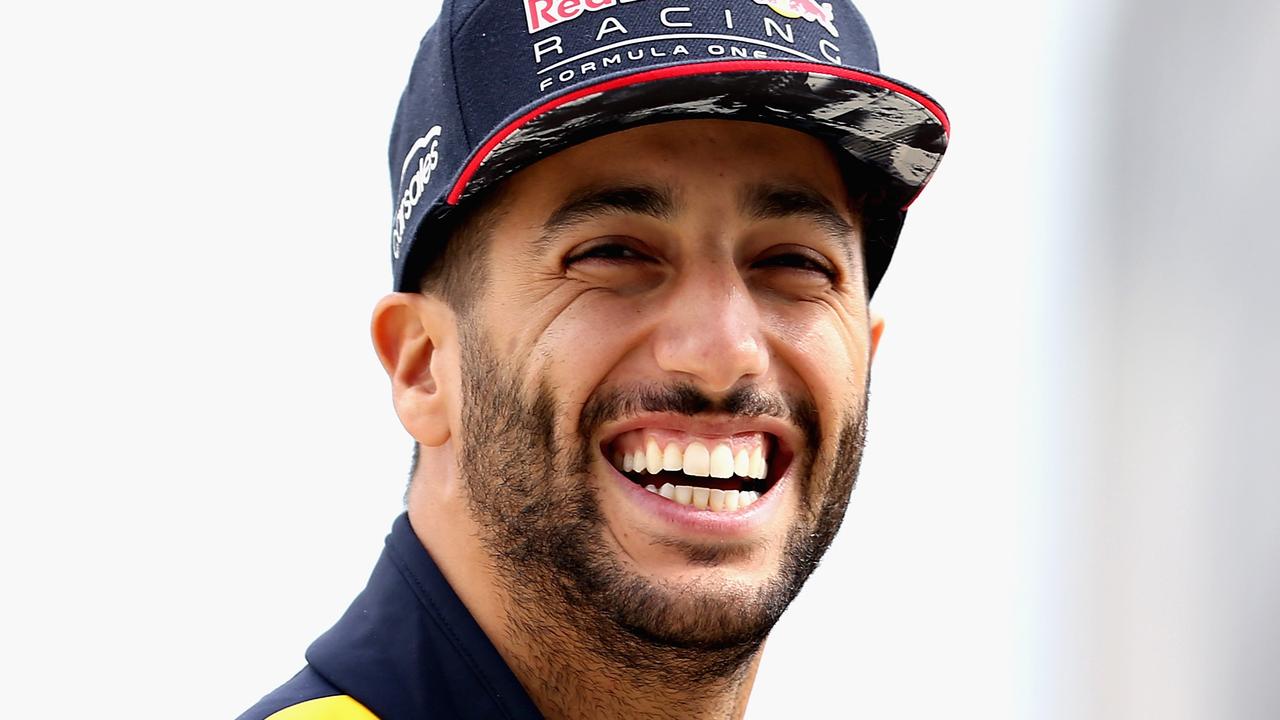
“He decides where he wants it delivered, and I deliver it. It’s like Deliveroo, you know?”
Isack Hadjar piloted the world’s fastest delivery scooter on Saturday at the Belgian Grand Prix, where he was deployed to create a slipstream for teammate Max Verstappen in Q3 to tow the Dutchman to the front row of the grid.
Fox Sports, available on Kayo Sports, is the only place to watch every practice, qualifying session and race in the 2026 FIA Formula One World Championship™ LIVE in 4K. New to Kayo? Join now and get your first month for just $1.

It was a decision made after Hadjar was dealt a back-of-grid penalty for an unscheduled engine change. Rather than write off the afternoon as a waste of engine mileage, Red Bull Racing used the Frenchman to maximise Verstappen’s chances of scoring a big result.
Verstappen was effusive with his praise afterwards, declaring Hadjar had gifted him as much as 0.3 seconds, or around three rows on the grid.
Had this been any other season in the last eight years, that would’ve been the end of Hadjar’s story. From 21st on the grid he might have scrapped for the last few points of the race or perhaps tangled with some midfielders on the way through and ended up in the gravel.
But the 21-year-old put in one of the performances of his career to finish an astonishing sixth, up 15 places from where he started.
It’s the most positions gained by any driver in a race this season.
It was a performance underpinned by a bold strategy, pitting twice behind the early safety car to cycle through a set of medium tyres for one lap.
It allowed him to run the entire race on a set of hards, though a later virtual safety car allowed him to switch to a second set of hard tyres without sacrificing his monumental progress.
The final stanza of his race was about perfectly managing his pace as reigning world champion Lando Norris closed fast on a fresher set of medium tyres.
The nonplussed Frenchman beat the Briton to the place by 0.7 seconds.
Antonelli takes pole in Belgium | 01:12
Team boss Laurent Mekies couldn’t speak highly enough of his young gun.
“I think it is his best race,” he said, per the F1 website. “It is the best race with us, no question.
“Honestly, it’s not only a spike; it has been just a little bit better every single race for speed, so he’s bringing some [more] speed every time he’s driving.
“Today is another step, this weekend is another step, because he was very, very fast from FP1.
“He was very, very strong. His pace was top three pace, so [I’m] very happy with his progress.”
The Belgian Grand Prix was Hadjar’s 10th Red Bull Racing start, having received the call-up from Racing Bulls at the end of last season.
Famously self-critical, he allowed himself a positive review of the stint so far.
“I think one-lap pace I’ve showed what I’ve needed to show,” he told Sky Sports.
“Today I think is probably my best race; race-pace-wise I’m right up there with the leaders, so I’m very glad with the first 10 races.
“To be honest, I’m looking forward to the rest, because there are so many things we need to tidy up with the team — in a good way — that I think there’s a lot more to come.”
For Hadjar it’s the realisation of his dream to be racing at the front of the field.
For Red Bull Racing, though, it could be the answer to a question it’s been asking itself for close to a decade.
Hamilton smashes the wall in P3! | 01:08
THE ORIGINAL PROBLEM
Hadjar’s successful transplant into Red Bull Racing is an enormous win for at a critical time in its history.
The off-track story of the season has been Verstappen’s threat to quit the team, a saga that dates back to last season.
The risk for RBR isn’t just that it loses the most talented driver of his generation; it’s that it loses the only driver that’s been able to deliver any kind of competitive result in its cars.
On average over the last five years Verstappen has contributed 72.4 per cent of the team’s score. Last year that rocketed up to an astounding 93.3 per cent.
Unplugging Verstappen would have left Red Bull Racing looking thoroughly midfield, probably with a line-up comprising a combination of struggling veterans and/or too-green rookies.
It’s a problem that dates back close to a decade — to Daniel Ricciardo’s decision in mid-2018 to depart the team for a seat at Renault for the following season.
Red Bull Racing has been forlornly looking for Ricciardo’s replacement ever since.
The Ricciardo-Verstappen partnership is arguably the most effective in Red Bull Racing’s history, even without coinciding with a championship run. They were extremely closely matched, and though there were moments of tension in their relationship, they got along very well and remain on good terms today.
Partnered for most of 2016 until the end of 2018, there was practically nothing between them when looking at the key metrics.
For the purposes of this comparison, we’ll look primarily at qualifying data — both the difference in lap time and difference in qualifying result — as well as how far apart the drivers were on average at the chequered flag in grands prix.
Daniel Ricciardo vs Max Verstappen (2016–18)
Time differential: 0.060 seconds slower
Qualifying differential: 0.8 places behind
Race differential: 0.1 places ahead
This ideal line-up was made all the sweeter by the fact Ricciardo had been backed by Red Bull during his junior career and was effectively homegrown, while it won Verstappen’s loyalty by offering him an immediate F1 driver as a 17-year-old rookie when no other team would take the punt.
But then Ricciardo, spurred by the appeal of a works team as well as his recognition that Red Bull Racing was building itself around Verstappen, quit for Renault ahead of the 2019 season.
Red Bull Racing didn’t realise it at the time, but it was in for years of pain attempting to replace him.
Gasly suffers wild crash in Belgium | 00:27
THE PIPELINE RUNS DRY
Pierre Gasly, after just one year in Formula 1, got the nod to replace the Australian.
The Frenchman clearly had the speed — and he’s proved since that he has the composure too — but he never clicked in the Red Bull Racing environment, revealing later that he felt he wasn’t supported to make the step up the grid.
His results were well short of the standard set by Ricciardo, and he was turfed at the mid-season break after just 12 races.
Gasly (2019): 0.426 seconds slower, 3.4 places behind (races: 4.5 places behind)
This was at a time the Red Bull junior pipeline was beginning to run dry, Verstappen having short-circuited it to some extent by rising so rapidly — Alex Albon, who had previously been axed from the Red Bull program, was recalled to replace Gasly at Toro Rosso for 2019 alongside Daniil Kvyat, who had also previously been given his marching orders.
Despite his inexperience, Albon was promoted to Gasly’s Red Bull Racing seat for the second half of the season, with Gasly shuffling back down to Toro Rosso.
It was taken as positive that Albon was roughly as good as Gasly immediately given his inexperience, but the Thai struggled to kick on in 2020 as the car became more extreme to drive, a trend that would continue for years for his successors.
He later memorably likened the car’s skittishness to turning the sensitivity of a computer mouse to the maximum setting.
With just one podium to Verstappen’s 11, including two wins, in 2020, Albon was dumped at the end of the season.
Albon (2019–20): 0.565 seconds slower, 4.4 places behind (races: 3.7 place behind)
Piastri responds to rumours | 01:14
THE EXTERNAL EXPERIMENT
The junior pipeline now totally dry, Red Bull looked outside its program to find Verstappen’s teammate, landing on midfield specialist Sergio Pérez, who sealed the deal shortly after winning the 2020 Sakhir Grand Prix for Racing Point.
He was a minor upgrade on Albon in his first season in terms of pure pace, qualifying less than 0.4 seconds behind Verstappen on average.
More important, though, was that he was more readily in position to back up Verstappen when things went wrong. He memorably won his first race for the team in Azerbaijan after a tyre failure took Verstappen out from the lead of the race.
This was crucial in what turned into Verstappen’s maiden title-winning campaign. His role holding Lewis Hamilton in Abu Dhabi is the stuff of legend — the time the Briton lost behind Pérez meant he didn’t have enough time to pit when the late safety car came out, leaving him vulnerable to the race-winning and title-winning move at the highly contentious last-lap restart.
But being thereabouts is as good as it got. Red Bull Racing’s car advantage in 2022 meant he was qualifying and finishing closer to Verstappen even as he was obliterated by bigger and bigger margins over a single lap, and though he gave the team its first and only one-two title finish in 2023, he only just scraped home in second despite driving the most dominant car in F1 history.
Team boss Christian Horner made the bizarre decision to renew his contract early in 2024 despite lacklustre results, and the team was forced to pay him out — and handsomely so — at the end of the year when they didn’t eventuate.
Pérez (2021–24): 0.536 seconds slower, 4.8 places behind (races: 3.5 places behind)
Cam Waters aiming for the Championship? | 01:03
RED BULL RACING DECLINE
Despite Pérez’s four years at the team, Red Bull’s young driver stocks were only barely replenished. Yuki Tsunoda had time to become established, but Nyck de Vries was burned to give Ricciardo a shot at redemption.
Ricciardo was then sacked to give Liam Lawson a six-race run-in at the end of 2024 to prepare him to replace Pérez at Red Bull Racing, jumping Tsunoda in the queue owing in part to Horner being unconvinced of the Japanese driver’s potential.
It was a disastrous decision, with Lawson flailing in the opening two rounds — enough that the team swapped him for Tsunoda before the third race of the season.
Though Horner claimed Lawson had been struggling mentally with the challenge, the Kiwi has since said he felt he was thrown under the bus as part of the team’s broader struggles for form.
Lawson (2025): 0.913 seconds slower, 15.5 place behinds (races: 8.0 place behind)
Tsunoda was in excellent form in 2024 and the opening two rounds of 2025 — so much so that his promotion to Red Bull Racing seemed like vindication.
Instead he went barely better than Lawson had done. He scored just 30 points to Verstappen’s 421 and was dumped at the end of the season.
Tsunoda (2025): 0.662 seconds slower, 9.3 places behind (races: 8.9 places behind)
Kostecki DOMINATES in Townsville | 01:11
IS HADJAR THE ANSWER?
By the end of last year it was clear the problem lay not with the drivers — at least not completely — but with the car and to some extent with the team.
Hadjar’s promotion, then, was well timed. Not only have the chassis and engine rules massively changed this year, but there’s also considerable change happening inside the team too, with established personnel departing and with new team boss Laurent Mekies setting the tone for those who take their place.
The sophomore’s results show a stark turnaround from the dire years the preceded him.
Hadjar (2026–ongoing): 0.162 second slower, 2.1 places behind (races: 3.0 places behind)
No-one since Ricciardo has returned figures like these alongside Verstappen.
They are of course not Verstappen-esque numbers, and Hadjar is clearly second-best to the Dutchman.
If Verstappen were to call it quits, Hadjar would still have shoes to fill while presumably taking on the role of senior driver at the team.
But for the first time in years, Red Bull Racing can face up to that problem with optimism.
Hadjar is achieving something several similarly experienced — and some even more experienced — forebears of his in that seat failed to do: look respectable and score points. In just his second year, he’s likely to get considerably better from here too.
Hadjar joked in Belgium, but the evidence suggests he really is delivering for Red Bull Racing.