
In a strong illustration of how far apart Major League Baseball’s players and owners are in the early days of collective bargaining, the union on Tuesday made an amateur draft proposal that looked virtually nothing like what the league proposed a month earlier.
MLB wants to greatly overhaul the draft and to let colleges take on more of the work and cost of developing professional baseball players in the U.S. In the league’s vision, teams could no longer draft high schoolers.
The union said Tuesday it had formally rejected the league’s proposal on the draft, and instead proposed something more akin to the current setup. While MLB wanted to reduce the number of rounds in the draft to 12, the union proposed to keep the current 20 — but to move it to June from July.
The union also wants revenue-sharing recipients, the smaller-market clubs, to receive an additional $1 million to spend in the draft if they make the playoffs, and to newly allow college sophomores to be selected. Presently, four-year college players can’t be drafted until they are juniors.
“Rejecting MLB’s proposals that would demolish the current system by shrinking the draft, slashing benefits by hundreds of millions, and removing all players’ right to negotiate, the MLBPA offered a framework that would maintain the economic structure of the Rule 4 draft, provide lower-revenue clubs enhanced access to amateur talent, and provide millions in benefits to such clubs that achieve (success) on the field,” the union said in a news release Tuesday after the sides met in New York City.
MLB declined comment Tuesday.
Before the COVID-19 pandemic, the amateur draft had traditionally taken place in June. It’s now been in July since 2021, but the union wants to put it back in June “to provide a longer season for recently-drafted players.”
The union also proposed increasing the number of draft picks that could be traded, which has been discussed by the sides many times in the past but never produces major change.
The MLBPA wants to increase signing bonuses — it is always trying to drive more money to players — and to significantly decrease penalties for teams that spend over the annual amount they’re allotted for the draft.
Each team enters a given draft with a pool, which this year ranged from just under $4 million for the Los Angeles Dodgers, the defending World Series champions, to more than $20 million for the Chicago White Sox, who had the top selection in the draft.
Today, a team that spends more 5 to 10 percent over its allotted pool loses a draft pick and pays a 75 percent fine on the overage. It also loses a first-round pick in the next draft. Teams that spend 10 to 15 percent over, meanwhile, pay a 100 percent tax and lose both a first- and second-round pick.
When teams go at least 15 percent over their allotment, a 100 percent tax is again paid while first- and second-round selections are lost for two consecutive drafts.
The union doesn’t want draft picks involved so quickly. In its proposal, a team that goes up to 10 percent over its pool would pay a 75 percent fee, and a team that is 10 to 15 percent over would pay a 100 percent fee on the overage — but with no loss of picks.
At 15 to 20 percent over, a team would lose a second-round pick, and at 20 percent over, it would lose a first-round pick.
But MLB, which wants to greatly reduce signing bonuses, is unlikely to be on board with these changes.
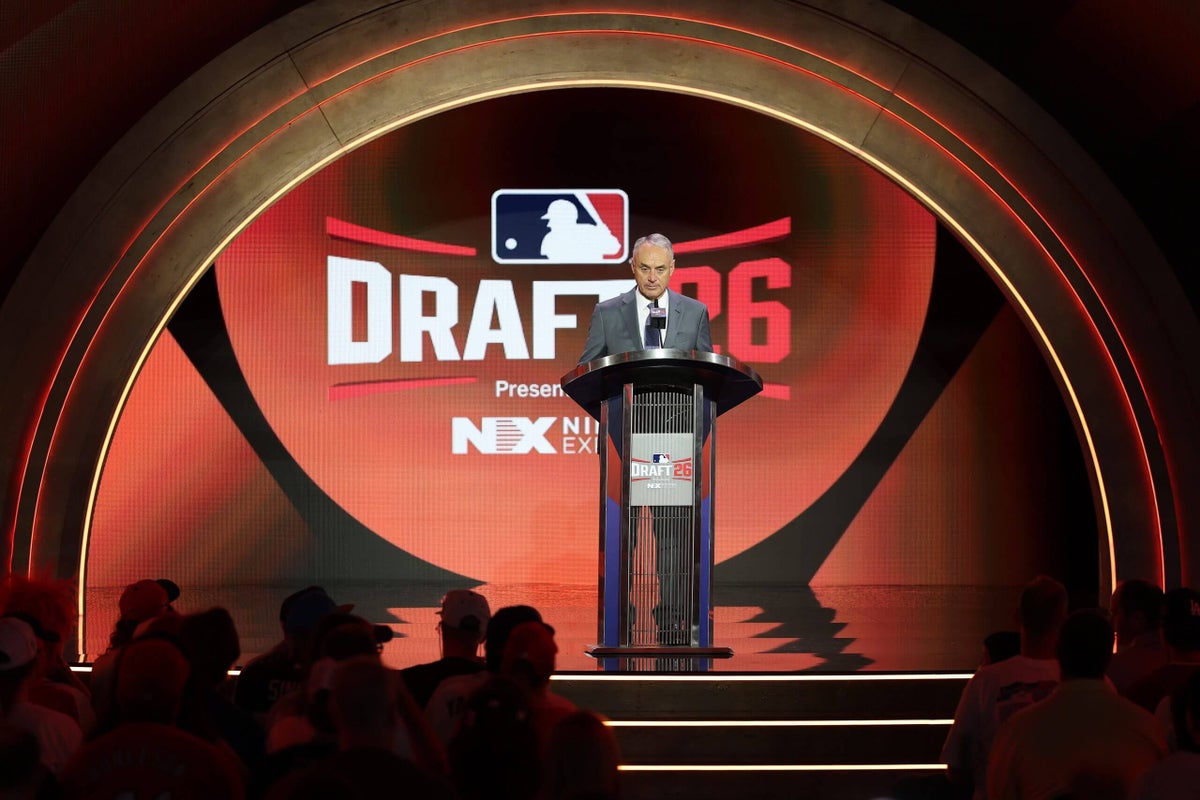
Commissioner Rob Manfred explained his view on the amateur draft at the All-Star Game last week.
“The easiest way to explain it is (a) recognition of reality that has taken place: 70 to 75 percent of our players are college players. That’s the state of play,” Manfred said. “That is a dramatic change in the way that baseball operations people think about colleges. Years ago, decades ago … nobody had a good word to say about players that were developed in college. That has changed dramatically.”
“I will also say this … Talking players out of going to college, I’m not sure I agree with that. Just in terms of, you know, the overall development of the human being. So I just think the proposal reflects what’s happening, and I think it’s probably a good thing overall to be encouraging education.”
The union also is trying to funnel some perks to smaller-market teams in the draft.
From 2027-31, the period of the five-year deal proposed by the union, any team that receives revenue-sharing dollars can increase its bonus pool by $2 million for one draft of its choosing over that period.
The players also want to bring back major-league contracts for draftees. Once upon a time, a drafted player could sign a big-league deal right away, without first needing to sign a minor-league contract. The union proposed that revenue-sharing recipients can sign two players to big-league deals over the 2027-31 span.
The union on Tuesday did not address the other piece of amateur entry, the international draft. When MLB made its amateur draft proposal last month, it also proposed an international draft. Back in 2022, the players were on board with the concept of an international draft — a notable development — but the sides weren’t able to work out the specifics back then.
Inside the industry, however, the progress made on an international draft last time was an indication for many that this go-around, the sides might eventually find common ground on that topic.
The league also made proposals on Tuesday in a few buckets, including daily allowances and meal money, health and safety, and the playoff bonus pool for players.
What complicates a lot of the discussion between players and owners at these early stages is that the league is making proposals in the context of a salary-cap system, and players are not. It is sometimes said in a labor negotiation that sides “are not speaking the same language,” but that saying takes on a little more truth in baseball at present.