
Thirty-five Aussie companies have been red flagged by one of the world’s biggest banks as ones to watch for major job losses in the coming months amid an AI revolution and a huge squeeze on the economy.
A scathing portfolio strategy note from Goldman Sachs analysts Matthew Ross and Tony Wu warns that corporate Australia is hurtling towards a brutal “cost-out” reporting season — a crucial time of the year when companies reveal to investors how things are going.

A toxic combination of cooling domestic demand, persistent inflation, and sharp wage increases has left dozens of top-tier ASX companies with rapidly shrinking profit margins, forcing executives to eye aggressive headcount reductions to defend their bottom lines.
“Our economists expect consumption growth to ease to 1.3 per cent, weighed down by falling house prices and slower income growth,” the report stated.
“Meanwhile, inflationary pressures from the Middle East conflict have emerged, adding to margin pressure that was already building. While energy costs have corrected from post-war peaks, they remain elevated, and the May CPI report showed evidence of second-round effects, particularly within housing.”
The big imbalance that could lead to job cuts
The report argued that the widening gap between earnings and wage growth means investors will be piling on pressure on big Aussie businesses to cut costs and possibly jobs to improve their returns.
It showed that despite widespread management attempts to rein in costs earlier in the year, employee expenses across the market grew by 8 per cent over the recent period, easily outstripping top-line revenue growth of 5 per cent.
Mr Ross and Mr Wu said the disparity is part of a longer-term structural trend. Since 2022, wage bills for the median ASX 300 business have expanded by 10 per cent annually, outstripping revenue growth of 7 per cent by three percentage points per year.
With the recently announced 4.75 per cent increase in Award wages feeding directly into corporate balance sheets, analysts predict elevated wages expenses will drag on well into the 2027 financial year.
The 35 companies under pressure
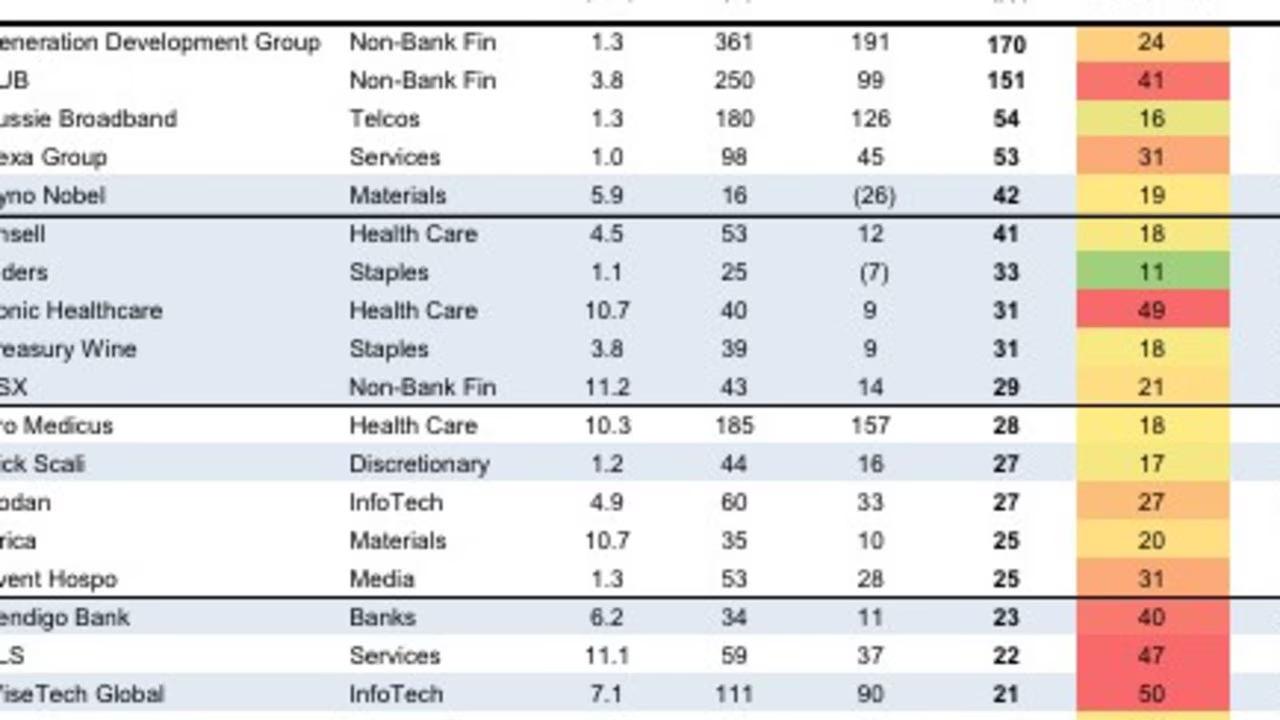
To identify the firms facing the most urgent pressure to trim payrolls and restructure operations, Goldman Sachs found ASX 200 companies where labour accounts for more than 10 per cent of sales and wage growth has surged ahead of revenues since 2022.
At the top of the list is wealth management firm Generation Development Group, alongside insurance broker AUB Group, telecommunications provider Aussie Broadband, property technology platform PEXA Group, and explosives maker Dyno Nobel.
All five have seen wage costs escalate at rates far exceeding top-line sales expansion over recent years. At Dyno Nobel, for instance, labour costs rose 16 per cent even as revenue contracted by 26 per cent over the same period.
Several high-profile market darlings are also feeling the burn, including tech leader Pro Medicus, software firm WiseTech Global, and electronic equipment manufacturer Codan, alongside established heavyweights such as National Australia Bank, Coles, JB Hi-Fi, and Cleanaway Waste Management.
The squeeze is even harder for companies whose net profit margins have already collapsed below their ten-year historical medians.
Diagnostic provider Sonic Healthcare, wine giant Treasury Wine Estates, exchange operator ASX Limited, agribusiness Elders, drinks retailer Endeavour Group, and hearing implant maker Cochlear are all trading with compressed profit margins, leaving management with little choice but to look at staff ratios and overheads during upcoming reporting season.
AI revolution accelerating job cuts
The pressure to cut expenses coincides directly with the rapid rise of artificial intelligence, which is accelerating corporate restructuring around the world.
We’ve seen evidence here in Australia in recent weeks, as WiseTech Global revealed plans to slash headcount in its product development and customer service divisions by up to 50 per cent as internal AI tools dramatically improve team output.
Similarly, online retailer Temple & Webster reported that automated AI systems handled 80 per cent of customer service interactions, driving down customer support costs as a percentage of revenue by more than 60 per cent.
However, the Goldman Sachs report highlighted growing concerns over “AI-washing,” where companies rebrand routine post-pandemic staff normalisations or standard cost-cutting initiatives as technological breakthroughs
It has backfired for some Aussie tech and software companies that saw their stock prices crash by around 40 per cent because investors panicked that AI would ruin their business models.
The report stated that the panic selling has stopped, but investors are still too scared to buy back in until these companies prove AI won’t become a burden.
Amid warnings of an AI jobs apocalypse, Mr Ross and Mr Wu said broader headcount rebalancing has played a role three to four times larger than actual AI automation in driving corporate job cuts across the technology sector.
They argued AI adoption is proving to be a double-edged sword on company balance sheets. While chief executives speak about future efficiency gains, global enterprise surveys show that companies are directing between 1 and 5 per cent of their total IT budgets purely towards AI running costs, funding these new expenses by reallocating money away from existing software programmes and headcount budgets.
The authors argued that, as the August reporting season gets underway, investors are expected to punish companies that fail to provide detailed plans for controlling spiralling labour costs, while rewarding those that can prove artificial intelligence is delivering genuine improvements to operational efficiency and revenue.