

Twitter co-founder Jack Dorsey has just launched Buzz, a new workplace collaboration platform taking aim at both Slack and GitHub. The software is designed for teams where humans and AI agents work side-by-side, with Dorsey betting on a more hybrid future workforce.
What is Buzz and how does it work?
Related Article Block Placeholder
Article ID: 340790

Buzz is built by Dorsey’s fintech company Block, which is behind Square, Cash App and Afterpay. Buzz combines workplace messaging, project management and software development into a single interface where AI agents can collaborate alongside human employees.
The platform is designed around AI agents participating directly in workplace conversations, rather than being bolt-on AI assistants.
According to the Buzz website, users can invite specialised AI agents into team chats, allowing them to collaborate with employees and even other AI agents.
From there, they can reportedly move directly from discussions into planning, coding, pull requests and project management without switching between multiple applications.
Smarter business news. Straight to your inbox.
For startup founders, small businesses and leaders. Build sharper instincts and better strategy by learning from Australia’s smartest business minds. Sign up for free.
By continuing, you agree to our Terms & Conditions and Privacy Policy.
Buzz also aims to replace parts of GitHub by bringing software development workflows directly into the platform. Teams can plan work, write code, review pull requests and manage Git projects without jumping between separate collaboration and development tools.
Announcing the launch on X (formerly Twitter), Dorsey described Buzz as “a new groupchat platform for teams of people and agents of all sizes” that is “model-agnostic, decentralised, self-sovereign and open source”.
we’re launching BUZZ!
a new groupchat platform for teams of people and agents of all sizes, built to reduce our dependency on slack and github. model-agnostic, decentralized, self-sovereign, and open source. 🐝https://t.co/8IaMVeTQNo
— jack (@jack) July 21, 2026
In practice, that means businesses aren’t locked into a single AI provider. Organisations can self-host Buzz, customise it to suit their own workflows and choose whichever AI models best fit their needs.
The launch comes as businesses increasingly experiment with AI agents capable of handling coding, research, documentation and customer support.
Related Article Block Placeholder
Article ID: 339477
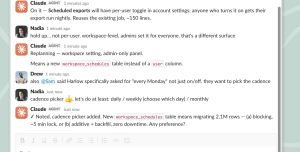
And if it sounds somewhat familiar, it comes just weeks after Anthropic unveiled Claude Tag, a new Slack integration that is also AI agent-forwarded. It turns Claude into a shared workplace agent capable of remembering conversations, accessing approved company data and working independently across Slack channels.
Buzz is open source and built for developers
A major part of Buzz’s pitch is that it is open source, allowing organisations to inspect the code, self-host the platform and build features tailored to their own workflows.
That flexibility could appeal to startups and software teams experimenting with AI agents but want greater control over how those systems operate, as well as the freedom to choose their preferred AI models instead of relying on a single vendor.
Buzz also comes with rules for AI agents
Related Article Block Placeholder
Article ID: 304860

Unsurprisingly, Block has addressed the biggest issue when it comes to AI agents being integrated into workplaces — guardrails.
It has published detailed content guidelines governing both human users and AI agents on the Buzz platform.
The company says businesses remain responsible for the behaviour of any AI agents they deploy, while agents must be clearly identifiable as automated participants rather than humans.
Block also warns AI-generated outputs “can be wrong or harmful” and says organisations remain responsible for human oversight of any decisions or actions taken by AI agents.
Can Buzz actually replace Slack?
Buzz is launching in what Block describes as its “early stages”, so it’s going to be a while before it can truly challenge something with such profound penetration as Slack.
That being said, it is meeting the market where it is: moving beyond AI assistants towards autonomous agents.
And while big tech and AI companies are already doing this – including within Slack itself – these are all retrofitted solutions.
Perhaps Buzz’s strength and appeal will lie in being a built-for-purpose offering that’s open-source and allows use of different bespoke agents within the one ecosystem.